THE ANCIENT STIRLING JUG OR STOOP CAPACITY CODES ... AND THE MEDIAEVAL SCOTTISH ELL MEASUREMENT.
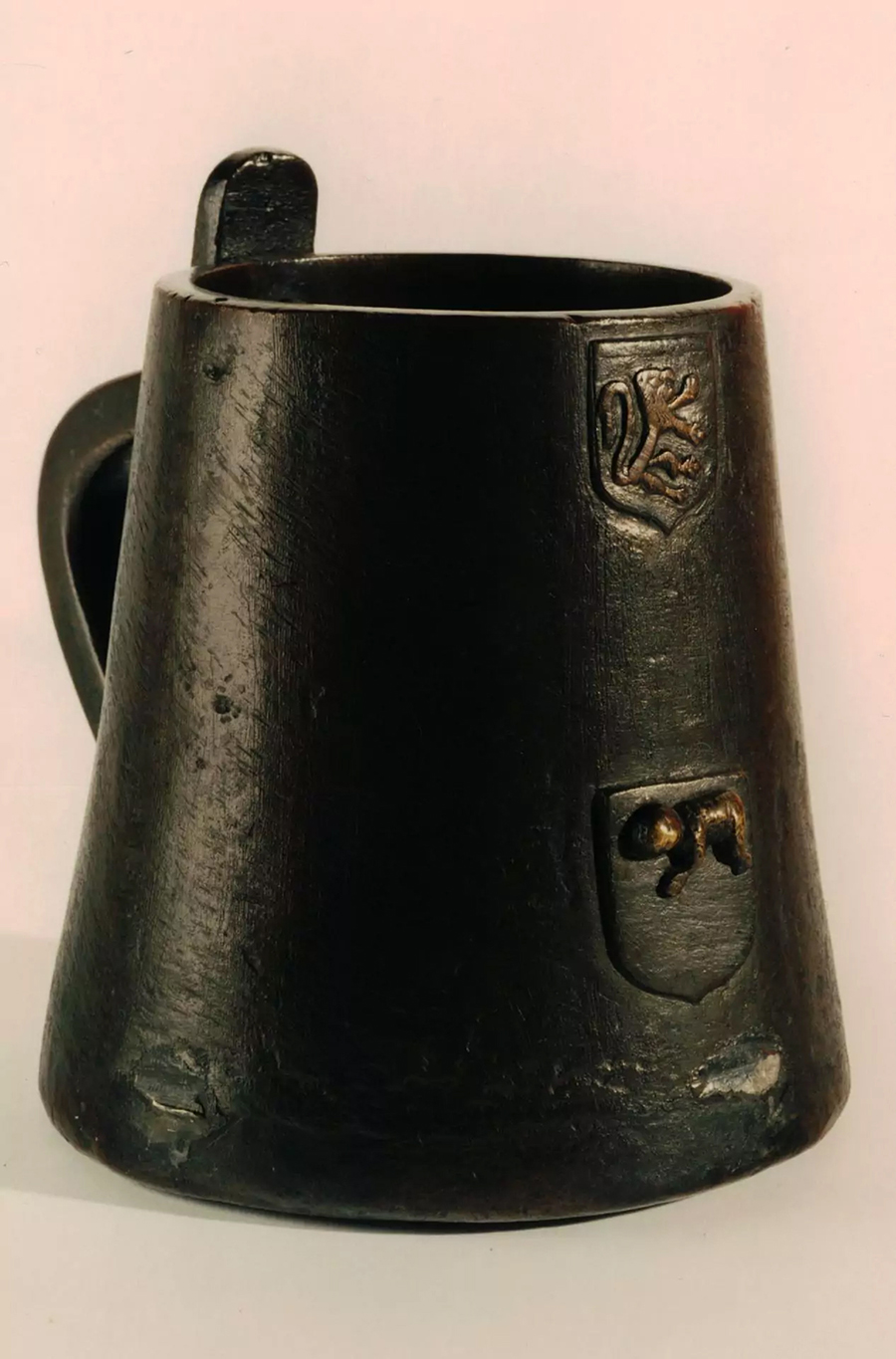
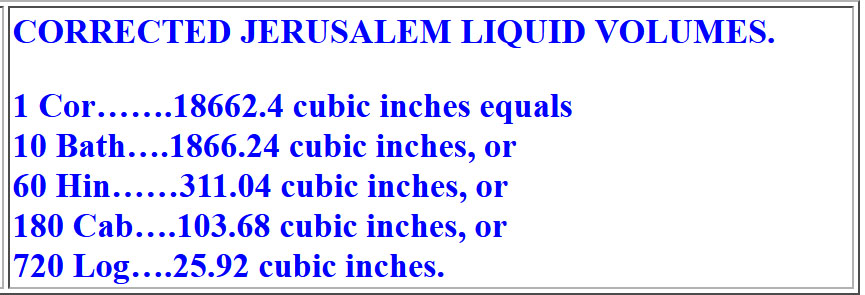
The ancient Stirling Jug or Stoup with an official capacity of 103.68 cubic inches. This capacity is the same as the Jerusalem Standard "Cab" (Kab) volume of circa 957 BCE or about 3000-years ago.
Donald Lee Lenzen did a decade of comprehensive research into ancient weights, measures and volumes, in an attempt to correct the illogical, non-ratio sequences or divisions between groupings within a standard.
He was able to ascertain that there were, in fact, 3 different readings for the Cab volume, under three separate ancient Hebrew systems, namely the Desert Standard, the Jerusalem Standard and the Sepphoris Standard.
The Stirling Jug of Scotland has a pedigree back 3000-years and provides a means of restoring the original, intended and traditional Weights, Measures & Volume Standards of Scotland, as well as other cousin nations.
The capacity of the Stirling Jug is officially 103.68 cubic inches, to a tolerance of 1/50th of a cubic inch (rounded to 103.7 cubic inches in scientific literature).
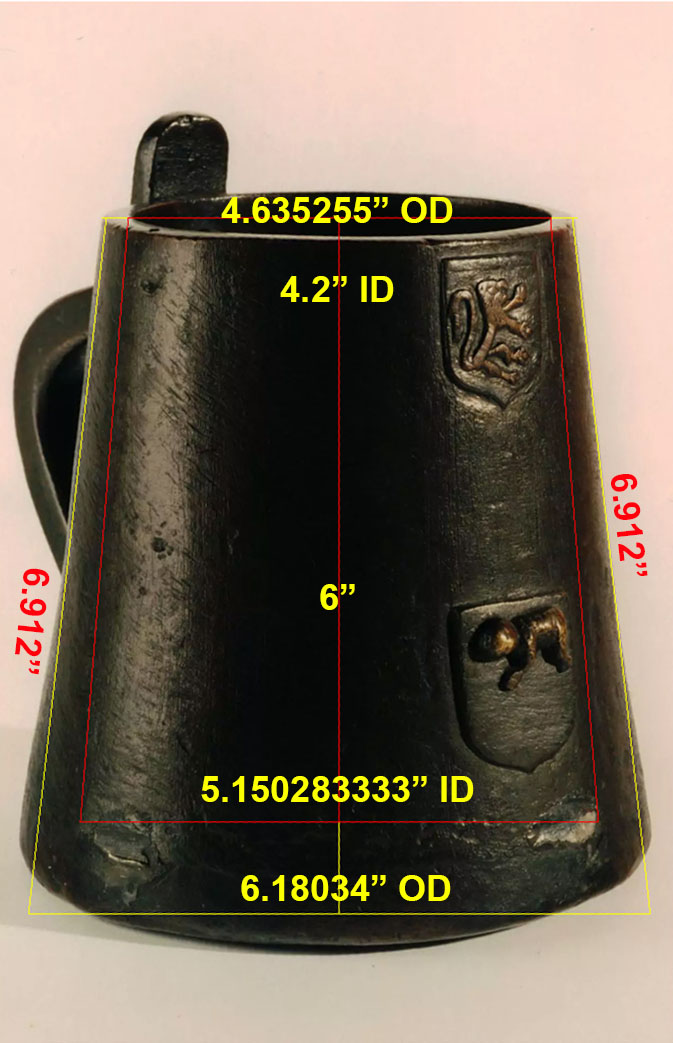
Here above is this researcher's estimate of the Jug's final dimensions, (based upon using the Scottish Ell rule as the calculator) and each value represented will be fully explained as we proceed.
Some of the above dimension numbers might look cumbersome, but this is because they are based upon the PHI Reciprocal of 6.18034"... the foundation increment of a specialised ancient Scottish ELL.
There was also a non-PHI, standard Ell rod of 37.125" (37 & 1/8th)". The two close-proximity length Ell rods had slightly different functions.
Because the worldwide research community is not granted access to modern, comprehensive internal and external measurements of the Stirling Jug, one has to scale it based upon the "mean" measurements taken by Scottish Geometrician-mathematician, astronomer, Alexander Bryce's "mean" in 1752.
It is also said to be 3.6 ancient (Mediaeval) Scottish pints and this also helps to achieve a very close proximity scale on the high resolution photos of the artifact.
Note: Scotland adopted England's volume standards in 1701-1707 and their pint became 28.875 cubic inches, however the Stirling Jug, at 103.68 cubic inches capacity had already been the Scotland-wide standard for over 264- years.
'The Stirling jug is mentioned in acts of Parliament as being in the town before the reign of James II. in 1437: and the last mention made of it is in the reign of James VI., in an "Act of Parliament, 19 February, 1618, anent (meaning "concerning" ...archaic Scottish) settling the measures and weights of Scotland'.
However, based upon the Stirling jug capacity standard being first mentioned in historical accounts as early 1457, their original pint division would have been 28.8 cubic inches or 103.68 ÷ 3.6 = 28.8 cu ". That makes perfect sense, as a 28.875" has no significance in very ancient weights, measures and volumes standards, whereas 288 occurs frequently.
For example: The readout for the Greek Theban capacity is: 1 Theban = 5 Metretes or 60 Chous or 720 Cotyle or 2880 Oxybaphon or 4320 Cyathus.
The measured diameter of the Aubrey Circle at Stonehenge is 288-feet and the ancient Egyptian Pyramid Acre can be calculated to be 28800 sq.', based upon the writings of Greek historian, Herodotus.
The Stirling Jug's geometry also qualifies as a Truncated Cone, both internally and externally and, based upon a recorded internal depth of 6", coupled with its official 103.68 cubic inch capacity, the formula of a Truncated Cone can be applied :
Volume formula:
V = (1/3) × π × h × (r² + r × R + R²).
THE PEDIGREE OF THE STIRLING JUG GOES BACK 3000-YEARS TO THE JERUSALEM STANDARD CAB VOLUME VESSEL.
The Stirling Jug, the official standard for the Scottish pint measure for centuries, is thought to be decorated with a Paschal Lamb. The original jug dates to the early 15th century, or much older and the Paschal Lamb emblem detail is a key feature in its history.
'The Paschal Lamb on the Stirling Jug:
Original Symbol: The early 15th-century jug, believed to have existed prior to 1437, featured a religious symbol interpreted by historians as the Paschal Lamb. The Paschal Lamb, a symbol of Christ, was a reference to the sacrifice and redemption found in the Christian faith.
Post-Reformation Change: After the Protestant Reformation, which reached its height in Scotland in the mid-16th century, religious symbols were often removed or replaced to reflect the new Protestant doctrine.
Symbol Replaced: When later copies of the Stirling Jug were made after the Reformation, the Paschal Lamb was deliberately replaced with the wolf, the burgh symbol of Stirling. This change reflected the shift from a national standard rooted in religious imagery to a secular, civic one.
Historical Significance: This detail reveals a microcosm of the political and religious transformation of Scotland. The Paschal Lamb on the original jug is a historical marker, distinguishing it from its later counterparts.
The Stirling Jug today
The original Stirling Jug, featuring the pre-Reformation Paschal Lamb, is now a treasured artifact at the Stirling Smith Art Gallery and Museum. It was the official standard for all liquid volume measurements in Scotland until the country adopted English measures in 1701 AD.'
So, there definitely appears to be a link to the ancient Hebrew religious observance of the Feast of the Passover, their most holy annual event. The 103.68 cu" capacity standards, 2500-years apart, seem to have been preserved from remote antiquity. Many other ancient standards were passed down fully-intact until at least the middle ages, but thereafter the significance of the numbers began to drift slightly off the mark and the original, very important numbers were lost.
Here's an example:
The Scottish Ell measurement is absolutely known to have been slightly in excess of 37-inches in mediaeval times and the Edinburgh Ell was considered to be 37.1", with yet others around 37.2". It's mathematically obligatory that there were two very close proximity versions of the Ell, one @ 37.08201" (the PHI Reciprocal ELL) & another one @ 37.125" ... for calculating the length of the Scottish mile as 320 falls equaling 37.125" X 6 = 222.75" per fall) = 71280" (5940'). The difference between the two Ells would be .04299" or 1/24th of an inch. The Fifeshire & Langhom ell in Dumfriesshire is said to have been 37 & 1/8th (37.125").
There also existed other ells specifically for cloth. Swinton and others mention some local variants in Scotland:
Aberdeeshire (plaiding), 38 & 5/12ths"; Angus (woolen cloth); 37 & 1/4th"; Dumfriesshire (parts ... not specified); 39"; Inverness (coarse woolens & linens), 38" ; Ross & Cromartie (home manufactures), 38"; Kincardineshire (home manufactures), 38 & 1/2"; Edinburgh (plaiding & stuffs), 39 & 1/2"; Wigtownshire (raw woolen cloth), 40-41".
If we take the 37.1" Scottish Ell and divide it by 6 we get the figure 6.1833333" ... Hmmn, what does that remind a mathematician of?
There is the very important PHI ratio of 1 : 1.6180339, which has been known about and used amongst many great civilisations for thousands of years.
The PHI Reciprocal value is 1 ÷ 1.6180339 = .618034.
We find that the great civilisations had the ability to "Square the Circle" by applying a formula of 10-inches ÷ 1.6180339 = 6.18034" ... and an original Scottish Ell (1 of 2) was based upon this (i.e.) 6 X 6.18034 = 37.08201" .
The (slightly drifted) mediaeval Ell @ 37.1" is only 1/56th of an inch greater in length than the Ell generated by using the PHI Reciprocal. ... and that's been the problem in recent centuries ... The original numbers for standards, and their very important numerical significance, have been, one-by-one, forgotten or obscured by inept officials whose duty it was to know and preserve the original numbers of civilisation.
Scottish Geometrician-mathematician, astronomer, scientist and poet-Alexander Bryce commented on this fact in his writings of 1752:
'These very remarkable mistakes must have proceeded from the ignorance or inaccuracy of the persons authorized by parliament to make the calculations, and to determine the exact dimensions of the firlot measure'.
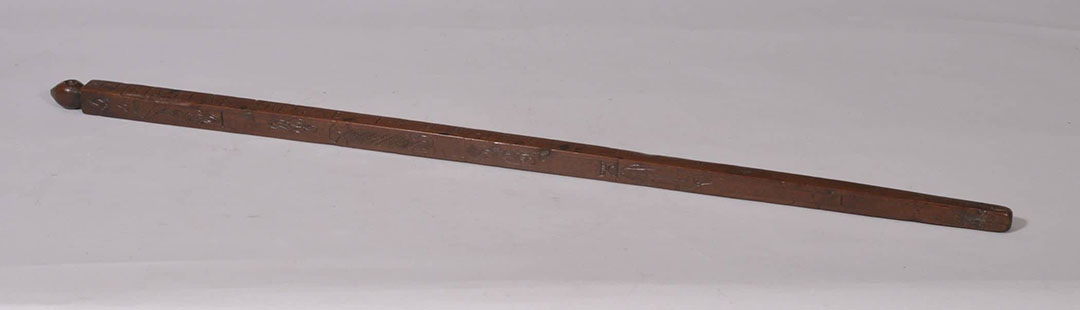
An example of an old Scottish Ell measuring rule, used copiously by tailors in the making of garments throughout Scotland. A PHI Reciprocal version @ a length of 37.08204" (6 X 6.18034") or in increments of 1/9th, 1/8th, 1/6th, 1/4th, 1/3rd , 2/3rds, 3/4ths, etc., of the rod, could square the circle, rendering a precise, full circle area in square inches.
This special PHI-Reciprocal based measuring rule was essential to anyone creating drinking vessels, marketplace tubs, barrels etc., where a perfect standard capacity had to be accurately attained. Also, tailors cutting cloth for attire, based upon 2-dimensional measurements of clients, could facilitate making clothing for a 3-dimensional fit around the body. Anywhere circular geometry was required, the Ell rod could be pressed into service to achieve a perfect result.
Seemingly, all of the European nations had their own Ell rods in greater or lesser lengths, with some of them based upon the PHI Reciprocal value and others not. We will identify several of these national or provincial standards as we proceed.
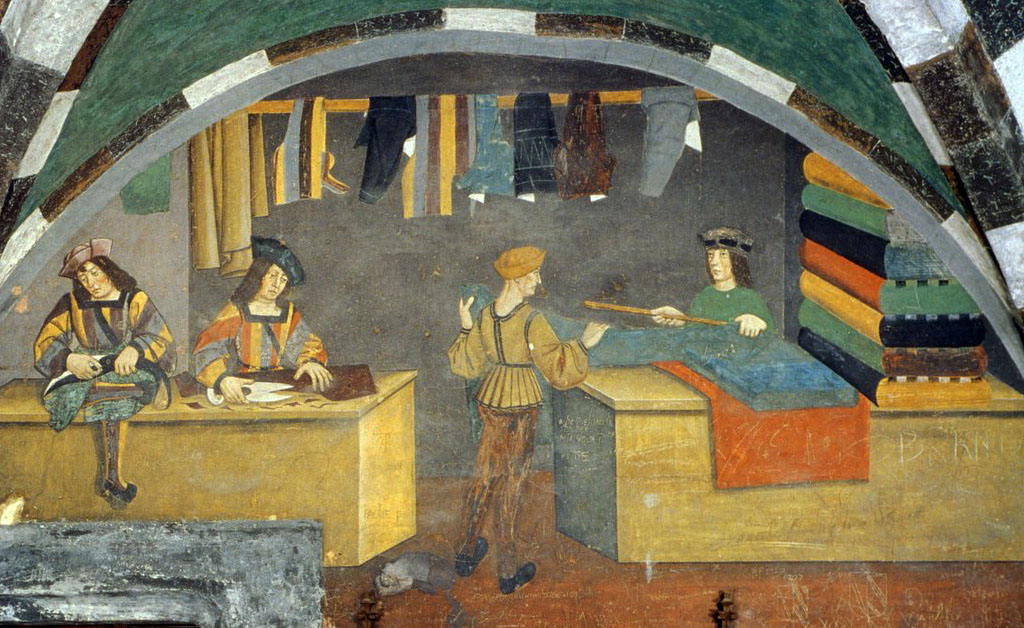
All across ancient Continental Europe and the British Isles, tailors or those involved calculating circle geometry of perfect, sought after square inch area, used Ell rods based upon the PHI Reciprocal.
SOME EXAMPLES:
Using the formula: Area of a circle = π × r2 ... (but given here as a full length Ell diameter).
1. The Scottish Ell @ 37.08204 = 4320"sq.
2. The Polish Ell @ 30.9017 = 3000"sq.
3. The Danish Ell @ 24.72136 = 1920"sq.
4.The Prussian foot @ 12,36068" = 480"sq.
5. The Winchester Standard Ell @ 18.54102 = 1080"sq.
6. The Hamburger Ell was very probably 22.249224 (6.1804" X 3.6) ... a shortfall of about 1/12th of an inch on the present day accepted value (22.5523622").
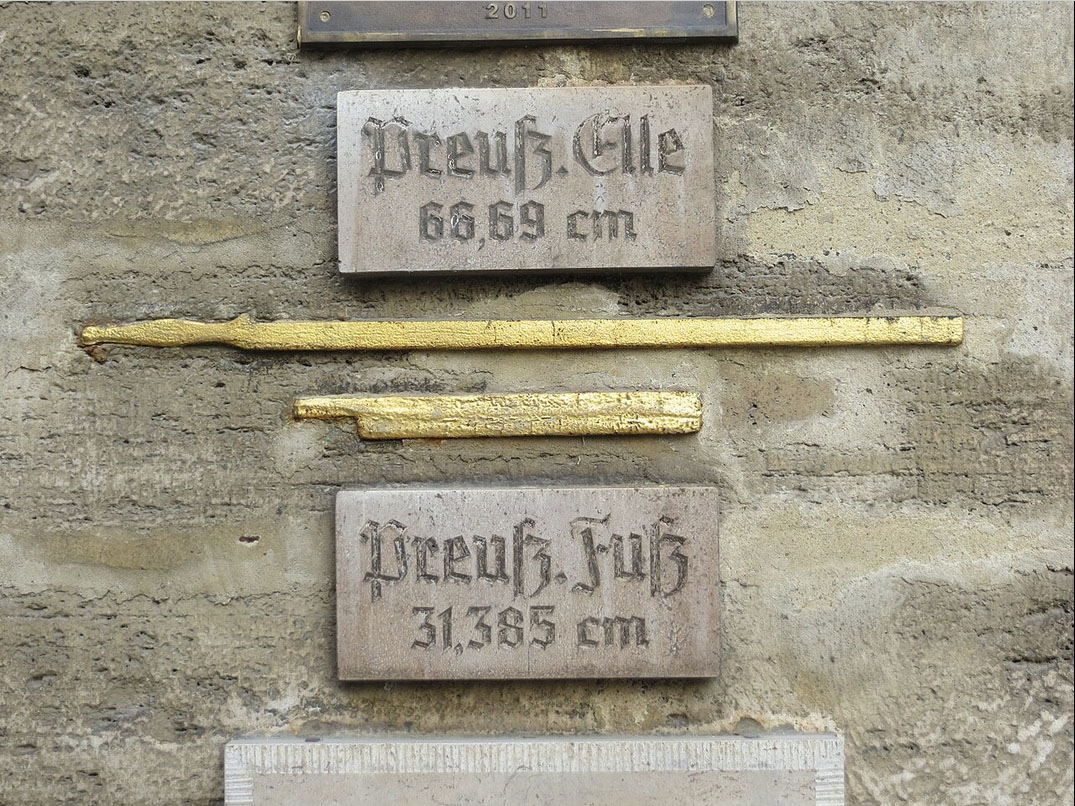
The Prussian foot was 31.385 cm, which converts to 12.3562992" or 6.18034 X 2 (12.36068") to a tolerance of about 1/230th of an inch ... beyond human vision to detect. The Prussian Ell (seen above) @ 66.69 cm converts to 26.255906" and is based upon the ancient Roman overland foot of 11.66666" X 2.5 = 26.25". Also, the ancient Greek mile was 5250-feet or 26.25' X 2.
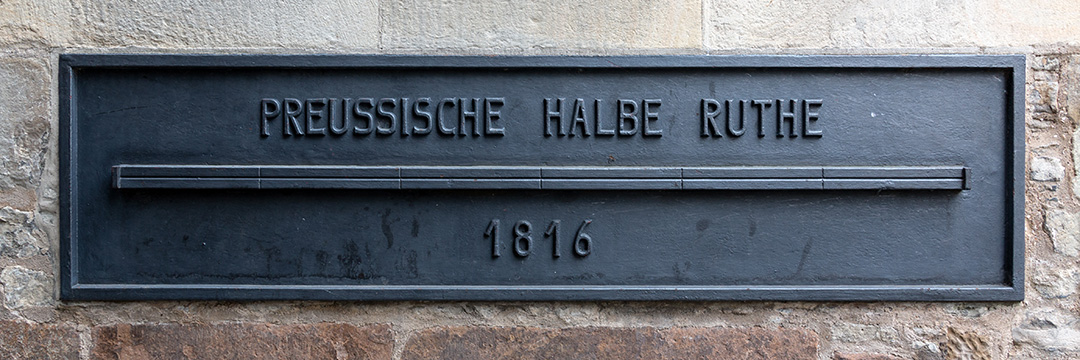
A standard at the City Hall in in Münster, Germany (Münster, Historisches Rathaus, Preussische halbe Ruthe from 1816). This bar shown is one "Prussian Half Rod" (1.883 m) long.
The length of 1.883 m converts to .6.1778213434' between the integral jaws with flat parallel faces, designating the intended length of this Ell standard. It is 0.0025186566 of a foot shortfall from 6.18034' or 1/34th of an inch. We can safely surmise that this rod was intended to be based upon the PHI reciprocal reading, as 6.18034'. It is divided into 6 divisions of Prussian feet @ 12.36068" each.
THERE WAS ONCE A UNIVERSAL SYSTEM, USING THE SAME SPECIAL VALUES IN ALL WEIGHTS, MEASURES & VOLUMES SHARED AMONGST THE EUROPEAN COUSIN NATIONS.
Ancient Metrology Historian, Donald Lenzen writes:
'Statements made by ancient writers make it clear there was an exact ratio between weights and measures of different civilisations This would suggest a common origin. If this is true, the entire evolution of civilised man could be accurately traced from its common centre, through the study of Ancient Metrology!
In ancient times, volume was based on weight. The Babylonian Qa, a unit of volume, was one mina in weight. In Rome, it was enacted by law that an Amphora of wine should equal 48 sextarii in capacity and 80 libra in weight.
In Babylon, when a man purchased a sutu of wine, he would, of course be concerned whether the sutu contained the correct volume. However, when engaged in weighing gold, the concern would be 100 times greater. Therefore, because weight and volume were tied together, weight would be the determining factor in arriving at an absolute exact standard.
Ancient writers often agree as to the ratio between Babylonian, Greek and Roman measures. But what was the weight of the Babylonian mina or the Roman libra? Until one value can be reestablished precisely and exactly all these ratios by ancient writers are worthless.
There must first be a starting point. One ancient standard must be established with absolute precision, based upon hard solid evidence, proven beyond any shadow of doubt. This starting point will be the foundation around which a true science of Ancient Metrology will unfold'.
IT'S ALL ABOUT PYRAMID NUMBERS.
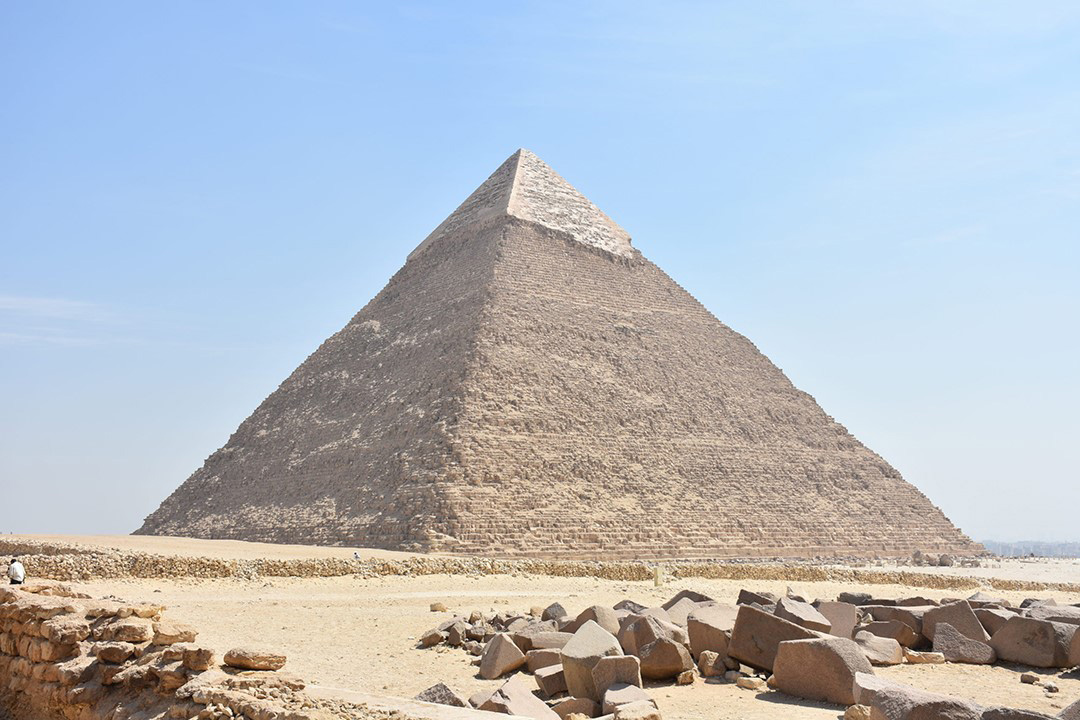
The Great Pyramid of Egypt and other pyramids of the Gizeh Plateau acted as a Bureau of Standards from which the civilisations of antiquity, extending to modern eras, based their Weights, Measures and Volume Standards.
It was obviously realised in remote antiquity that if one is to enjoy the abundance and benefits of "CIVILISATION", then there is a body of essential, prerequisite, scientific knowledge that must first be gained. Once a civilisations has that knowledge, then its “wise-ones” (the few set aside to bless the many) must religiously preserve it and hand it on intact to each ensuing generation. Failure to do so means that one has just cursed one's children and, to whatever degree the knowledge is lost, so too is lost one's grasp on civilisations.
One truth that will come as a surprise to some is that the "so-called" British Standard "inch" and "foot" are very ancient and all of the cubits or feet of the great civilisations of recorded history in the Mediterranean-Continental European-British Isles theatres were based upon the self-same inch. Moreover, all of the measurement standards of one civilisations were either the same, or precise ratio expressions to the standards of the surrounding confederation of cousin civilisations.
Everyone used the same integrated parcel of factorable numbers to describe their cyclic or astronomical sciences and the way they eternally recorded those sciences was by incorporating those special numbers, by code-bearing lengths and angles, into public buildings/ edifices or portable memory devices.
Even much earlier in history, extending from the Neolithic Age, the sprawling marker-mound complexes and multitude of standing-stone circles were eternal repositories of the special numbers, (extractible by length and angle calculations from a hubstone to an outlier stone). Added to that, specialist teachers carried mnemonic devices into which the numbers were encoded and this, as it turns out, included the carefully fabricated “Volva staffs” of the traveling, wise women of Europe.
In the 19th century J Ralston Skinner, American archaeologist, did extensive investigations and measurements of Ohio's expansive, ancient, geometric earth-embankments. Skinner's conclusion was that the mound builders of the Ohio Valley had positively used the increment that today is known as the British standard inch in the design and construction of the geometric complexes. See: Skinner, J. Ralston. "Identification of the British Inch as the Unit of Measure of the Mounds of the Ohio Valley Builders." Journal of the Cincinnati Society of Natural History Vol. 9 (July 1886), pp. 51-63.
This journal could formerly be accessed online by going to: Cincinnati Historical Society Digital Journals.
Likewise, Sir William Flinders Petrie deduced that the "inch" used on the Great Pyramid was within 1/100th of an inch (visually undetectable) to the British Imperial Inch. Other researchers had come to similar conclusions, one of which (Taylor) put the Pyramid Inch to within 1/1000th of the Imperial Inch.
The finalised, big numbers that had to be remembered by ancient civilised society might look reasonably unfriendly. This is because nature has a bad habit of running cycles to its own schedule, without consulting accountants. A solar year is 365.2422-days and a lunar year is 354.3643519-days. The lunar nutation cycle, where the Moon goes to a position called major standstill, returns to minor standstill, then returns to major standstill again, takes 6798.36-days or 18.61329277 solar years. The Earth is 24902.44523-miles in equatorial circumference. The polar circumference is 24816.55084-miles. The cycle of the Precession of the Equinoxes takes 25776-years to complete.
So, with these cumbersome, non-factorable numbers to contend with, how did ancient scientists turn this chaotic set of difficult values into an ordered, integrated and functional mathematical system?
- The solar year can be called 365 & 1/4-days, which is a nice rounded number equating to 8766 hours.
- The lunar year can be called 354 & 3/8th-days, which is 8505 hours.
- If a calendar is produced that runs for 7 solar years, then that equates to 2556 & 3/4th-days.
- If the lunar period within that calendar runs for 7 & 1/5th lunar years (one tenth of 72-years), then that equates to 2551 & 1/2-days.
- If a measurement rule is produced, based upon 5 & 1/4 feet, then 487 X 5 & 1/4 = 2556 & 3/4 feet/ days.
- The same measurement rule can be used for the Moon and 486 X 5 & 1/4 = 2551 & 1/2 feet/ days.
- If an auspicious mistletoe culling ceremony is performed on the 6th day after the calendar commences at the Summer Solstice, then the solar and lunar cycles can end on the same day 7 solar years later.
- If the world is described as 12 X 12 X 12 X 12 X 1 & 1/5th-miles (note: 1 & 1/5th is a tenth of 12), then that's 24883 & 1/5th-miles...only 18.8 miles short of the true equatorial circumference.
- If one wishes to navigate using a "6&7" series of numbers, those miles can be 5250' each.
- If one wishes to navigate using an "11" series of numbers, those miles can be 5280' each (for a world with a circumference of 24750-miles).
A wonderful little window of opportunity arises when a straight-line diameter, using an "11" number is converted to a "6" based circle using PI @ 314 & 2/11th ÷ 100 (1728/550th). Therefore 550 X this rendition of PI = 1728, which is fluidly divisible by 360°.
A wonderful little window of opportunity arises when a straight-line diameter, using a "6&7" number is converted to an "11" based circle, using PI @ 22/7. Therefore 525 X 22/7ths = 1650, which is divisible by 330, 660 or 360°.
A wonderful little window of opportunity arises when 1/7th of a 360° circle (51 & 3/7ths°) is multiplied by 1.75 = 90. A 630° compass will work very well using "7" series values.
If the cycle of the Precession of the Equinoxes is described as 25920-years, then that's 72 X 360.
If the lunar nutation cycle is described as 6804-days, then that's 19 & 1/5th lunar years, which is nicely divisible by "6&7".
On the basis of these "big" numbers, which had been "factored" to be in very close tolerance to the true size of the Earth or duration of cycles, the ancient civilisations then produced their "Weights, Measures & Volume" standards in direct compliance to the highly factorable numbers generated.
Therefore:
What (much later) became known as a "Greek" foot has an overall length of 12 & 3/5ths British standard inches (one tenth of 126"). A Greek foot is simply half of an Assyrian cubit or a tenth of a Hebrew Reed (10 & 1/2 British standard feet). Babylonian-Sumerian or Egyptian standards, as well as ancient Swedish, Germanic or many others preceding the fledgling Greek & Roman civilisations, comply to this same integrated system. All are in direct ratio to the standards of their cousin nations or more distant forebears of remote antiquity.
THE STIRLING JUG HAD BEEN LOST FOR SEVERAL YEARS BEFORE 1743, BUT WAS FOUND AGAIN IN 1752.
'BRYCE, (the Rev.) ALEXANDER, an eminent geometrician, was born in the year 1713, at Boarland in the parish of Kincardine, and received the first rudiments of learning at the school of Downe, Perthshire. He studied afterwards at the university of Edinburgh, where his proficiency in mathematics and practical astronomy, early attracted the notice and secured for him the patronage of professor Maclaurin.
In the year 1750, having occasion to visit Stirling, and knowing that, by an act of the Scottish parliament, this borough had the keeping of the Pint Jug, the standard, by special statute, for weight and for liquid and dry measure in Scotland, he requested a sight of it from the magistrates. Having been referred to the council house, a pewter pint jug, which had been kept suspended from the roof of the apartment, was taken down and given to him; after minutely examining it, he was convinced that it could not be the standard. The discovery was in vain communicated to the magistrates, who were ill able to appreciate their loss. It excited very different feelings in the mind of an antiquary and a mathematician; and resolved, if possible, to recover this valuable antique, he immediately instituted a search; which, though conducted with much patient industry during part of this and the following year, proved unavailing. In the spring of 1752, it occurred to him, that this standard might have been borrowed by some of the braziers or coppersmiths, for the purpose of making legal measures for the citizens; and having learned that a person of this description, called Urquhart, had joined the rebel forces in 1745, that his furniture and shop utensils had been brought to public sale on his not returning; and that various articles which had not been sold, were thrown into a garret as useless, he obtained permission to inspect them; and to his great satisfaction, discovered, under a mass of lumber, the precious object of his long research. Thus was recovered the only legal standard of weight and measure in Scotland; after it had been offered, in ignorance, for public sale, and thrown aside unsold as trash, and long after it had been considered by its constitutional guardians as irretrievably lost.
The standard Stirling pint jug is made of brass, in the form of a hollow truncated cone, and weighs 14 pounds, 10 ounces, 1 drop, and 18 grains, Scotch troy. The mean diameter of the mouth is 4.17 inches. The mean diameter of the bottom 5.25 inches, and the mean depth 6 inches English. The handle is fixed with two brass nails; the whole is of rude workmanship, and indicates great antiquity.
By an act of the Scottish parliament, Edinburgh had the keeping of the standard ell; Perth the reel; Lanark the pound: Linlithgow the firlot, and Stirling the pint jug; an arrangement made by the legislature, in the view of improving the internal commerce of the country .... Hence it may be inferred, that Lanark was then the principal market for wool; Perth for yarn; Edinburgh for cloth; Linlithgow for grain; and Stirling for distilled and fermented liquors. The Stirling jug is mentioned in acts of Parliament as being in the town before the reign of James II. in 1437: and the last mention made of it is in the reign of James VI., in an "Act of Parliament, 19 February, 1618, anent settling the measures and weights of Scotland." No accurate experiments appear to have been afterwards made with it for fixing the legal quantity of these measures and weights, till the following by Mr. Bryce in 1762-3; a period of about one hundred and thirty-five years!
Having been permitted, after recovering the Standard jug, to carry it with him to Edinburgh, his first object was to ascertain precisely, by means of it, the number of cubic inches, and parts of a cubic inch, in the true Scotch pint.
This vessel was filled several times with the same water as in the trials with the jug, and its content was found to weigh 25,318 grains, English troy. This number divided by 100, gives 253 18/100 grains, as the weight of a cubic inch of water: therefore, 26180 divided by 153 18/100=103 404/1000, the exact number of cubic inches, and parts of a cubic inch, in the standard Scotch pint: 51 702/1000 cubic inches in the chopin: 25 851/1000 cubic inches in the mutchkin; and so on, proportionally, in the other smaller Scotch measures.'
INTERNAL CAPACITY CODES
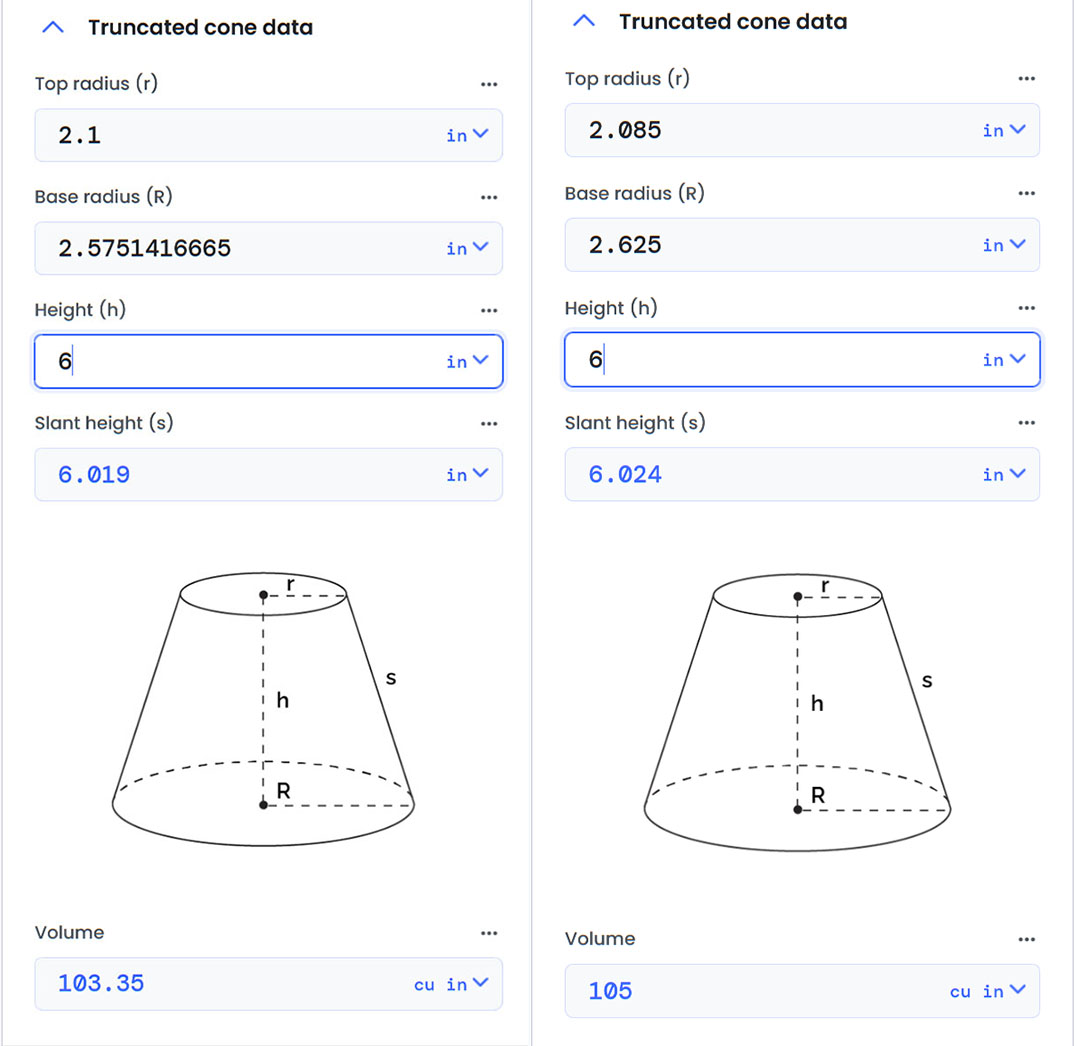
To the left is seen the values inserted, based upon known ancient, much used numbers in weights measures and volumes, coupled with circle geometry based upon the PHI Reciprocal. To the right is shown the measurements of the Stirling Jug undertaken by Alexander Bryce in 1752. As can be seen, the cubic capacities arrived at are quite compatible and the more modern reading, based upon measurements of the physical Stirling Jug proportions, fix its cubic capacity to 103.7 cubic inches (103.68).
WHY MUST THE CAPACITY BE READ AS 103.68 CUBIC INCHES?
Due to the fact that generations of assayers or guardians, whose sworn duty it was to maintain the precise values encoded into all weights, measures and volume standards, being derelict in their duty, the original numbers were lost.
In most cases the amount of drift away from a true value has been relatively small, but sufficiently large enough to obscure the integrity and dynamic meaning of the original, ancient number.
The very ancient rule that was universally adhered to from remote antiquity through the era of the Druids and their forebears, is that every weight, measure and volume must contain an identifiable, encoded number that related to one or another of the following:
(1). The equatorial circumference of the Earth and its divisions.
(2). The 354.375-day Lunar Year.
(3). The 7-solar year - 7.2 lunar year lunisolar Sabbatical Calendar system of tracking the progress of both the sun and the moon, on a daily basis, through to the end of the Sabbatical Year.
(4) The 6804-day Lunar Nutation cycle, where the moon goes from Lunar Major Standstill to Lunar Minor Standstill, then returns to Lunar Major Standstill.
(5). The Precession of the Equinoxes, leading to a calculation as to when to change the calendar equinox day, by one day, every 72-years.
(6). Navigation, positional plotting and dead-reckoning when sailing on the wind across the featureless oceans or traveling overland, under several ratio-related navigational systems shared by the cousin nations of antiquity.
(7). How to make perfect capacity tubs for use in the marketplaces, such that the public receive the precise cubic quantities they paid for and no disputes arise over short measures.
SO LET'S DECIPHER THE APPARENT, INBUILT NUMBERS-OF-CIVILISATION ENCODED INTO EACH PART OF THE STIRLING JUG.
Without access to precise vernier caliper measurements, the above values, derived from scaling a high-resolution photo, would seem to be correct.
The approach taken uses the ages-old method of calculating two-dimensional, circular parts of the Stirling Jug using the PHI Reciprocal @ 6.18034" or precise, PHI related divisions of the 37.08204" Scottish Ell. The approach also locks diameters to very close tolerances with the 1752 measurements of Alexander Bryce, but takes into account that every ancient diameter, found in mnemonic devices like the Stirling Jug, must be identifiable as a known, ancient code-bearing value from the parcel of special numbers dedicated to maintaining abundant "civilisation".
INTERNAL CODES
Alexander Bryce measured the top "mean" opening of the Stirling jug as 4.17" diameter. A value of 4.17" has no significance within the parcel of ancient numbers used in weights, measures and volume standards, whereas the close proximity number of 4.16666666" would have great importance. A number string based upon 4.166666 goes:
4.166666, 8.33333, 12.5, 16.66666, 20.833333, 25, 29.16666, 33.33333, 37.5, 41.66666, 4.5833333, 50 ... 58.333333 ... 62.5 ... 75 ... 87.5 ... 100 ... 112 ... 116.6666 ... 125 ... 137.5 ... 145.833333 ... 437.5 ... 687.5,etc.
In the above line-up of generated numbers is 116.6666 and the Roman overland foot was 11.66666", whereas their Pace (5 Roman feet) was 58.33333". Also, 437.5 - grains became the weight of 1-ounce and 68.75-miles became 1-degree of equatorial circumference arc for the Earth in one of the several navigational methods used in antiquity.
Despite this, the very close proximity diameter of 4.2" was chosen by this researcher as the most viable code to include. It is only 1/34th of an inch different than Alexander Bryce's "mean" value, but has great significance as the base increment in what became the Greek system of metrology. A number string based upon 4.2 goes:
4.2, 8.4, 12.6, 16.8, 21, 25.2 ... 33.6, 37.8, 42 ... 50.4 ... 63, 67.2 ... 75.6 ... 100.8, 105 ... 113.4 ... 126 ... 151.2 ... 189 ... 2016 ... 2268 ... 3024 ... 3150 ... 3402 ... 4536 ... 6048 ... 6804 ... 3110.4 ... 130636800.
In this line-up are 12.6 (the Greek foot was 12.6"); 168 (there are 168-hours in a week); 756 (the Great Pyramid is 756' long per side); 100.8 (1-second of arc for the equatorial circumference of the world), 105 (the number of inches in a Hebrew reed measurement adopted by the Greeks); 1512, 2268, 3024 (2, 3 & 4 side lengths of the Great Pyramid ... an ancient Bureau of Standards for the world); 6048 (1-minute of arc for the equatorial circumference); 6804 (the number of days in the Lunar Nutation Cycle); 3110.4 (the number of miles in 1/8th of the equatorial circumference of the world); 13063680000 (the number of feet in the equatorial circumference of the world ... 12 X 12 X 12 X 12 X 1.2 Greek miles of 5250' each or 5000 Greek feet of 12.6" each per Greek mile ... 24883.2-miles.
THE DIAMETER OF THE INTERNAL BASE OF THE STIRLING JUG.
This is where the Scottish Ell had to be pressed into service, as the assayer-designer or fabricator had to square the circle, based upon an expression of the PHI reciprocal. In this case the 37.08204 length of the Ell had to be divided by 7.2 = 5.150283333". There would be 1.2 X 5.150283333" in 6.18034".
In and of itself 5.15028333", multiplied by π × r2 = 20.83333.(half of 41.6666 and a code-bearing value from the ancient parcel of special numbers).
As a full diameter (squared) then multiplied by PI @ 3.1416 = 83.333" X 6" (the internal height) = 500 in. sq. However, the internal geometry of the Stirling Jug is that of a Truncated Cone, with a top opening hovering between 4.16666" and 4.2" (code bearing numbers), so the formula, V = (1/3) * π * h * (r² + r * R + R²), has to be applied = 103.68 (the intended. code-bearing ancient value).
WHY IS 103.68 SUCH AN IMPORTANT ANCIENT VALUE, OCCURING IN WEIGHTS, MEASURES AND VOLUME STANDARDS OF MANY NATIONS?
The Great Pyramid @ 756 per side is 7.5 seconds of arc (100.8'). Two full circumnavigations of the Great Pyramid (8 sides) = 6048' for 1-minute of equatorial arc. The 6048' value X 60 = 362880' for 1-degree of arc. This value multiplied by 360 = 130636800' or 12 X 12 X 12 X 12 X 1.2 miles of 5250' (the mile adopted by the Greeks from the Egyptians). This equals 24883.2-miles under that navigational system literally encoded into the base dimensions of the Great Pyramid of Egypt.
Therefore, if one wishes to know how fast the Earth spins in a 24-hour period under this navigational assignment for the equatorial circumference reading, it's 24883.2 ÷ 24 = 1036.8 MPH.
A number string based upon 103.68 goes:
103.68, 207.36, 311.04, 414.72, 518.4, 622.08, 725.76, 829.44, 933.12, 1036.8 ... 1244.16 ... 1555.2 ... 1866.24 ... 2073.6 ... 2488.32 ... 2592 ... 3628.8 ... 4665.6 ... 5184 ... 6531.84 ... 7776 ... 12441.6 ... 24883.2 ... 130636800
In the above line-up we have 207.36 and the largest of the 3 Egyptian Royal Cubits is 20.736"; 51.84-degrees is the slope angle of the Great Pyramid and 5184-years is 1/5th of the 25920-year duration of the Precession of the Equinoxes; there are 3110.4 miles in 1/8th of the equatorial circumference of the Earth; according to the literal perimeter length coding of the Great Pyramid; the sum of 18662.4-miles would be .75 of the Earths circumference.
It can be seen that the ancient Jerusalem Standard for liquid volumes carries all of the essential numbers which, if placed in number strings, will generate everything necessary to identify the equatorial circumference of the Earth and its divisions:
Julius Caesar was an avid historian and writer who lived contemporaneously with the Druids of Britain and Continental Europe. He recorded the following observation concerning what the Druids taught in their open-air universities:
"The magnitude of the Earth and its divisions"... or ... "astronomy, mathematics, geometry, medicine, jurisprudence, poetry and oratory were all proposed and taught-natural philosophy and astronomy with severe exactitude". (See: De Bello Gallico, VII, 15, 16.. See also: Strabo I IV, page 197. Caesars Comm. Lib V. Sueotonius, V Calegula. E. Campion, Accounts of Ireland, pg. 18.).
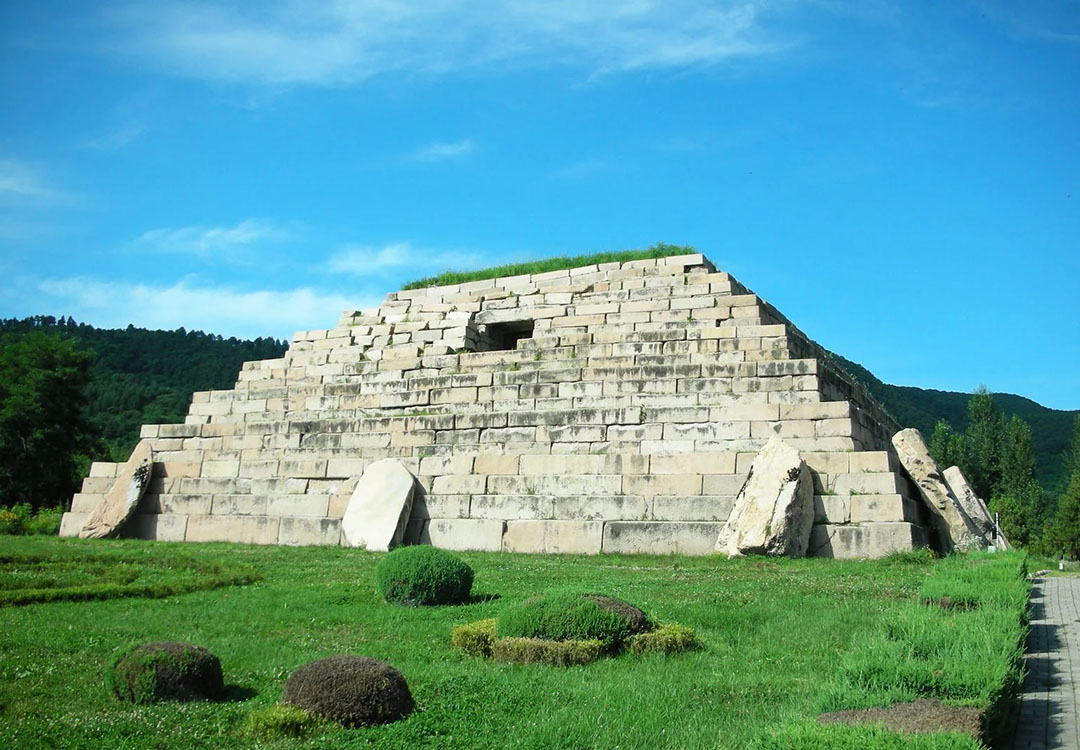
This very impressive stepped stone pyramid is called variously the Gaogouli Pyramid or the Tomb of the General. It is situated to the North of Korea at Ji'an, Jlin, China at coordinates 41° 09' 27" N 126° 13' 34" E
This Chinese-Korean Pyramid is officially said to have a square base measurement of 31.58 metres per side. The pyramid's square base is offset from the cardinal points of the compass and its eastern side appears to orientate towards north at an intended azimuth angle of 314.16-degrees (coding PI @ 3.1416).
There are hundreds, possibly thousands of these very impressive monuments in this region of southeastern China and further down the Korean Peninsula, stemming from the bronze age or before. The code-bearing attributes of this monument hints at the fact that it's probably far older than the era attributed to it.
'While it is possible that the square based tomb was an independent invention in the jian region, it seems probable that it is related to square tombs of Liaoning, which date back at least as far as the Hongshan culture* (Fang and Wei 1986). This new style of tomb appears as an elite style, quite suddenly and without antecedants in the Huanren Jian region.'
*Note: The Hongshan culture was Neolithic (4700 to 2900 BC).
The measurement standard by which it was built is recognisable within the factorable number system and universal measurement standards used by European cousin nations since remote antiquity and up until modern times. Consider the following:
1. The base length of 31.58 metres easily converts to an intended 103.68' or 1244.16", for a full perimeter circuit of 414.72 ... both dynamic navigational numbers encoded into the Great Pyramid's base perimeter.
2. This length is equivalent to 60 of the largest of the Egyptian Royal Cubits @ 1.728' (20.736"). Sir William Flinders Petrie identified usage of this particular cubit in his measurement of the coffer in the Khafre Pyramid, wherein it was 5 of these cubits long or 103.68-inches.
Note: A cubic foot (12 X 12 X 12 inches) = 1728 cubic inches. Also the circumference of Silbury Hill in England is 1728', based upon a diameter of 550' with π read as 1728/550ths or 3.141818182 .
3. The "Cab" volume,within the Jerusalem liquid volume standard was 103.68 cubic inches.
So, the length of the Gaogouli Pyramid duplicates the cubic inch capacity numbers generated in the (circa 957 BCE) Jerusalem Liquid Volume Standard, as well as the Stirling Jug of Scotland.
Ancient European & Eurasian peoples built thousands of sophisticated astronomical and code-bearing megalithic sites, from the Sea of Japan northwards, or southwards all the way down the Korean Peninsula. These standing stone circles and monuments are all over (especially) the northern islands of Japan as well as southern Japan and are attributed to remote antiquity inhabitants that pre-date the modern Japanese.

The Manza & Nonakado standing stone circles at Oyu Japan dating to 4200-years ago. The builders were the pre-Japanese Jomon European or Eurasian people, also related to the Ainu and spanning about 14,500-years of human occupation throughout the vast region.
The code-bearing attributes of these standing-stone circles duplicate both the measurement standards and number-generating modus operandi of British Megalithic sites, as well as Continental European and Mediterranean sites, all of which have code-bearing attributes with a pedigree to the pyramids of the Giza Plateau of Egypt. Here are a few examples of inbuilt numbers of civilisation at Oyu:
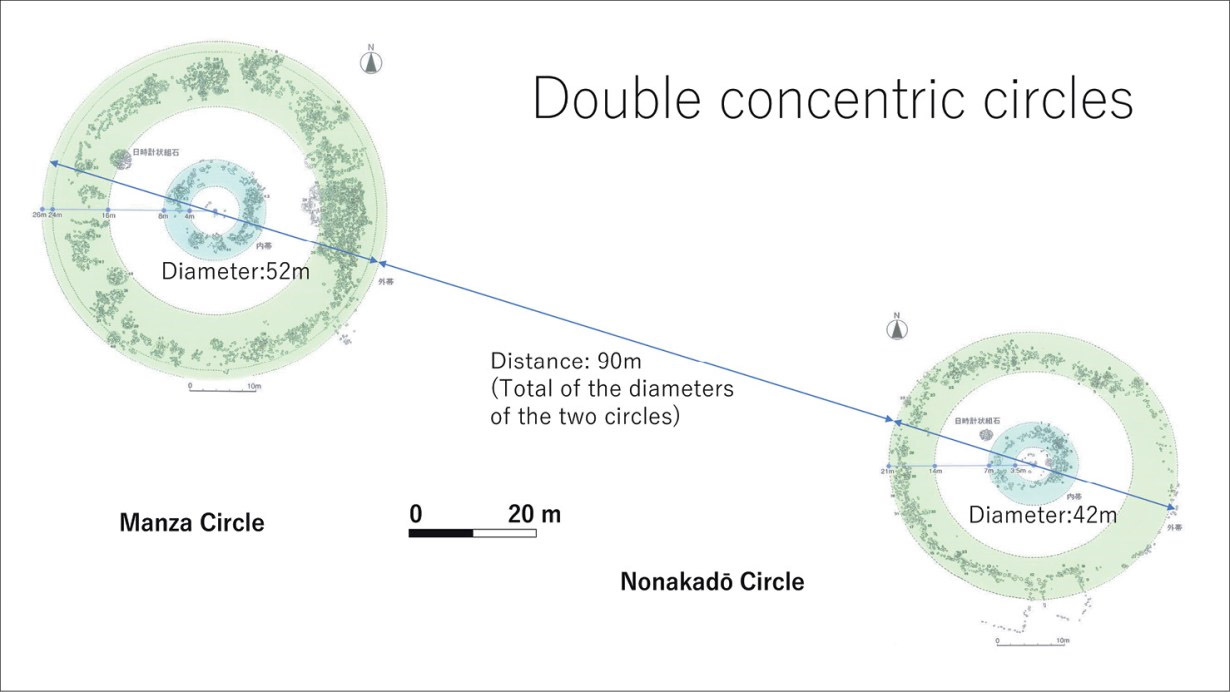
THE MANZA CIRCLE
Careful archaeological measurements of the 5-ring Manza concentric circles provides the following radius divisions from the centre to the extreme exterior ring:
4m, 8m, 16m, 24m & 26m. These divisions, converted to ancient feet generate the following coded lengths:
(4m) = 13.125' ... This provides both navigational and lunar cyclic numbers.
(8m) = 26.25' ... The Greek mile was 5250' or 2625' X 2.
(16m) = 52.5' ... The Greek short Stadium measurement was 525'. Also 52.5' would be 5 Hebrew Reeds of 10.5' or 50 Greek feet or 25 Assyrian cubits.
(24m) = 78.75' or 1/8th of a Greek long Stadium (630'). It would also be 7.5 Hebrew Reeds or 75 Greek feet.
(26m) = 85.05 to a shortfall tolerance of 3". The outer rim radius was encoding the 6804-day Lunar Nutation cycle, of which 850.5-days was 1/8th of the duration.
Of course the full diameter of the circle @ 52m = 170.1' to a tolerance of 6". This circle is 1/2 the diameter of the southern circle at Avebury Henge in England and 1/2 the diameter of the standing stone ring at Brodgar in the Orkney Islands of Scotland.
THE NONAKADO CIRCLE
Careful archaeological measurements of the 4-ring Nonakado concentric circles provides the following radius divisions from the centre to the extreme exterior ring
3.5m, 7m, 14m, 21m.
(3.5m) = 11.52' to a tolerance of 0.0370607 of 1' or .44 of an inch. This is navigational coding and 11.52' would be 1/9th of 103.68' ... the side length of the Gaogouli Pyramid.
(7m) = 23.04' ... This relates to navigation with the world configured to be, in a factorable number, 12 X 12 X 12 X 12 X 1.2 -miles in equatorial circumference.
(14m) = 46.08'' ... This, in miles, X 1.5 was 1-degree of arc under this navigational system, found in the base dimensions of the Great Pyramid @ 756' per side, with 2 circumnavigations of the pyramid's perimeter being 1-minute of arc (6048').
(21m) = 69.12 ... Under this navigational system, the Earth was calculated to be 24883.2-miles in equatorial circumference or 69.12-miles per degree of arc.
The distance between the outer rims of both circles (based upon the scale bar reading) appears to be 83m, or coded to represent 272.16' and relating to the equatorial circumference of the Earth. This distance, outer-rim to outer-rim would be 1/480000th of the equatorial circumference of the Earth.
Also, there were anciently two major navigational systems adopted by most nations of the Mediterranean-European theatres, one that read the equatorial circumference as 130636800' (24883.2 Greek-miles of 5250' each) and the other that read the equatorial circumference as 130680000' (24750 English-miles of 5280' each). The epicentre to epicentre of each circle can be read as 435.5' - 435.6' ... thus coding 1/300000th of the equatorial circumference of the Earth ... 435.6' X 3 = 1306.8.
The epicentre to epicentre line running through the two circles orientates onto the horizon's sunrise position of the winter solstice.
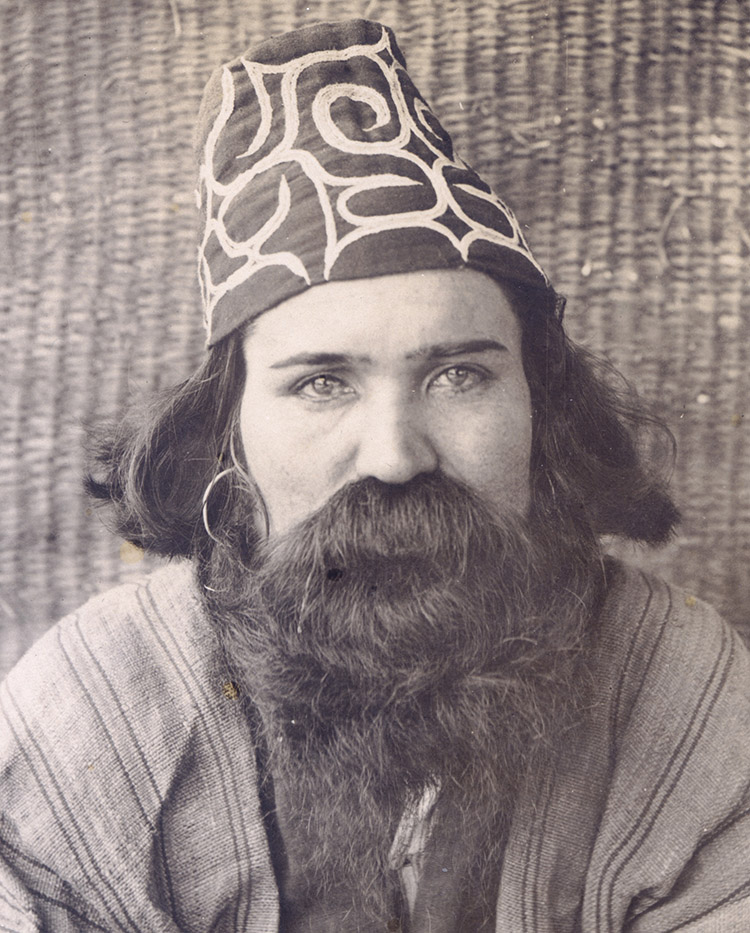
An Ainu leader in 1904.
THE EXTERIOR CODES OF THE STIRLING JUG
The side-to-side diameter at the top of the Stirling Jug appears strongly to achieve a diameter of 1/8th of the Scottish Ell or 4.635255" which is .75 of 6.18034".
In and of itself, a diameter of 4.635255 X π × r2 would achieve 67.5 in. sq. However, halved to a radius (2.3176275") it achieves 16.875 in. sq. of area at the top of the Stirling Jug.
A mathematical progression string based upon 16.875 goes:
16.875, 33.75, 50.625, 67.5, 84.375, 101.25, 118.125, 135, 151.875, 168.75, etc. However, as the progression increases, the following larger expressions of 16.875 are generated:
354.375 ... 472.5 ... 590.625 ... 708.75 ... 1417.5 ... 2126.25 ... 2835, etc. These are numbers that relate directly to the dimensions (in feet of 12-inches) to the Khafre Pyramid of Egypt (a pyramid of the moon).
The number 354.375' (half the length of the Khafre Pyramid) codes 354.375-days, the length of the lunar year; the full length of the pyramid is 708.75' (or in days = 2 lunar years); the number 472.5' is the design height of the Khafre Pyramid and 590.625' is the slope length of a face. Half the slope length is 295.3125 and the lunar month is 29.53125-days to a tolerance of under 1-minute of time per month. The number 2835' is the total perimeter distance around all 4 sides of the Khafre Pyramid. The number string also generates the values for 2 & 3 side lengths (1417.5' & 2126.25' respectively).
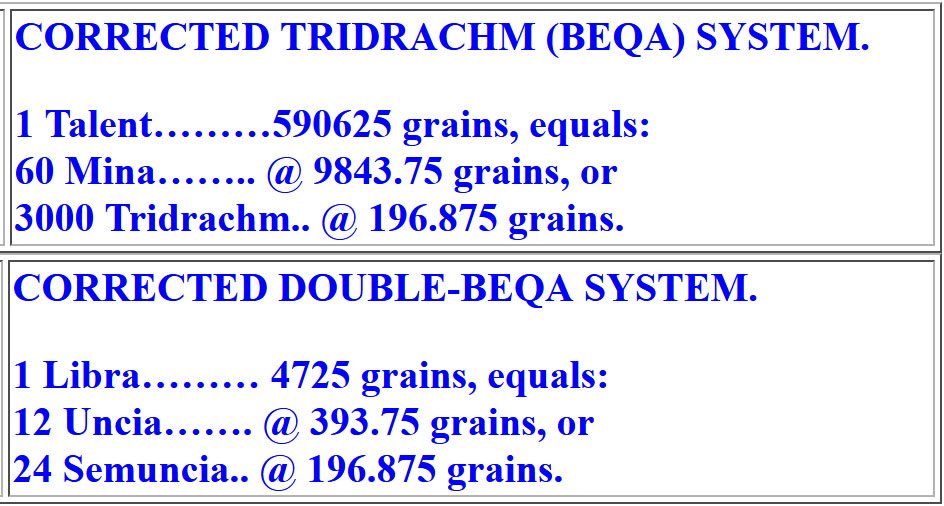
The Beqa weights system was specifically for weighing out quantities of gold and 19.6875-grains constituted 1 Beqa.
By using any of the numbers of ancient Tridrachm Standard in a number-string or progression, all of the lunar cycle numbers can be generated.
Likewise, the 16.875 number string will also generate Great Pyramid numbers at higher expressions of the string:
1890, 3780, 7560, 11520, 22680, 30240 ... 45360 ... 60480 ... 90720 ... 362880 ... 130636800 (the full equatorial circumference of the Earth, or 12 X 12 X 12 X 12 X 1.2 Greek miles of 5250' or 24883.2-miles.
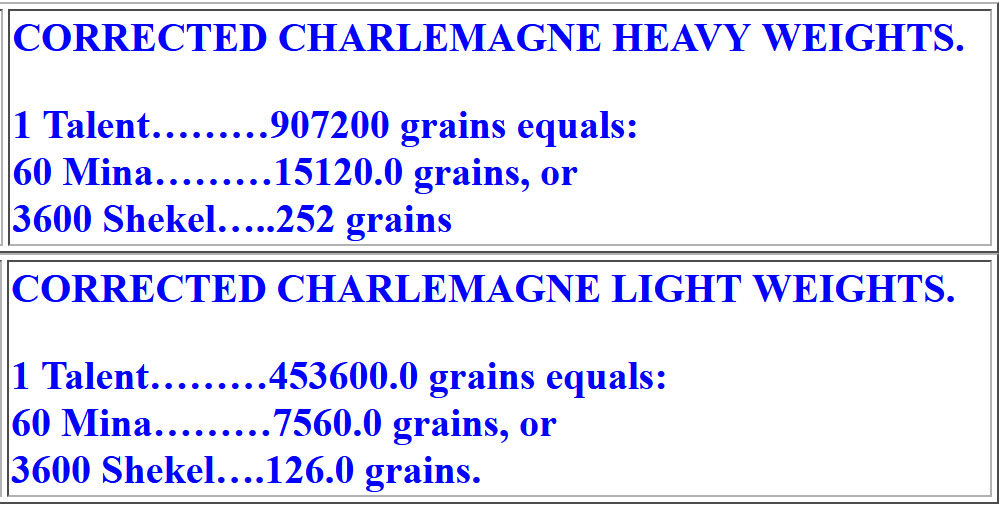
Numbers that relate directly to the dimensions of the Great Pyramid are found in the Charlemagne Standards (introduced in 789 AD) for heavy and light weights. Expert consultation that had occurred between Charlemagne, King of the Franks and the Caliph Harun-Al-Rashid of Baghdad. Charlemagne introduced the ancient Babylonian system, based upon the Arabic gold Dinar.
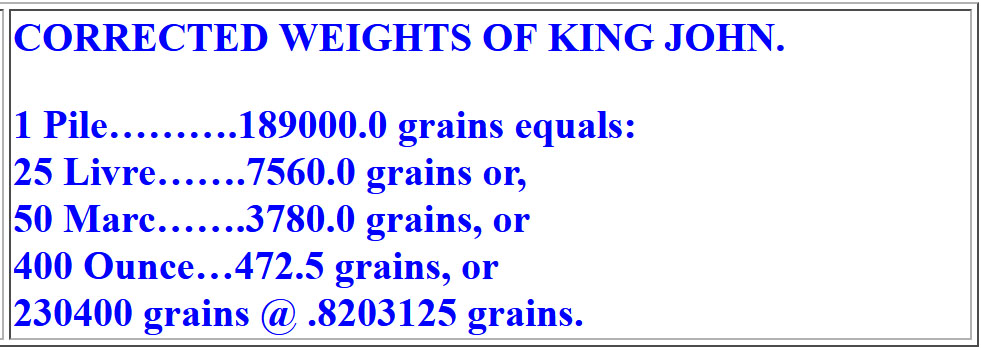
Again, the Great Pyramid numbers were used in the Weights Standard introduced by King John of England (1166-1216 AD). It closely mirrored the Charlemagne system of 426-years earlier that had been based upon the ancient Babylonian/ Sumerian metrology system.
THE SQUARE INCH AREA OF THE STIRLING JUG'S CIRCULAR BASE.
The exterior, circular base of the Stirling jug was intended to code a diameter of 6.18034" or half a Prussian foot. This halved = 6.18034" ÷ 2 = 3.09017" X π × r2 = 30 in. sq.
A mathematical progression based upon 30 goes:
30, 60, 90, 120, 150, 180, 210, 240, 270, 300, 330, 360 ... 390, 420, 450, 480, 510, 540, 570, 600, 630, 660, 690, 720 ... all very useful for readings of the 360-degree compass.
However, if we choose to multiply the exterior base, square inch reading by the 6.912" length of the Stirling jug's sides, we get 30 X 6.912" = 207.36".
The largest Egyptian Royal Cubit found by Sir William Flinders Petrie was 20.736" or 1.728'.
WHY WOULD THE 6.912" SLOPING SIDE VALUE ON THE STIRLING JUG BE IMPORTANT?
In and of itself, the value 69.12 is an extremely important number in the 24883.2-mile equatorial circumference.
The 24883.2 number was used to describe the equatorial circumference under two different mile readings, 5250' (Greek) or 5280' (English).
If using the 5250'-mile that the late era Greeks adopted from the Egyptians, 1-degree of equatorial arc for the world was 69.12-Greek miles or 362880' or 345600 Greek feet of 12.6"each (130636800'of 12"each)..
If using the 5280'-mile adopted in Britain and some other Continental European nations, 1-degree of equatorial arc for the world was 69.12 English miles or 363000' of 12"each (130680000'of 12"each).
Amongst European nations we are very aware of the 5280'mile, but where did it come from and are numbers derived from it represented in ancient weights, measures and volume standards?
By elongating the Great Pyramid's side length of 756' to 756.25' (3" longer) the 5280' mile system of navigation is created and numbers derived from that system show up in some weights, measures & volumes standards of antiquity.
All this would take is an etched line marked into the paving stone base of the Great Pyramid, symbolically elongating the edifice by 3" per side ... then the 5280' mile navigational system would come into play.
Let's consider the Sextarius volume of Alexandria @ 33 cubic inches and what it would generate in a number string:
33, 66, 99, 132, 165, 198, 231, 264, 297, 330, 363, 396, 429, 462, 495, 528, 561, 594 ... 660 ... 792, 825 ... 1056 ... 1485 ... 1584 ... 1650 ... 1980 ... 2475 ... 5280 ... 5940 ... 7920 ... 24750 ... 363000 ... 130680000
Under this navigational system the equatorial circumference of the Earth was read as 24750-miles of 5280'each.
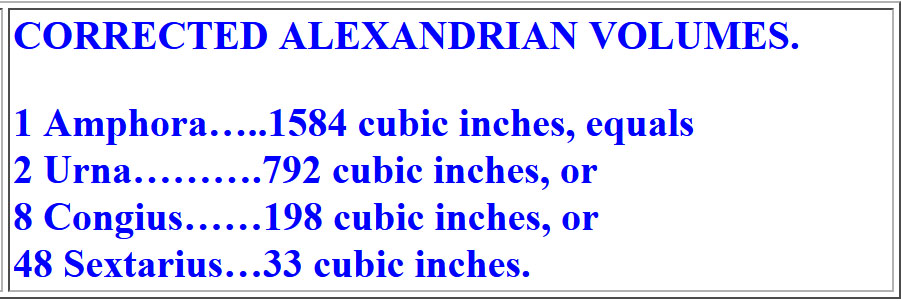
These ancient cubic inch volumes lead on to understanding where the following, much-used European measurements, used for centuries, originated. Parts of the ancient system still survive in the USA:
7.92" (the link), 5.5' (the Merchant fathom ... still in use in the early 20th century), 16.5' (the rod or perch), 66' (the chain), 660' (the furlong or furrowlong), 1760' (1/3rd of a mile), 5280' (the English mile), 5940' (the ancient Scottish mile, which was 1-furlong greater than the English mile), 16500' (the ancient English league or 3.125 English miles).
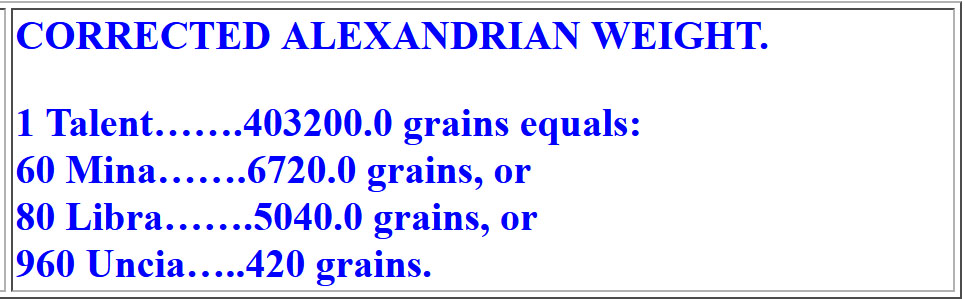
In the line-up of ancient Alexandrian weights the Mina @ 6720 grains provides the number that was later to be adopted as the Irish mile (6720').
A mathematical progression, based upon 672 goes:
672, 1344, 2016, 2268, 3360, 4032 ... 5376, 6048, 6720 ... 10080 ... 12096 ...16800 ... 50400, etc. There were 19440 Irish miles in the 130636800' equatorial circumference (24883.2 Greek miles).
SO, USING THE 103.68 IN. CU CAPACITY OF THE STIRLING JUG, LET'S RESTORE THE TRUE WEIGHTS, MEASURES & VOLUME DIVISIONS OF CIRCA 1400 AD SCOTLAND.
With the Stirling jug having a capacity of 103.68 in. cu, we can now calculate the true values for the ancient Scottish Volume Measures, before they drifted away from their Great Pyramid related numbers and became unrecognisable. The mathematical progression upon which each liquid volume measure was based begins with 3.24 in cu.
WET MEASURES ...
1. The Gill for Ale (beer) = 3.24 in. cu.
2. The Gill for spirits (whisky & wine) = 6.48 in. cu.
3. The Mutchkin = 12.96 in. cu. (4 gills).
4. Chopin = 51.84 in. cu (4 Mutchkins or 16 Gills).
5. Pint (Ale) = 103.68 in. cu. (2 Chopins, also called a Joug)..
6. Pint (spirits) = 28.8 in. cu. (Tappit hen). This would today be called a Gill, although the English Gill /Pint is erroneously 28.875 in. cu. It should be 28.8 in. cu and 3.6 such Gills should be a Scottish pint of 103.68 in. cu.
7. Gallon of ale = 829.44 in. cu.
8. Gallon of wine = 829.44 in cu.
9. Hogshead for ale (12 Scottish pints @ 103.68 in. cu each = 1244.16 in. cu.).
10. Hogshead for wine (14 Scottish pints @ 103.68 in. cu each = 1451.52 in. cu.).
DRY MEASURES ... for wheat, peas, beans, meal, etc., based upon the 24883.2-mile equatorial circumference of the Earth in miles of 5250' (Greek) or 5280 (English).
1. Lippie or Forpet = 77.76 in. cu. (this, in miles, would equate to 1/320th of the equatorial circumference).
2. Peck (4 Lippies) = 311.04 in. cu. (this, in miles, would equate to 1/80th of the equatorial circumference).
3. Firlot (4 Pecks) = 1244.16 in. cu. (this, in miles, would equate to 1/20th of the equatorial circumference).
4. Boll (4 Firlots) = 4976.64 in. cu. (this would, in miles, equate to 1/5th of the equatorial circumference).
5 Chalder (16 Bolls) = 79626.24 in. cu. (this would, in miles, equate to 3.2 X the equatorial circumference of 12 X 12 X 12 X 12 X 12 X 1.2 miles) ... also 22118.4 Scottish miles of 5940'each.
DRY MEASURES ... for barley, oats, malt, etc.
1. Lippie = 116.64 in. cu. (an ancient Roman foot was 11.664" ... variously read as 11.666666" for easy calculation in overland marching).
2. Peck (4 lippies) = 466.56 in. cu. (the Swedish Rydaholmsalm measurement was 23.328" or 1/20th of 466.56).
3. Firlot (4 Pecks) = 1866.24 in. cu. (the sum of 1866.24' would equate to 1/70000th of the 130636800' equatorial circumference (Greek mile of 5250' reading).
4. Boll (4 Firlots) = 7464.96 in. cu. (the sum of 7464.96'would equate to 1/17500th of the equatorial circumference under the Greek mile reading).
5. Chalder (16 Bolls) = 119439.36 in. cu ( the sum of 119439.36' would be 1/1093.75th of the equatorial circumference under the Greek mile reading).
THE WINCHESTER BUSHEL
'And to the End all His Majesties Subjects may know the Content of the Winchester Bushel whereunto this Act refers, and that all Disputes and Differences about Measure may be prevented for the future, it is hereby declared that every round Bushel with a plain and even Bottom, being Eighteen Inches and a Halfe wide throughout, & Eight Inches deep, shall be esteemed a legal Winchester Bushel according to the Standard in His Majesty's Exchequer.' ... 1696.
One of the casualties, seriously affected by "drift" occurring in cubic capacity measures, rendering them unable to encode the true, original coded number, was the bushel. Due to a mistaken rendition of its true, intended ancient capacity in 1696, the Americans adopted a bushel of 2150.42 cubic inches. The original bushel was, assuredly, meant to encode how the Sun, during the long cycle of the Precession of the Equinoxes spends 2160-years in each of the Houses of the Zodiac.
Here's a memory-device that helped ensure a perfect capacity for the ancient British bushel volume:
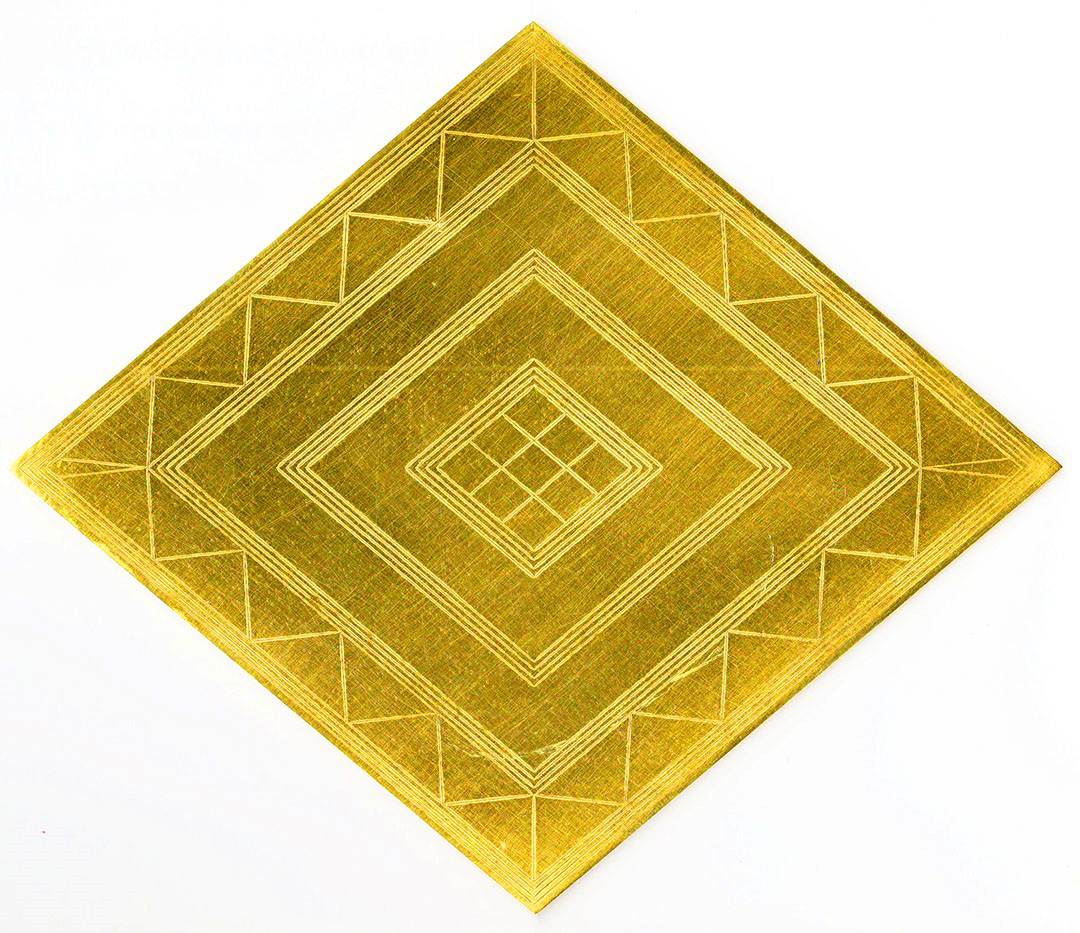
The Bush Barrow Lozenge, found in a Tumulus grave very close to Stonehenge, which is thought to date to circa 1900 BC. It measures 7.29" across and, 90-degrees opposed, is 6.18034".
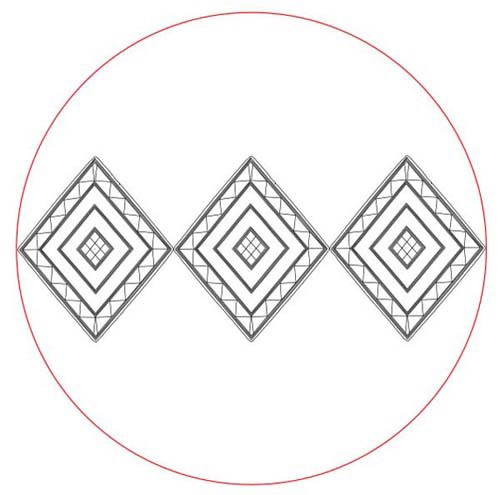
The width of the Bush Barrow Lozenge of Southern England was intended to encode 6.18034-inches (the lozenge has suffered some minor edge damage, slightly obscuring the original codes) and two such widths equated very visually close to 12.36068-inches or 1.0300566 feet, (convincingly the same as a Swedish & Norwegian long "Fot", as well as the Prussian fusse and "Prussian Half Rod", Münster, Historisches Rathaus).
The Bush Barrow Lozenge is 6.18034” X 7.29” (lunar code).
A primary purpose of the Bush Barrow Lozenge appears to have been for "market-place" inspectors to check the base width of "Bushel" barrels and tubs used by ancient merchants of the Neolithic Age, extending to Mediaeval times.
Very slightly "drifted" dimensions, for building a Bushel tub, are, as stated, described in the old English Winchester Standard as: "Any round measure with a plain and even bottom, being 18.5 inches wide throughout and 8 inches deep". In fact, that should be 3 X 6.18034” or 18.54102” (a shortfall of 1/25th of an inch). The Americans, who adopted the Winchester Bushel standard in 1836, have now been short-changed by 9.58 cubic inches per bushel for 189-years.
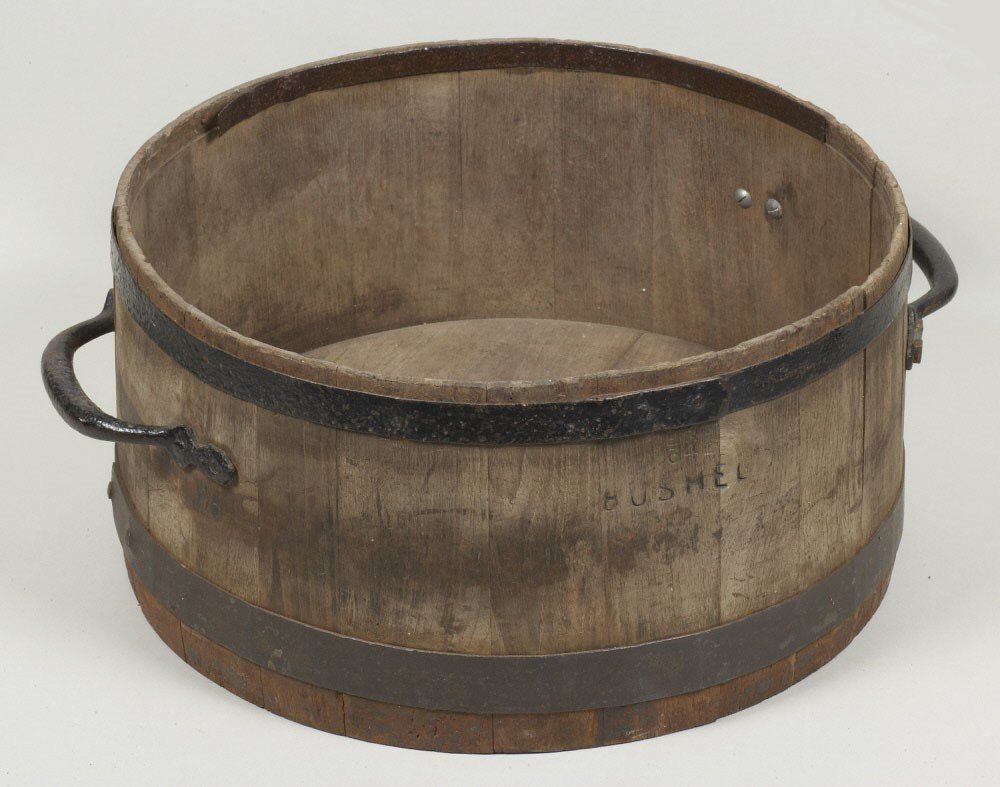
To make a bushel of perfect capacity, one would use half a Scottish Ell of 37.08204". Therefore, 18.54102" X π × r2 = 270 in. sq. X 8" (side height) = 2160 in. cu.
Note: The Sun spends 2160-years in each house of the Zodiac before moving into a new house during the 25920-year cycle of the Precession of the Equinoxes. At the Vernal Equinox, we are presently in the House of Pisces but will move into the House of Aquarius next.
The increment of 6.18034 X 2 = 12.36068-inches (the Prussian fusse). This value equates to 1.03005666 feet and is assuredly the measurement identified by researcher Gary Anderson as the largest "Fot" utilised by the Vikings, who had a Tunnah tub, with a capacity of 10080 in cu.
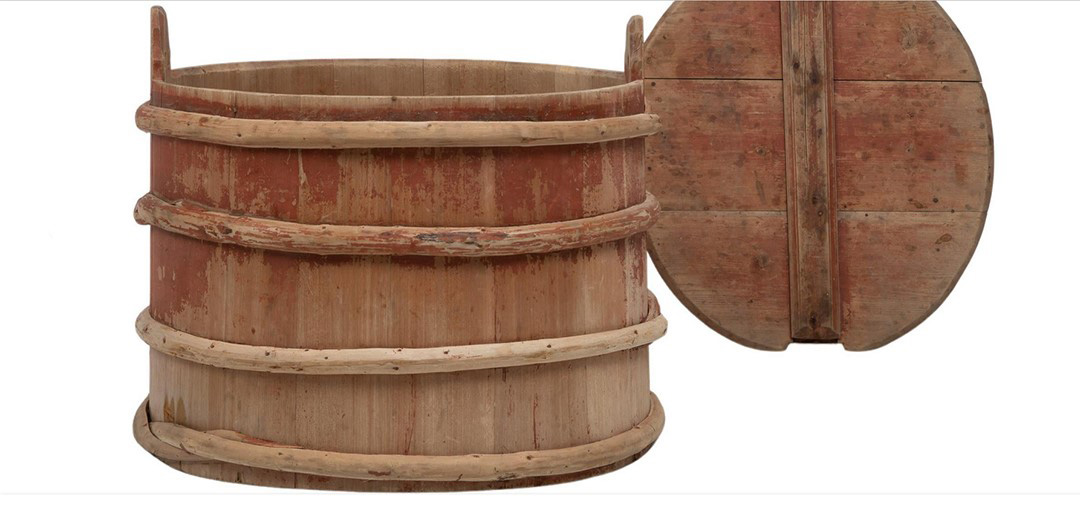
To make the Tunna tub base, take a large thin slab of flat smooth timber or tightly edge-splice several planks together to form a single piece of sufficient size.
Next take the 1.0300566 foot rule and mark double that length (2.0601132 feet) onto the wooden base as the total diameter.
Now create a circle from the halfway point of 2.0601132 feet diameter.
Because you have used a rule derived directly from the PHI formula, your base is exactly 480 square inches of surface area.
Your formula for determining the square inch area is PI X the radius squared, memorised by every schoolchild in the formative years of their education. So, the diameter of 2.0601132 feet ÷ 2 = 1.0300566 feet = 12.3606792-inches. This value "squared" = 152.7863903 X PI (3.14159) = 480 square inches of base.
The 480 number is a much-used coded value of antiquity and all aspects of ancient tub had to contain recognisable codes in the base surface area, internal side height and cubic capacity to be contained.
Because the tub needs to achieve 10080 cubic inches for this Swedish Tunna vessel, the internal height of the tub, from the top surface of the base to the brim of the side wall is 21-inches. This value (21-inches...sometimes called a Celtic Royal Cubit) is found in the base length of the Great Pyramid, which is 432 X 21-inches in length per side or 1728 X 21-inches for all four sides.
Note: A cubic foot (12 x 12 x 12) is 1728 cubic inches.
Note 2: A length of 100.8’ is one second of arc in the 24883.2 Greek mile (5250’) equatorial circumference of the Earth.
Having built your marketplace Tunna tub properly, you cannot be accused of swindling the public with short measures, thus ending up in the stocks and being bombarded with rotten vegetables by very irate, cheated consumers … or worse! ...
THE ANCIENT SCOTTISH LENGTHS SYSTEM, BASED UPON THE STANDARD INCH AND PHI-RECIPROCAL BASED ELL.
1. The Ell was based upon the PHI reciprocal of 10" ÷ 1.6180339 = 6.18034" X 6 = 37.08204". There is said to be a "fraudulent smaller inch of 1/42nd of a Ell" , which would equate to 1/7th of 6.18034" and very useful to tailors, marking out and cutting cloth using an Ell with 42 divisions.
2. A foot (Fit) of 12-inches.
3. A yard (yaird) of 3 feet.
4. An Ell of 37.08204" (this is the measurement rule based upon the PHI Reciprocal of 6.18034", used for "squaring the circle".
5. A standard, non-PHI Reciprocal Ell was 37.125" and used for determining the length of a Fall (Faw) @ 6 X 37.125". There were 320 Falls of this length in a Scottish mile (5940'). The Scottish mile was 1-furlong (660') longer than the English mile (5280'). That the 37.125" Ell existed is mathematically obligatory, as will be explained as we proceed.
6. A Barony Ell could be considered to be 42.05103336" or 6.18034 X 6.804" (the value used to encode the duration of the Lunar Nutation Cycle (6804-days) ... (a more refined reading of the Barony Ell is needed). One is officially measured as 1069 mm or 42.08661".
7. A Fall (faw) composed of 6 Ells of 6.1804" or 37.08204 X π × r2 = 155512 ... X 12 = 1866240 ... X 70 = 130636800 or 12 X 12 X 12 X 12 X 1.2 Greek miles ... the 24883.2 mile equatorial circumference.
THE SCOTTISH ACRE ... THE TRUE SQUARE FOOTAGE NUMBER LOST FOR CENTURIES DUE TO APATHY AND BUREACRATIC MEDDLING.

'The Edinburgh Ell rod, fabricated in wrought-iron, probably made in the mid 16th century (1500s). At each end it has substantial, integral jaws with flat parallel faces, so that a merchant's Ell rod can be checked by trying to fit it within the jaws. It was the official standard for a particular type of Ell rod and was surveyed by a civil engineer in 1811 to determine its refined size between jaws. Engineer James Jardine determined it was 37.0598 " between jaws'.
One commentator writes:
'By the standards of 19ᵗʰ-century metrology, the faces of the Edinburgh ell bed are neither flat nor parallel. Moreover they are pitted from rust. The idea that the distance between the faces can be measured to the nearest ten-thousandth of an inch is absurd. And, of course, the blacksmiths who made the ell bed (around 1550?) did not work to ten-thousandths of an inch. It is more sensible to round off the measured distance to hundredths, 37.06 inches, and most people have.'
The difference between the PHI-Reciprocal based Ell (37.08204") and the Edinburgh Standard Ell 37.0598" is . 02224th of an inch or 1/45th of an inch and so small as to be difficult, visually, to detect.. This Ell was undoubtedly about the best the blacksmiths could produce at the time of its fabrication and is very close to correct in its tolerance.
Our commentator further writes:
'The Edinburgh ell bed's humble construction raises the question of whether it was originally made as a primary, national, prototype.³ Such a prototype may have existed and been destroyed during the warfare in Edinburgh. The existing ell bed seems to have been made as a gauge for a burgh, for the month-to-month checking of merchants' ell wands. Regular use would have subjected the faces to a great deal of wear, enlarging the distance between them. Thus, one would expect the distance between the faces to be greater than 1 ell. (The ell wands would also be worn, shortening them, which is why for at least the last century metrologists have frowned on using end measures as standards for linear measures.), John Chalmers Morton. A cyclopedia of agriculture, practical and scientific: in which the theory, the art, and the business of farming are thoroughly and practically treated. Vol. 2, Glasgow: Blackie and Son, 1855. Page 938.
We can logically conclude the following:
1. There was obviously another, non-PHI Reciprocal Ell that measured 37.125", which was 1/1920th of the Scottish mile of 5940'.
2. In The Acts of Parliaments of Scotland, 1124 - 1322 AD) the Scottish Acre was calculated to be: 4 Roods; the Rood 40 Falls; The Fall shall hold 6 Ells. As with the Furlongs of the English Acre, each of the 4 Roods was 40 Falls and 1 Fall wide. Thus a Scottish Acre was 160 square Falls. (See: The Acts of the Parliaments of Scotland. Volume 1. A.D. MCXXIV–MCCCCXXII. London: Great Britain Record Commission Publications, 1814. Page 751.
3. The English Acre is 1-Furlong (660') X 1 Chain (66') = 43560'sq.
4. Creating the Scottish Acre also used the same method of a Scottish Furlong 742.5' X 1/10th of a Scottish Furlong (74.25') to create their Scottish Acre. Therefore, 742.5' X 74.25' = 55130.625' sq or 6125.625 sq. yards (yairds).
5. A Scottish Mile @ 5940' is 1.125 bigger than an English Mile of 5280', thus 5940 ÷ 5280 = 1.125 (1 & 1/8th).There would be 1920 X 37.125" in 5940'.
6. A Scottish Acre was1.265625 (1 & 17/64ths) larger than an English Acre, thus, 43560 X 1.265625 = 55130.625' sq. There would be 17820 X 37.125" in 55130.625'. Note: the "Y" Holes Circle at Stonehenge has a diameter of 178.2'.
7. Using the 37.125" Scottish Ell we have the formula in the Acts of Parliament, 1124 - 1322 AD and can calculate the size of the Scottish Fall, Rood and Acre.
Thus: 6 Ells @ 37.125" = 1 Fall = 222.75" or 18.5625'... X 40 = 742.5' (1 Scottish Furlong). The Scottish Acre is 2970 X 18.5625' = 55130.625' sq or 6125.625 sq Yards (9 sq feet each).
Another way of calculating this is 37.125" X 8 = 297" ÷ 12 = 24.75' X 247.5' = 6125.625 X 9 = 55130.625'sq.
Note: Under the navigational method that used the 5280'' English-mile, as well as the 5940' Scottish-mile, the Earth was considered to be 24750-miles in equatorial circumference (130680000' of 12" each). There would be 42240000 Ells of 37.125" in this equatorial circumference reading.
The English League was 3.125 times larger than their mile (5280') or 16500'. If the Scottish League was 3.125 times larger than their mile (5940') then that would equate to 18562.5' or 222750", which is 6000 Ells of 37.125"each.
Under this navigational assignment, using the "11" family of numbers, the Great Pyramid side length was read as 756.25'. The literal length of 756' was symbolically elongated, by an increase of 3".
Therefore, 1-second of equatorial arc was 100.833333', a minute of arc was 6050'; a degree of arc was 36300' and the full 360° circuit = 130680000 or 24750 English miles or 22000 Scottish miles of 5940'each.
This navigational method incorporated the following increments:
7.92" (the Link); 5.5' (the Merchant Fathom); 16.5' (the Rod or Perch ... 3 Merchant Fathoms); 66' (the Chain); 660' (the Furlong or Furrowlong); 1760' (the Yard); 5280' (the English Mile); 5940' (the Scottish Mile); 16500' the League ... (3.125- English Miles).
A mathematical progression using these navigational-based increments will lead on to identifying values for 1/4th, 1/2, 3/4th, and the full diameter of the Earth (7920-miles), plus the Earth's equatorial circumference in feet of 12" (130680000') or 24750-miles.
ROOD
Four Roods equated to 1-Scottish Acre.
THE OXGANG
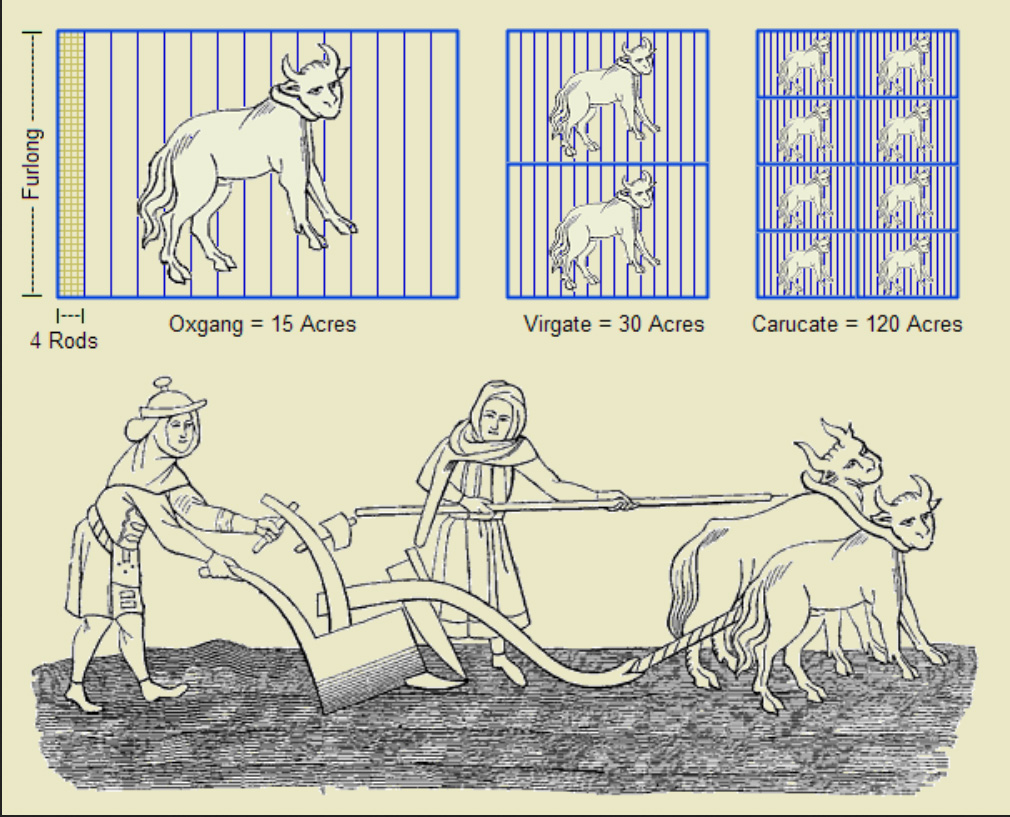
According to The Acts of Parliaments of Scotland. Volume 1., 1124 - 1322 AD, an Oxgang was 13-Acres (79633.125 sq Yards). There were also larger Oxgangs ... 15 to 20 acres.
VIRGATE
Considered to be 30 Acres.
CARUCATE
Considered to be 120 Acres.
.DECIPHERING SOME ELL RODS.
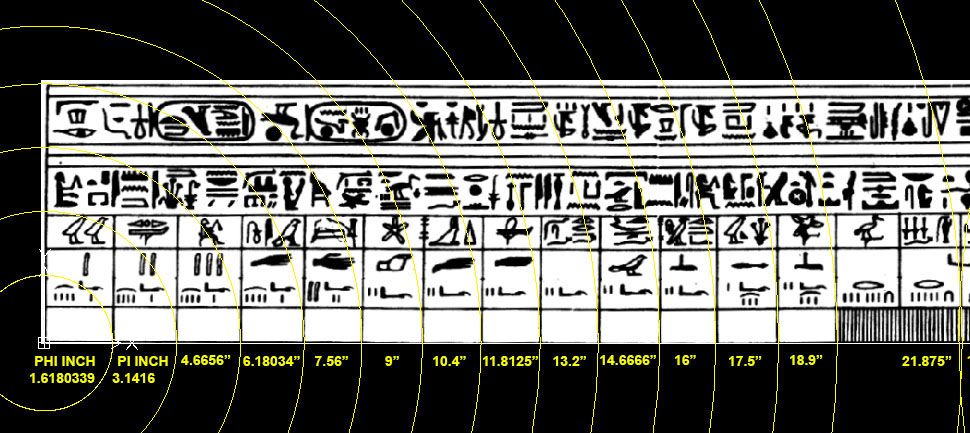
Just as the irregular segments of the Egyptian Royal Cubit encode special numbers, starting from the left end lower corner and measuring inwards, the various Ell rods do the same.
Some Ell rods have regular divisions and others, like several below, are providing numerical codes for various kinds of calculations ... (i.e.) ... the size of the Earth and its divisions, lunar cycles, the Precession of the Equinoxes, lunisolar Sabbatical Calendar periods within the 6804-day Lunar Nutation cycle, etc.
The 3 main Egyptian Royal Cubits were marked out in increments that were of different lengths and, therefore, could never be used by builders to construct buildings. They were only ever repositories of special numbers to be extracted by proper measurement rules set out in inches with exact divisions.
Many of the Ell rods found all over Continental Europe and the British Isles are solely mnemonic devices, where one measures from an end to a marked division to extract a code-bearing number. The number, once known, is placed into a number string (a mathematical progression) and the higher values are generated. Each of the special values will then identify the duration of a particular astronomical cycle, division of the Earth, etc.
The overall length of certain Ell rods and regular divisions thereupon do qualify them as measurement rules, but most seem to have been static calculators and memory devices

'This square, tapering wooden rule has a brass tip around the narrow end. Three sides are finely carved with fruit and vines, possibly oranges and pineapples. The fourth side is marked with inlaid brass dots: ANNO IIV DB 1757 NAVW. Inlaid brass bars provide measuring marks that are 1, 3.8, 6, 10.2, 18.7, 26, and 53 cm from the wide end. The spacing of the marks is similar to those on 318246. The overall length of the rule is 70 cm (27-1/2"), which is close to the usual length for a Flemish ell (68.6 cm, 27"). Reference: Herbert Arthur Klein, The Science of Measurement: A Historical Survey (New York: Simon & Schuster, 1974), 57.'
The segments or divisions of this Flemish Ell rod have been measured from the head or large end in centimetres, which will now be converted to inches to extract the intended codes:
1cm
.39375"... (to a tolerance of 0.000049" increase), .7875, 1.18125, 1.575, 1.96875, 2.3625 ... 3.15, 3.54375 ... 4.725 ... 590625, 6.3 ... 7.0875 ... 9.45 ... 12.6 ... 14.175 ... 17.7 1875 ... 18.9 ... 19.6875 ... 25.2 ... 28.35 ... 29.53125 ... 118.125 ... 354.375 ... 378 ... 472.5 ... 504 ... 567 ... 590.625 ... 630 ... 708.75 ... 756 ... 850.5 ... 1512 ... 1701 ... 2268 ... 3024 ... 3402 ... 5130 ... 6048 ... 6804 ... 362880 ... 12441.6 ... 24883.2 ... 130636800.
The string generated by .39375" (the intended increment of this division), delivers up all the essential pyramid-related values for calculating the equatorial size of the Earth (@ 24883.2 Greek-miles) , the 6804-day Lunar Nutation cycle (6804-days), the lunar month (29.53125-days) and lunar year durations in days, the ancient Beqa gold standard (19.6875-grains) adopted by the Egyptians,Romans & Greeks, the 3-4-5 triangle (354.375', 472.5', 590.625') built into the dimensions and angles of the Khafre Pyramid (a pyramid of the moon), etc.
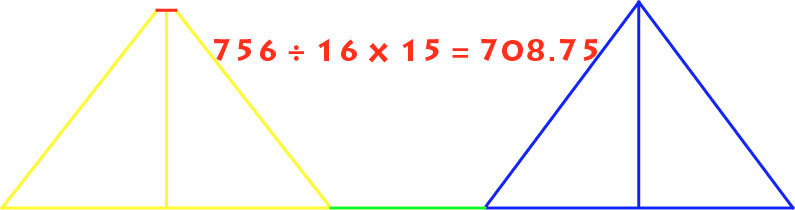
The Khafre Pyramid is 15/16th the length of the Great Pyramid or 756'' ÷ 16 X 15 =708.75'. The Khafre Pyramid (a pyramid of the moon is also built as two back-to-back 3-4-5 triangles.
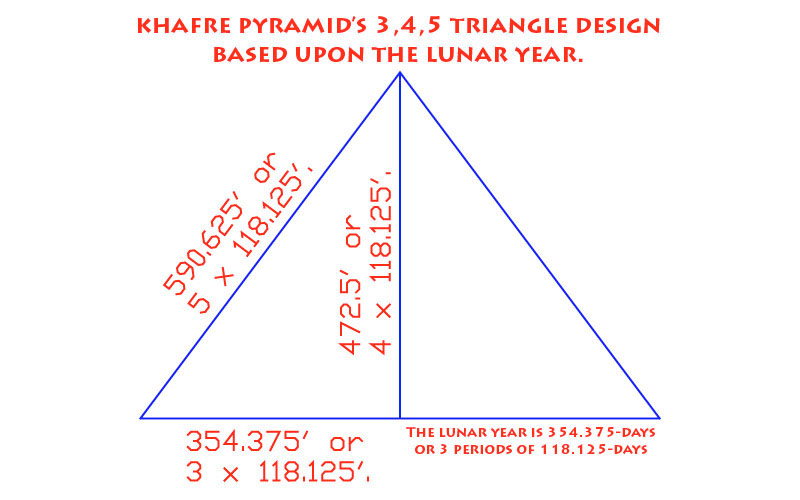
The 3,4,5 triangle dimensions built into the Khafre Pyramid, using lunar cycle numbers. The value for creating the 3-4-5 triangle is 118.125-days (4-lunar months of 29.53125-days ... or 29 & 17/32nds).
3.8cm
1.5" ... (to a tolerance of 0.00394" increase) 3, 4.5, 6, 7.5, 9, 10.5, 12, 13.5, 15, 16.5, 18, 19.5, 21, 22.5, 24, 25.5, 27, 28.5, 30, etc.
There are no real surprises here, just increases of 1.5".
6cm
2.3625"... (to a tolerance of 0.0003" increase), 4.725, 7.0875, 9.45, 11.8125, 14.175, 16.5375, 18.9, 21.2625, 23.625 ... 28.35 ... 35.4375 ... 37.8 ... 42.525 ... 354.375 ... 472.5 ... 567, 590.625 ... 708.75 ... 756 ... 850.5 ... 1134 ... 1152 ...1701 ... 2835 ...3024 ... 3402 ... 5130 ...6048 ... 6804 ... 362880 ... 130636800.
This is a very dynamic string that homes in on the Khafre Pyramid lunar-related dimensions, the Great Pyramid navigational dimensions for the equatorial circumference of the Earth, minutes-degrees of equatorial arc and divisions within the Lunar Nutation cycle.
10.2cm
4"... (to a tolerance of 0.015748" decrease), 8, 12, 16, 20, 24, 28, 32, 36, 40, 44, 48, 52, 56, 60, 64 ... etc.
No great surprises here ... just a means of preserving a string in 4" increments.
18.7cm
7.3828125" ... (7 & 49/128ths) 14.765625, 22.1484275, 29.53125 ...118.125... 177.1875 ... 354.375 ... 472.5 ... 590.625.
This string starts out providing the duration, in days, of a lunar week, then goes on to identify a lunar month, half lunar year, lunar year, 16 lunar months and 20 lunar months, etc.
26cm
10.24" ... (to a tolerance of 0.0206075" increase) 20.48, 30.72, 40.96, 51.2, 61.44, 71.68 ... 92.16, 102.4 ... 153.6 ... 256 ... 358.4 ... 460.8 ... 512 ... 716.8 ...768 ... 829.44 ... 9216 ... 10137.6 ... 24883.2 ...131383296
This string is particularly dynamic. There were 3 main navigational systems in antiquity based upon 3 close-proximity concepts of the equatorial circumference of the Earth. Each of these was encoded into the length of a slightly different Egyptian Royal Cubit. These were:
1. 20.61818182" (an example is in the Turin Museum). This one, multiplied by 1200 (and the total read as miles of 5280') = 130636800' or 24883.2 Greek miles of 5250' or 12 X 12 X 12 X 12 X 1.2 Greek miles. Under this much used system, 1-second of equatorial arc was 100.8', 1-minute of arc was 6048' and 1-degree of arc was 362880'.
2. 20.625" (found by Sir William Flinders Petrie). This one, multiplied by 1200 (and the total read as miles of 5280') = 130680000' or 24750 English miles of 5280' ... or 22000 Scottish miles of 5940'. Under this much used system, 1-second of arc was 100.833333', 1-minute of arc was 36300' and 1-degree of arc was 363000'.
3. 20.736" (found in the lengths of the paving stones at the base of the Great Pyramid ... 1.728', as well as Petrie's measurement of the length of the coffer in the Queen's Chamber ... 5 X 20.736") X 1200 = 24883.2 English miles of 5280' or 22118.4 Scottish miles of 5940'. This 3rd system was for determining the TRUE size of the Earth, but seems to have been little-used for navigation at sea. Its main purpose was probably to have factorable divisions that drew as close as possible to the Earth's TRUE equatorial circumference @ 24883.2-miles of 5280' each or 131383296'. This reading was only 18.2-miles short of the TRUE circumference. Under this reading 1-second of equatorial arc was 101.376', 1-minute of arc was 6082.56' and 1-degree of arc was 364953.6'.
53cm
20.82857143 ... (to a tolerance of 0.3752857" decrease). This string would produce 7ths values for the Roman navigational system, based upon a foot of 11.664", (20.82857143" X 56 would be 1166.4"). Another possibility might be that the museum assayer has slightly "rounded" the measurement to 53cm and the original increment was supposed to represent 20.736" (52.66944 cm or 0.33056 cm decrease)?
68.6cm
27" ... (to a tolerance of 0.00787" decrease), 54, 81, 108, 135, 162, 189, 216, 243, 270, 297, 324 ... 378, 405, 432 ... 486 ... 567 ... 594 ... 648, 675 ... 729 ... 756 ... 864... 945, 972 ... 1134 ... 1188 ... 1215 ... 1296 ... 1458 ... 1485 ... 1512 ...1701... 1728... 1782 ... 1944 ... 2160 ... 2268 ... 2376 ... 2592 ... 2835 ... 2916 ... 2970 ... 3024 ... 3402 ... 3456 ... 3888 ... 4725 ... 5103 ... 5184 ... 5832 ... 5940 ... 6048 ... 6534 ... 6804 ... 362880 ... 12441.6 ... 24883.2 ... 130636800.
This is a power-packed string that could be used for gaining an understanding the equatorial circumference of the Earth, according to the Great Pyramid's literal base dimensions, as well as its slope angle and height. It divulges significant divisions of the Earth, as well as divisions of both the Precession of the Equinoxes and the Lunar Nutation cycle. It also gives dimensions of the Khafre Pyramid, increments of the Roman Pace length and honorable mention of the Scottish mile, etc.
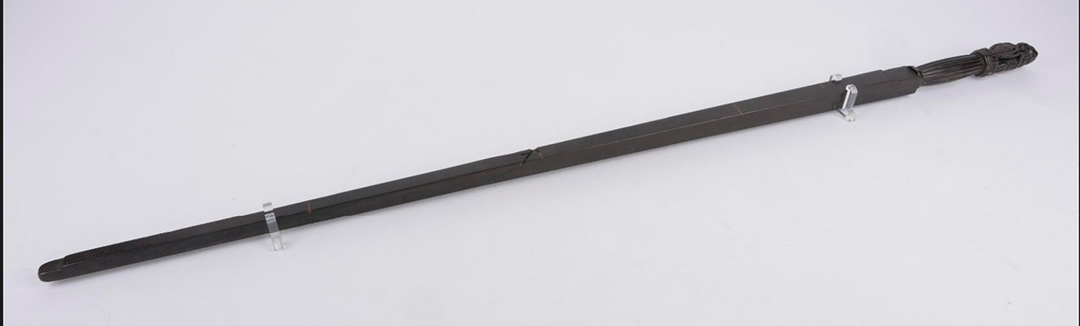
Flemish Ell Rod in ebony with inlaid divisions and the handle carved in the form of a seated lion holding up a shield, 17th century. Length overall 33".
The overall length of 33" is a significant code and a mathematical string generated from it would provide all of the essential values for navigation using the 5280' English mile or the 5940' Scottish mile.
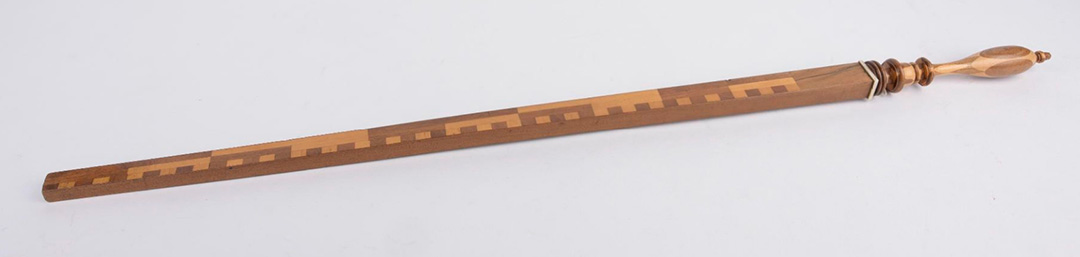
Polished mahogany German Ell rod as used by master-tailors early 19th century (1816-1820 AD). No incremental values have been provided for analysis, but the divisions are very nicely laid out.
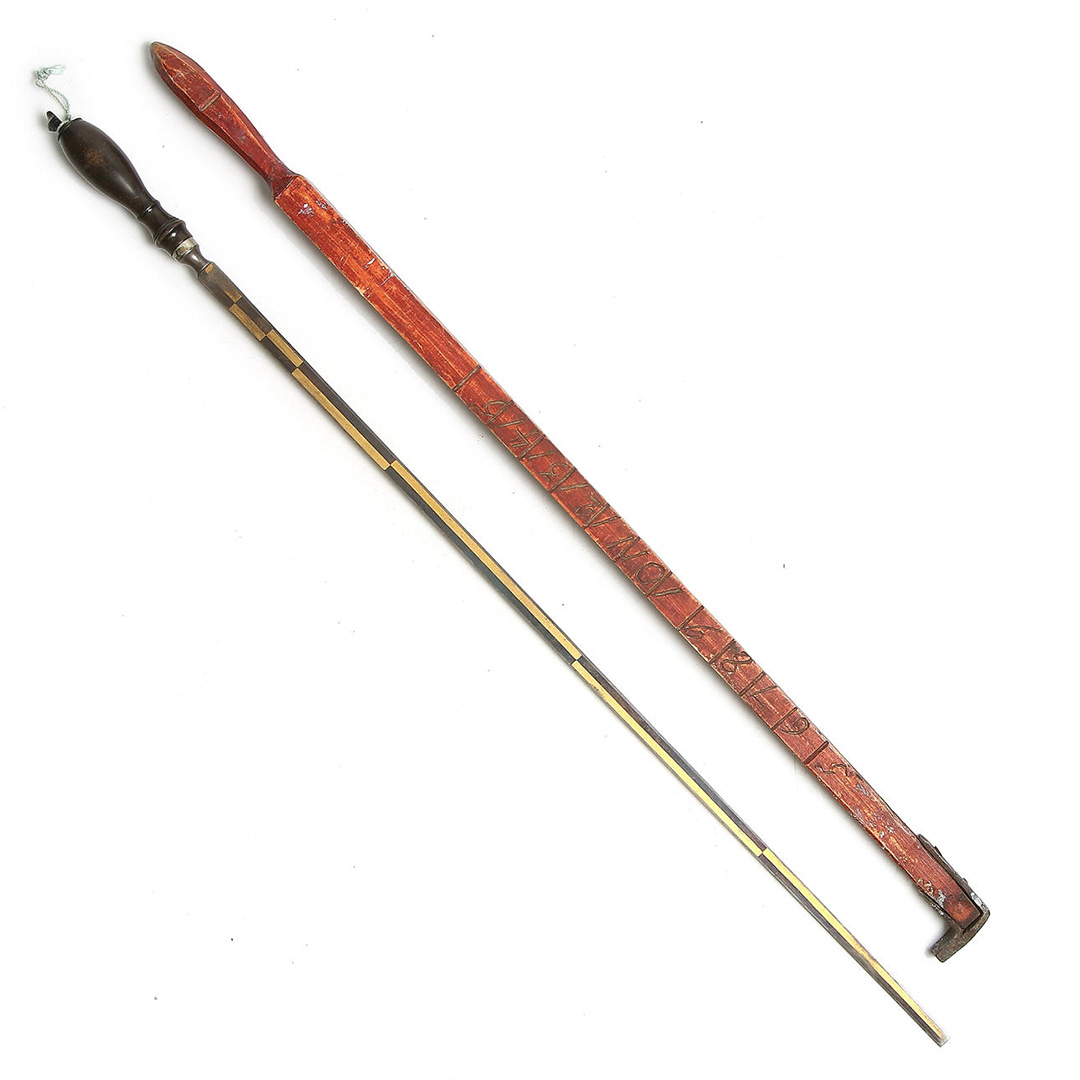
Described as: 'Cubit with guilded decorations. Length approximately 72 cm, alongside an Ell of 66.5 cm'.
The longer, thinner Ell is 28.35" in length. The overall length carries the perimeter code of the Khafre Pyramid @ 2835' for a full circumnavigation (708.75'per side).
The heavier Ell, with the end demarcation jaw is 26.25" to a shortfall tolerance of 1/15th of an inch on the estimated approximate length. If the 26.25" length holds true, then it's an increment in the Greek method of navigation (2625' is half of a Greek mile of 5250').
The heavier Ell has its divisions clearly marked along the length of the staff, but no measurements have been published concerning them. Perhaps we'll have to scale both Ells in AutoCAD to read the divisions.
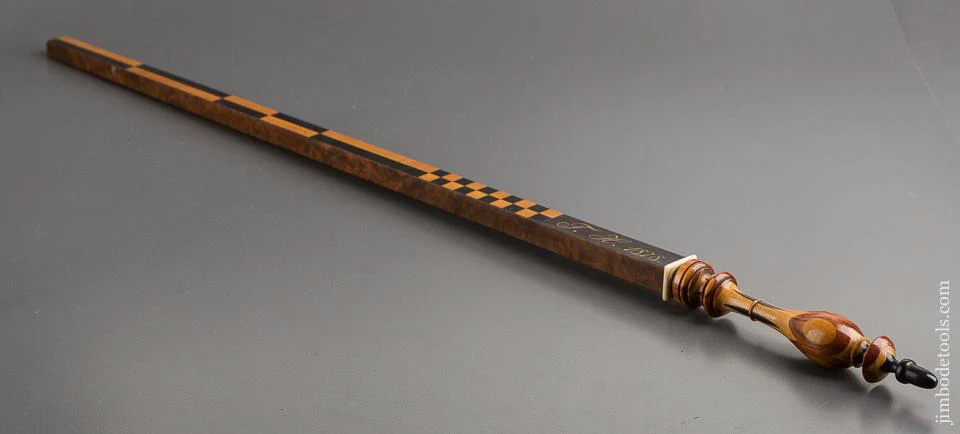
Yet another beautifully made Ell rod, with inlaid wood sections to show the divisions.
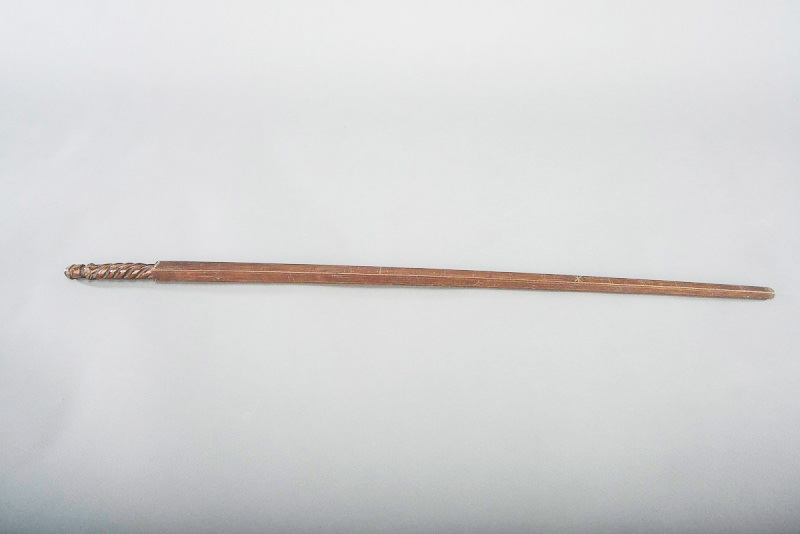
Dutch Ell made before 1820. Measurements supplied by the Smithsonian - National Museum of American History: https://americanhistory.si.edu/collections/object-groups/scale-rules/length-measures
'This wooden rectangular rule consists of a fluted handle with a carved head at the end and a tapered, ruled part. The rule is cracked between two nails below the handle on the side with the head's face. On the side with the back of the head, the rule is marked with straight lines that are 27.5, 38.5, 42.0, 49.7, 53.2, 56.9, 60.8, 64.5, and 68.1 cm from the base of the handle (or, 44.5, 33.5, 30.0, 22.3, 18.8, 15.1, 11.2, 7.5, and 3.9 cm from the tip of the rule). The mark at 49.7 cm is an asterisk rather than a plain line.'
27.5 cm.
10.8" (to a tolerance of 0.02677" decrease), 21.6, 32.4, 43.2, 54, 64.8, 75.6, 86.4, 97.2, 108, 1188.8, 129.6 ... 151.2, 162, 172.8 ... 194.4... 216 ...226.8 ... 237.6 ... 2592... 270 ... 291.6 ...302.4 ... 345.6 ... 378, 388.8 ... 453.6 ... 486 ... 518.4 ... 583.2, 594, 604.8, 680.4, 6912 ... 712.8 ... 745.2, 756 ... 777.6 ...907.2 ... 1036.8 ... 1134 ... 1166.4 ... 1188 .. 1209.6 ... 1306.8 ... 1382.4 ... 1458 ... 1512 ... 1555.2 ... 1782 ... 1890 ... 1900.8 ... 2073.6 ... 2227.5 ... 2268 ... 2332.8 ... 2700 ... 2851.2 ... 2970 ... 3024 ... 3110.4 ... 3402 ... 6048 ... 6804 ... 362880 ... 24883.2 ... 25920 ... 130636800.
Again, we have a power-packed string providing all the essential numbers for the equatorial circumference of the Earth under the Great Pyramids literal navigational assignment; the divisions of the Earth; the lunar Nutation cycle; the Precession of the Equinoxes, etc.
38.5cm
15.12" (to a tolerance of 0.03748" decrease), 30.24, 45.36, 60.48, 75.6, 90.72 ... 120.96, 136.08 ... 226.8 ... 272.16 ... 302.4 ... 378 ... 453.6 ... 544.32 ... 604.8 ... 680.4 ... 756 ... 1134 ... 1512 ... 2268 ... 3024 ... 6048 ... 6804 ... 362880 ... 24883.2 ... 130636800.
Again, a string primarily devoted to the navigational system encoded into the dimensions of the Great Pyramid, but also touching upon the Lunar Nutation cycle.
42cm
16.5" (to a tolerance of 0.0354" decrease), 33, 49.5, 66, 82.5, 99, 115.5, 132, 148.5, 165 ... 198 ... 247.5 ... 264 ... 297 ... 330 ... 363 ... 396, 412.5 ... 528 ...594 ... 660 ... 792 ... 825 ... 891 ... 1056 ... 1188 ... 1584 ... 1650 ... 1782 ... 1980 ... 2112 ... 3168 ... 3960 ... 4125 ... 5280 ... 5940 ... 6336 ... 6534 ... 7128 ... 7920 ... 9075 ... 36300 ... 24750 ... 130680000.
This string introduces the 5280' mile system of navigation, based upon the Great Pyramid's side length being symbolically increased from 756'' to 756.25". Under this reading, 1-minute of equatorial arc was read as 6050'and a degree of arc as 36300', for a full equatorial circumnavigation equating to 24750 English miles or 22000 Scottish miles. The string also identifies the diameter of the Earth as 7920-miles, dividing it into half (3960-miles); quarter (1980-miles) and eighth (990-miles ). It uses PI @ 3.125 to convert the diameter of the Earth to its circumference, thus 7920 X 3.125 = 24750-miles. The increments for this navigational system are:
7.92" (the Link); 5.5' (the Merchant Fathom); 16.5' (the Rod or Perch ... 3 Merchant Fathoms); 66' (the Chain); 660' (the Furlong or Furrowlong); 1760' (the Yard); 5280' (the English Mile); 5940' (the Scottish Mile); 16500' (the League ... 3.125- Miles).
49.7cm
19.6875" (to a tolerance of 0.12057" increase), 39.375, 59.0625, 78.75, 98.4375, 118.125, 137.8125, 1575, 177.1875, 196.875, 216.5625, 236.25, 255.9375, 275.625, 295.3125 ... 354.375.
This string is purely lunar and identifies fractions of the lunar month (29.53125-days = 1.96875-days X 15) & the lunar year (1.96875-days X 180). The sum of 1.96875-days would be 47.25-hours. Also the ancient Beqa weight for gold dust was 19.6875-grains. This was the gold standard for the Egyptians and was adopted by both the Greeks and Romans.
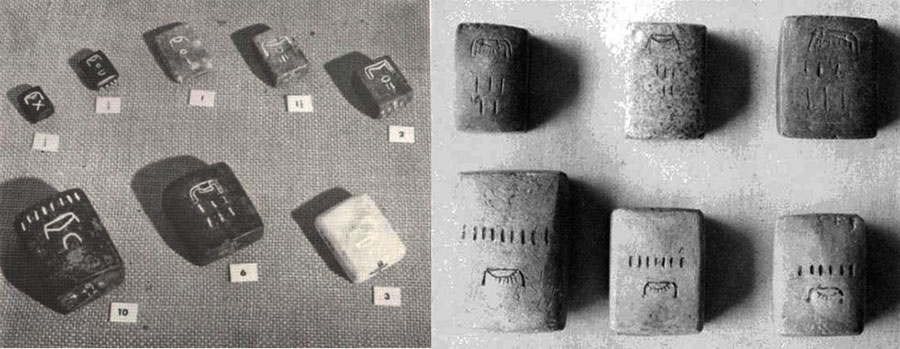
Left: The 8 stone weights shown are "Beqa weights", which were formerly used in the Nubian gold fields and inscribed with the "Nub" sign (the hieroglyph for gold). Right: These Egyptian "Beqa" weights are all marked to indicate that they were used for weighing quantities of gold dust, as each bears the "gold" insignia. This, seemingly, complete set was found at Khartoum.
The Egyptian Talent was 393750 grains and their Beqa Shekel was 196.875 grains. The Greek Attic Talent was 393750 grains also.
The Greek Commercial Mina was 9843.75 grains and their Didrachma or Tridrachm for gold dust were 196.875 grains. A yet smaller weight Drachma was 98.4375 grains (98 & 7/16ths).
By consequence, the Roman Uncia was 393.75 grains or 2 Egyptian Beqa @ 196.875 grains. They also had a Semuncia of 196.875 grains.
53.2cm
21" (to a tolerance of .05512" increase), 42, 63, 84, 105, 126, 147, 168, 189, 210, 231, 252, 273, 294, 315, 336, 378, 420, 504. 525, 567 ... 630 ... 672 ... 756 ... 945 ... 1008 ... 1050 ... 1134 ... 1260 ... 1344 ... 1512 ... 1575 ... 1680 ... 1701 ... 1890 ... 2016 ... 2268 ... 2520 ... 2625 ... 2835 ... 3024 ... 3402 ... 4032 ... 4536 ... 4725 ... 5103 ... 5250 ... 6048 ... 6300 ... 6720 ... 6804 ... 9072 ... 362880 ... 130636800.
Again we have another string that gives all the important numbers for the Great Pyramid and its system of encoding the equatorial size of the Earth,, as well as the Khafre Pyramid dimensions. It also homes in on standard lengths in ancient Greek metrology, including their foot (12.6"), Reed (10.5' ), short Stadium (525'), long Stadium (630') and Mile (5250'). The important periods within the 6804-day Lunar Nutation cycle are also identified (1/4th, 1/2, 3/4ths and the full duration.. There is mention of 1-minute of arc for the Great Pyramid, as well as 1-degree of arc, and the entire equatorial circumference of the Earth in feet of 12".
56.9cm
22.4" (to a tolerance of 0.00157" decrease), 44.8, 67.2, 89.6, 112, 134.4, 156.8, 179.2, 201.6, 224 ... 268.8, 291.2 ... 336, 358.4... 403.2 ... 537.6 ... 560 ... 604.8 ... 672 ... 7168 ... 1008 ... 1120 ... 1209.6 ... 1680 ... 2240
The above string contains numbers that ended up being adopted into the English weights system. The value 6720' (2240 -Yards of 3-feet each) became the Irish mile. In the above line-up, 6048' ( two circumnavigations of the Great Pyramid @ 756' per side) was 1-minute of arc for the equatorial circumference of the Earth. A second of arc was 100.8'.
The values mentioned here as 112 and 2240 may have a pedigree back to the ancient Egyptian Sep, Deben & Kite weights. A CWT or hundredweight was 112 lbs (pounds) of 16 ounces in a pound and 14 pounds in a Stone.
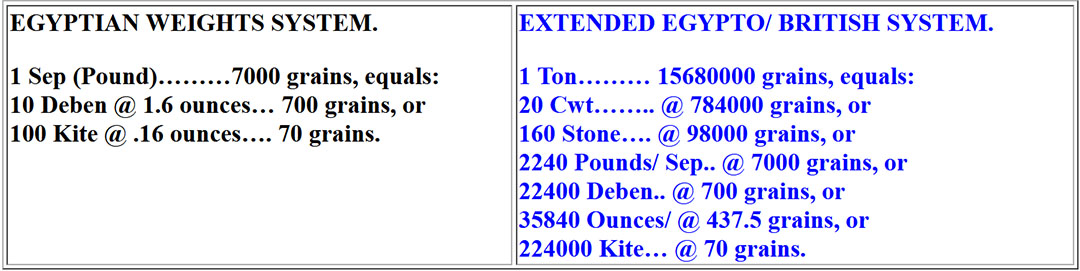
The ancient Egyptian Sep weight @7000-grains was the equivalent to the English Pound and the sub-divisions of the Deben & Kite also have a relationship to the Old English weights Standards of the 14th century.
60.8cm
24" (to a tolerance of 0.06299" increase), 48, 72, 96, 120, 144, 168, 192, 216, 240, 264, 288, 312, 336, 360, 384, ... 432 ... 504, 528 ... 576, 600 ... 648, 672 ... 768, 792 ... 864 ... 1008 ... 1056, 1080 ... 1152 ... 1296 ... 1320, 1344 ... 1440 ... 1536 ... 1584 ... 1728 ... 1944 ... 2016 ... 2304 ... 2520 ... 2592 ... 3024 ... 3888 ... 4032 ... 4536 ... 4608 ...5160, 5184 ...5280 ... 5832 ... 6048 ... 362880 ... 130636800.
The string provides a means for tracking divisions in the equatorial circumference of the Earth, based upon the Great Pyramid's dimensions. Also values for seconds, minutes and degrees of equatorial arc are present.
64.5cm
25.3125 (to a tolerance of 0.0812" decrease) 50.625, 75.9375, 101.25, 126.5625, 151.875, 177.1875, 202.5, 227.8125, 253.125, 278.4375, 303.75, 329.0625, 354.375.
These are simply 14 lunar bi-weeks, culminating in the value for the lunar year of 354.375-days. In hours, these are : 607.5, 1215, 1822.5, 2430, 3037.5, 3645, 4252.5, 4860, 5467.5, 6075, 6682.5, 7290, 7897.5, 8505.
Note: 850.5-days was 1/8th of the 6804-day Lunar Nutation cycle.
68.1cm
26.88" (to a tolerance of .06898" increase). In the 130636800' or 12 X 12 X 12 X 12 X 1.2 Greek-mile (5250') reading of the Earth's equatorial circumference there would be 19440 Irish miles of 6720' each. Note: 19440 ÷ 2 = 6720. This division on the Ell was possibly for mnemonic reference to the equatorial circumference of the Earth. There would be 1.28 X 5250' in an Irish mile or the Greek mile was 25/32nd of the Irish mile.
SIDE 2 ... measuring back from the tip pf the rod:
44.5cm
17.5 (to a tolerance of 0.01969" decrease) 35, 52.5, 70, 87.5, 105, 122.5, 140, 157.5, 175, 192.5, 210, 227.5, 245, 262.5, 280, 297.5, 315 ... 367.5 ... 420, 437.5 ... 472.5 ... 525 ... 560 ... 630 ... 700 ... 770, 787.5... 840 ... 945 ... 1050 ... 1120 ... 1260 ... 1312.5 ... 1417.5 ... 1680 ... 1890 ... 2240 ... 2520 ... 2625 ... 2835 ... 3780 ... 3937.5 ... 4725 ... 5040 ... 5250 ... 5670 ... 6300 ... 130636800.
This string contains many numbers that relate to the Greek-mile navigational system, with increments like 126, 105, 252, 525, 630 and 5250. It also contains numbers that went on to be used in "Weights" standards like 437.5 (the number of grains in an ounce), 14 (the number of pounds in a "Stone", 112 (the number of "Stones" in a CWT- Hundredweight) or 2240 (the number of pounds in a ton ... 20 CWT). Other numbers relate to the lunar codes of the Khafre Pyramid, like 393.75, 472.5 or 2835.
33.5cm
13.2" (to a tolerance of 0.01102" decrease), 26.4, 39.6, 52.8, 66, 79.2 ... 105.6, 118.8, 132.. 158.4 ... 198, 211.2... 264 ... 316.8, 330, 356.4, 396 ... 528 ... 594 ... 633.6 ... 660 ... 712.8 ... 792 ... 990 ... 1306.8 ... 1452 ... 1584 ... 1650 ... 1782 ... 1900.8 ... 1980 ... 2970 ... 3630 ... 3960 ... 4950 ... 5280 ... 5940 ... 6930 ... 16500 ... 7920 ... 247500 ... 130680000.
This string is all about the 5280' mile navigational system, which also included the 5940' Scottish mile in it's increments. The values for the Link (7.92"), Chain (66'), Furlong (660'), English Mile (5280'), League (16500') and Scottish Mile (5940) are included. The diameter of the Earth (7920-miles) is mentioned along with its divisions in miles 990, 1980, 2970, 3960, 4950, 5940, 6930, 7920-miles respectively. The string resolves to the equatorial size of the Earth under this navigational assignment @ 130680000' or 24750 English miles or 22000 Scottish miles.
30cm
11.8125" (to a tolerance of 0.0015" increase), 23.625, 35.4375, 47.25, 59.0625, 70.875 ... 94.5 ... 118.125 ... 141.75 ... 177.1875, 189 ... 283.5, 295.3125 ... 354.375 ... 378 ... 472.5 ... 567 ... 590.625 ... 708.75 ... 756 ... 850.5 ... 945 ... 1134 ... 1417.5 ... 1512 ... 1701 ... 1890 ... 2126.25 ... 2268 ... 2551.5 ... 2835 ... 2953.125 ... 3024 ... 3402 ... 5310 ... 6048 ... 6804 ... 362880 ... 130636800 .
This is a very important string that provides all of the essential lunar cyclic information for the lunar month (29.53125-days), year (345.375-days) or divisions thereof. It provides the value for the length of the Khafre Pyramid (a pyramid of the moon) @ 708.75', as well as the increases for 2, 3, and 4 sides (1417.5', 2126.25' & 2835', respectively). The divisions for the 6804-day Lunar Nutation cycle are also included as, 850.5, 1701, 3402, 5103 & 6804-days respectively.
An interesting number that occurs is 2551.5 and, in days this would equate to 7.2 lunar years of 354.375-days each.
This value was very important for reconciling the difference between the solar year (365.25-days) and the lunar lunar year (354.375-days or 11-days shorter). The ancient savants needed to have a lunisolar calendar system that tracked the periods of both the sun & moon on a daily basis, so devised parapegma plaques for this purpose. They could reconcile the two periods by tracking 7-solar years (2556.75-days) alongside 7.2 lunar-years (2551.5-days) ... a difference of 5.25-days. Therefore, they commenced their solar count, then began their lunar count (mistletoe culling from an Oak tree) 6 days later, so that the Sabbatical year could end on the same day 7 solar years (or 7.2 lunar years) later.
For the Calendar of Coligny parapegma bronze plaque of 128 sections (2 X 64) the savants used the number 1890 to calculate the periods for a lunar month as opposed to a solar month. Therefore 1890 ÷ 64 = 29.53125-days (lunar month), then 1890 ÷ 63 = 30-days (solar month). The value 1890 also appears in the above string.
The string also generates the numbers for Great Pyramid divisions, as well as minutes and degrees of equatorial arc (6048' and 362880'), leading to the value for the full equatorial circumference (130636800').
22.3cm
8.8" (to a tolerance of 0.020472" increase), 17.6, 26.4, 35.2, 44, 52.8 ... 70.4, 79.2, 88... 105.6 ... 132 ... 158.4 ... 211.2, 220 ... 264 ... 316.8... 352 ... 396 ... 528 ... 633.6 ... 660 ... 712.8 ... 792 ... 880 ... 950.4 ... 1056 ... 1100 ... 1760 ... 1900.8 ... 1980 ... 2200 ... 2640 ... 3960 ... 5280 ... 7920 ... 130680000.
This string is devoted almost exclusively to the equatorial circumference of the Earth and navigation by the mile of 5280'. It also generates values for the diameter of the Earth (7920-miles) and its divisions.
THE ELL @ 37.125"
18.8cm
7.425" (to a tolerance of .023425" increase), 14.85, 22.275, 29.7, 37.125, 44.55, 51.975, 59.4 ... 74.25 ... 89.1 ... 118.8 ... 148.5 ... 178.2, 185.625 ... 222.75 ... 237.6 ... 297 ... 356.4 ... 475.2 ... 594 ... 653.4 ... 71.28 ... 950.4 ... 1306.8 ... 1900.8 ... 2376 ... 2970 ... 5940 ... 3712.5 ... 55130.625 ... 17600000 ... 130680000.
The number 7.425" is 2 X 3.7125 and there was assuredly an Ell rod of 37.125" that was used to create the 5940' Scottish mile (1920 X 37.125") and the Scottish Acre (55130.625 square feet ... with a straight length of 55130.625' equating to 17820 X 37.125"). The string relates equally to the Scottish Mile, Scottish Acre and equatorial circumference of the Earth simultaneously.
THE ELL @ 37.08204" ... THE PHI-RECIPROCAL ELL.
However, a second reading of this marked position on the Dutch Ell being deciphered could also be interpreted to mean 7.416408"
7.416408" (to a tolerance of (0.014833" increase ), 14.832816, 22.249224, 29.665632, 37.08204"
This is the Ell based upon the PHI Reciprocal of 10" ÷ 1.6180339 = 6.18034"X 6 = 37.08204".
With this special Ell based upon PHI & the PHI Reciprocal it becomes possible to "Square the Circle" and achieve perfect capacity tubs for the marketplaces. It would also work for tailors cutting cloth to 3-dimensional sizes around the body, as opposed to 2-dimensional flat plain cutting.
Another consideration is in setting out large circles using the the Raip (rope) measure, which was considered to be the same length as a "Rod", (6 Ells or 222.75") (@ 37.125"each. However, the PHI Reciprocal equivalent would be 6 X 37.08204" = 222.49226" (18.54102').
Because it is based upon the PHI Reciprocal it will produce a circle of a precise square footage. Thus: 18.54102' x π × r2 = 1080 square feet.
Any variation to the rope's length, as long as it was in increments of 6.8034 inches or feet, could achieve a known, precise and sought after square-footage or cubic-footage result without computation difficulty.
15.1cm
5.94" (to a tolerance of 0.004882" decrease), 11.88, 17.82, 23.76, 29.7, 35.64, 41.58, 47.52, 53.46, 59.4, 65.34, 71.28 ... 95.04... 118.8 ... 130.68 ... 148.5 ... 178.2 ... 190.08 ... 237.6 ... 297 ... 5940 ... 130680000.
This string is devoted to navigation using the 5940 Scottish mile.
11.2cm
This string is devoted to navigation using the 5280' English mile
7.5cm
2.953125" (to a tolerance of 0.000365" increase), 5.90625, 8.859375, 11.8125, 14765626, 17.71875, 20.671875, 23.625, 26.578125, 29.53125 ... 35.4375,
This string is devoted to the 29.53125-day (29 & 17/32nds) lunar month, which is accurate to under a minute in time. The string goes on to identify the lunar year (354.375-days) as well as the duration of the Lunar Nutation Cycle (6804-days).
3.9cm
1.536 (to a tolerance of 0.00057" increase ), 1.536, 3.072, 4.608, 6.144, 7.68, 9.216 ... 13.824, 15.36 ... 23.04... 30.72 ... 38.4 ... 41.472 ... 46.08 ... 53.76 ... 69.12 ... 101.376 ... 115.2 ... 124.416 ... 138.24 ... 153.6 ... 192 ... 207.36 ... 2304 ... 248.832 ... 268.8 ... 307.2 ... 345.6 ... 384 ... 460.8 ... 537.6 ... 576 ... 311.04 ... 622.08 ... 12441.6 ... 15552 ... 18662.4... 217722.8 ... 24883.2.
This string is devoted to navigation using the number 24883.2-miles as the value for the equatorial circumference of the Earth.
49.7cm ... 'The mark at 49.7 cm is an asterisk rather than a plain line.'
It's a little uncertain what the asterix means, but 49.7cm converts in close proximity to either 19.6875 (to a tolerance of 0.03568" increase ... the Egyptian, Greek or Roman Beqa gold standard of 19.6875 grains ... a lunar code). It is also close to 19.44" (to a tolerance of 0.12693" decrease ... 194.4-miles would be 1/128th of the 24883.2-mile equatorial circumference).
ANOTHER DUTCH ELL.
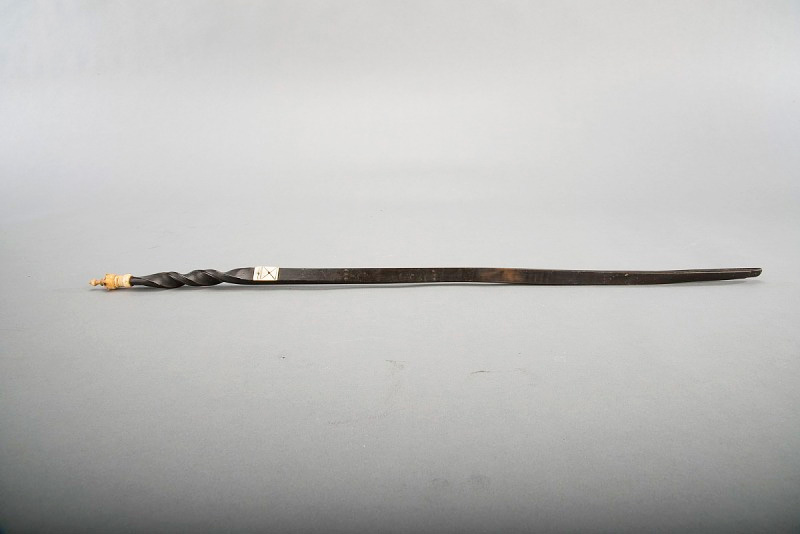
Dutch Ell made before 1820: Measurements supplied by the Smithsonian - National Museum of American History.
'This layered, curved wooden rule has a twisted handle with an ivory crown at the end. A piece of whalebone (2.4 X 1.5 cm) is carved with two horizontal lines and an "X" and is fastened to the rule just below the handle ... , The measuring part of the rule is 52 cm (20-1/2") long,there are no grooves marking off distances. Instead, horizontal rows of three nails are placed 5, 9.2, 17.8, and 35 cm from the base of the handle. A diagonal row of four nails is adjacent to the last horizontal row. One layer of wood has been removed from the tip of the rule'.
5cm
1.96875" (to a tolerance of 0.00025" decrease ), 3.9375, 5.90625, 7.875, 9.84375, 11.8125, 13.78125, 15.75, 17.71875, 19.6875, 21.65625, 23.625, 25.59375, 27.5625, 29.53125 .... 354.375 ... 6804.
This string relates to 15 divisions of the lunar month. The solar month was 30-days, thus these represent part-weeks within the solar month count. The lunar count extends through the lunar year (354.375-days) to the end of the 6804-day Lunar Nutation Cycle (230.4 lunar months).
9.2cm
3.6288" (to a tolerance of 0.006753" increase), 7.2576, 10.8864, 14.5152, 18.144, 21.7728, 25.4016, 29.0304, 32.6592, 36.288 ... 362880 ... 130636800.
This string relates to the value of 1-degree of equatorial arc (362880'X 360 = 130636800' or 24883.2 Greek miles for the equatorial circumference of the Earth).
17.8cm
7" (to a tolerance of 0.007874" increase), 14, 21, 18, 35, 42, 49, 56, 63, 70, 77, 84, 91, 98, 105, 112, 119, 126, 133, 140 ... 168, 175 ... 189 ... 210 ... 224 ... 252 ... 280 ... 315 ... 336 ... 350 ... 364 ... 378 ... 420 ... 504 ... 525 ... 567 ... 630 ... 672 ... 700 ... 756 ... 770 ... 875 ... 1008 ... 1050 ... 1120 ... 1134 ... 1260 ... 1512 ... 1575 ... 1680 ... 1701 ... 1890 ... 2016 ... 2240 ... 2520 ... 2625 ... 2688 ... 2800 ... 2835 ... 3024 ... 3402 ... 5250 ... 6048 ... 6804 ... 362880 ... 130636800.
And again, another string that relates to the Greek mile of 5250 feet and sub-divisions of it like the Greek foot, reed, short-stadium, long- stadium and the navigational increments that lead to identifying the number for the full equatorial circumference of the Earth.
In the string are the lunar numbers encoded into the dimensions of the Khafre Pyramid or divisions of the 6804-day Lunar Nutation cycle. Equally, one sees the values for minutes and degrees of arc encoded into the dimensions of the Great Pyramid or the numbers that became the divisions within the grain-weights systems of ancient Egyptian or latter European nations.
35cm
13.75" (to a tolerance of 0.0295" decrease), 27.5, 41.25, 55, 68.75, 82.5, 96.25, 110, 123.75, 137.5, 151.25, 165 ... 206.25, 220 ... 247.5 ... 302.5 ... 330 ... 371.25 ... 440 ... 495 ... 550 ... 605 ... 618.75 ... 660 ... 687.5 ... 756.25, 770 ... 880 ... 9075 ... 990 ... 1100 ... 1320 ... 1375 ... 1485 ... 1512.5 ... 1650 ... 1760 ... 1980 ... 2062.5 ... 2475 ... 2640 ... 2970 ... 3025 ... 3520 ... 3630 ... 3712.5 ... 4125 ... 4950 ... 5156.25 ... 5280 ... 5940 ... 6050 ... 7040 ... 7920 ... 27450 ...130680000.
This string relates directly by the navigational method that used the 5280' English mile and 5940' Scottish mile, leading to an equatorial circumference of the Earth of 130680000' (24750 English miles or 22000 Scottish miles).
The Egyptian Royal cubit that was for mnemonic reference to this equatorial circumference was 20.625" and the formula used for mnemonic recall was 20.625 X 1200 = 24750 ... (read as miles of 5280'). Included in the string are the values, in expanded numbers for the "Link" (7.92"), Merchant Fathom (5.5'), Chain (66'), Rod or Perch (16.5'), Furlong or Furrowlong (660'), English Mile (5280'), Scottish Mile (5940') & English League (16500').
The string also identifies the 3" elongation of the base length of the Great Pyramid to create this second navigational system ... from 756' to 756.25', making 1 perimeter circumnavigation of the pyramid's base go from 3025' to 3025'. Also 1-minute of equatorial arc moved from 6048' to 6050' under this second system of navigation that used the "11" family of numbers. Similarly, 1-degree of arc went from 362880' to 363000'.
The value for the diameter of the Earth (7920 English miles) is also generated, along with divisions thereof.
52cm ...'One layer of wood has been removed from the tip of the rule'.
20.61818182" (to a tolerance of 0.1458" increase). Originally, before tip damage, this overall length might have equaled the length of an Egyptian Royal cubit.
THE PERSIAN DRAH ... Measurements supplied by the Smithsonian - National Museum of American History
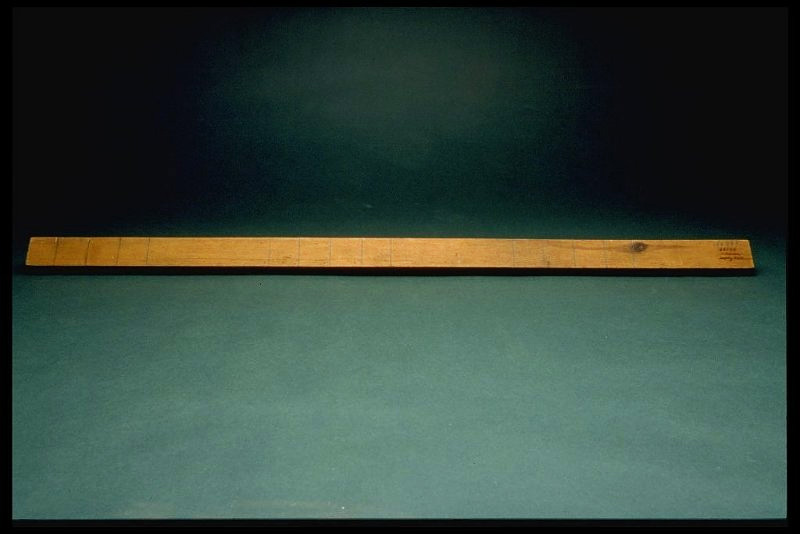
-
'This wooden rectangular rule is reported to be a Persian drah, or pic, a unit of length measure used in surveying and architecture. According to Russ Rowlett, the pic (or pik) was a traditional unit of distance in the Eastern Mediterranean and Near East. An "arm" unit, like the ell, the pic varied considerably. A typical value was about 28 inches (71 centimeters). This example is divided on one side in pencil and on the other with carved notches. The divisions on the pencil side are at: 3.0, 6.3, 9.6, 12.7, 25.3, 28.3, 31.6, 37.8, 50.3, 53.4, 56.6, 59.8, and 62.7 cm. The divisions on the notched side are at: 12.5, 15.7, 18.8, 21.8, 25.0, 37.9, 41.0, 44.2, 47.1, 50.2, 56.2, 59.2, and 62.3 cm.'
3cm
1.18125" (to a tolerance of 0.00015 decrease).
As stated above for a 30cm increment on a Dutch Ell;
11.18125, 23.625, 35.4375, 47.25, 59.0625, 70.875 ... 94.5 ... 118.125 ... 141.75 ... 177.1875, 189 ... 283.5, 295.3125 ... 354.375 ... 378 ... 472.5 ... 567 ... 590.625 ... 708.75 ... 756 ... 850.5 ... 945 ... 1134 ... 1417.5 ... 1512 ... 1701 ... 1890 ... 2126.25 ... 2268 ... 2551.5 ... 2835 ... 2953.125 ... 3024 ... 3402 ... 5310 ... 6048 ... 6804 ... 362880 ... 130636800 .
This is a very important string that provides all of the essential lunar cyclic information for the lunar month (29.53125-days), year (345.375-days) or divisions thereof. It provides the value for the length of the Khafre Pyramid (a pyramid of the moon) @ 708.75', as well as the increases for 2, 3, and 4 sides (1417.5', 2126.25' & 2835', respectively). The divisions for the 6804-day Lunar Nutation cycle are also included as, 850.5, 1701, 3402, 5103 & 6804-days respectively.
An interesting number that occurs is 2551.5 and, in days this would equate to 7.2 lunar years of 354.375-days each.
This value was very important for reconciling the difference between the solar year (365.25-days) and the lunar lunar year (354.375-days or 11-days shorter). The ancient savants needed to have a lunisolar calendar system that tracked the periods of both the sun & moon on a daily basis, so devised parapegma plaques for this purpose. They could reconcile the two periods by tracking 7-solar years (2556.75-days) alongside 7.2 lunar-years (2551.5-days) ... a difference of 5.25-days. Therefore, they commenced their solar count, then began their lunar count (mistletoe culling from an Oak tree) 6 days later, so that the Sabbatical year could end on the same day 7 solar years (or 7.2 lunar years) later.
For the Calendar of Coligny parapegma bronze plaque of 128 sections (2 X 64) the savants used the number 1890 to calculate the periods for a lunar month as opposed to a solar month. Therefore 1890 ÷ 64 = 29.53125-days (lunar month), then 1890 ÷ 63 = 30-days (solar month). The value 1890 also appears in the above string.
The string also generates the numbers for Great Pyramid divisions, as well as minutes and degrees of equatorial arc (6048' and 362880'), leading to the value for the full equatorial circumference (130636800').
6.3cm
2.48832"(to a tolerance of 0.00801" increase).
This, of course, is for mnemonic recall to identify the equatorial circumference of the Earth as 24883.2 miles (130636800').
Also, the 6.3cm value is an increase of 0.00531" of 2.4750 and could equally relate to the navigational system that used 24750 English miles of 5280' or 22000 Scottish miles of 5840' (130680000').
9.6cm
3.78" (to a tolerance of 0.00047" increase), 7.56, 11.34, 15.12, 18.9, 22.68, 26.46, 30.24, 34.02, 37.8 ... 45.36 ... 56.7, 60.48, 68.04, 71.82, 75.6 ... 90.72, 94.5 ... 113.4 ... 136.08 ... 151.2 ... 170.1... 189 ... 226.8 ... 272.16 ... 283.5 ... 302.4 ... 340.2 ... 362.88 ... 378 ... 453.6 ... 472.5 ... 510.3 ... 544.32 ... 567 ... 604.8 ... 680.4 ... 718.2 ... 756 ... 850.5 ... 907.2 ... 945 ... 1134 ... 1209.6 ... 1417.5 ... 1512 ... 1701 ... 1844.64 ... 1890 ... 2268 ... 2551.5 ... 2835 ... 3024 .. 3402 ... 6048 ... 6804 ... 362880 ... 130636800.
This string is primarily devoted to divisions within the Great Pyramid's dimensions that expand to provide the value for the equatorial circumference of the Earth @ 130636800'. The string also identifies the divisions, in days, for the 6804-day Lunar Nutation cycle: 850.5 (1/8th), 1701 (1/4th), 3402 (1/2), 5130 (3/4ths) and 6804 (the full duration).
The string also provides numbers that relate to the Moon ... 2835' (the perimeter value of the Khafre Pyramid), encoding the lunar year of 354.375-days X 8, or 2551.5 which, in days, would be 7.2 lunar years.
12.7cm
5" (to a tolerance of 0.0000). This was simply for producing increments in a 10-inch series.
25.3cm
10" (to a tolerance of 0.03937" increase). This was simply for measuring in 10" increments.
28.3cm
11.1375" (to a tolerance of 0.00423" decrease ) 22.275, 33.4125, 44.55, 55.6875, 66.825, 77.9625, 89.1, 100.2375, 111.375, 122.5125, 133.65, 144.7875, 155.925, 167.0625, 178.2 ... 222.75 ... 71280
There were two very close proximity versions of the Ell, one @ 37.08201" (the PHI Reciprocal ELL) & another one @ 37.125" ... for calculating the length of the Scottish mile as 320 falls @ 37.125" X 6 = 222.75" per fall X 320 = 71280" = 5940'.
1. There was obviously an Ell that measured 37.125" that was 1/1920th of the Scottish mile of 5940'.
2. In The Acts of Parliaments of Scotland, 1124 - 1322 AD) the Scottish Acre was calculated to be: 4 Roods; the Rood 40 Falls; The Fall shall hold 6 Ells. As with the Furlongs of the English Acre, each of the 4 Roods was 40 Falls and 1 Fall wide. Thus a Scottish Acre was 160 square Falls. (See: The Acts of the Parliaments of Scotland. Volume 1. A.D. MCXXIV–MCCCCXXII. London: Great Britain Record Commission Publications, 1814. Page 751.
3. The English Acre is 1-Furlong (660') X 1 Chain (66') = 43560'sq.
4. Creating the Scottish Acre also used the same method of a Scottish Furlong 742.5' X 1/10th of a Scottish Furlong (74.25') to create their Scottish Acre. Therefore, 742.5' X 74.25' = 55130.625' sq or 6125.625 sq. yards (yairds).
5. A Scottish Mile @ 5940' is 1.125 bigger than an English Mile of 5280', thus 5940 ÷ 5280 = 1.125 (1 & 1/8th).There would be 1920 X 37.125" in 5940'.
6. A Scottish Acre was1.265625 (1 & 17/64ths) larger than an English Acre, thus, 43560 X 1.265625 = 55130.625' sq. There would be 17820 X 37.125" in 55130.625'. Note: the "Y" Holes Circle at Stonehenge has a diameter of 178.2'.
7. Using the 37.125" Scottish Ell we have the formula in the Acts of Parliament, 1124 - 1322 AD and can calculate the size of the Scottish Fall, Rood and Acre.
Thus: 6 Ells @ 37.125" = 1 Fall = 222.75" or 18.5625' X 40 = 742.5' (1 Scottish Furlong). The Scottish Acre is 2970 X 18.5625' = 55130.625' sq or 6125.625 sq Yards (9 sq feet each).
Another way of calculating this is 37.125" X 8 = 297" ÷ 12 = 24.75' X 247.5' = 6125.625 X 9 = 55130.625'sq.
Note: Under the navigational method that used the 5280'' English-mile, as well as the 5940' Scottish-mile, the Earth was considered to be 24750-miles in equatorial circumference (130680000' of 12" each). There would be 42240000 Ells of 37.125" in this equatorial circumference reading.
31.6cm
12.4416" (to a tolerance of 0.00066" increase), 24.8832 ... in reference to the 12 X 12 X 12 X 12 X 1.2 mile reading of the Earth's circumference = 24883.2-miles.
37.8cm
14.85" (to a tolerance of 0.03189" decrease), 14.85, 29.7, 44.55, 59.4, 74.25, 89.1, 103.95, 118.8, 133.65, 148.5 ... 1782 ... 2227.5 ... 237.6 ... 2970 ... 4752 ... 5940 ... 6534 ... 7128 ... 8910 ... 9504 ... 11137.5 ... 13068 ... 19008 ... 22275 ... 23760 ... 29700 ... 37125 ... 47520 ... 59400 ... 65340 ... 71280 ... 74250 ... 130680000.
This string relates to the equatorial circumference of the Earth based upon the Ell of 37.125"and the Scottish Mile of 5940'.
50.3cm
19.8" (to a tolerance of 0.00315" decrease ), 39.6, 59.4, 79.2, 99, 118.8, 138.6, 158.4, 178.2, 198, 217.8, 237.6 ... 297, 316.8... 356.4 ... 396 ... 4752, 4950 ... 5940 ... 6336 ... 6534 ... 7128 ... 7920 ... 8910 ... 9504 ... 9900 ... 130680000.
This string relates to divisions leading up to the diameter of the Earth @ 7920 miles. It introduces the Scottish Mile of 5940 and extends to the 130680000' equatorial circumference of the Earth (24750-miles of 5280' or 22000 Scottish miles).
53.4cm
21" (to a tolerance of 0.02362" decrease), 42, 63, 84, 105, 126, 147, 168, 189, 210, 231, 252 ... 315, 336 ... 378 ... 420 ... 504, 525 ... 567 ... 630 ... 672 ... 756 ... 840 ... 945 ... 1008 ... 1050... 1134 ... 1260 ... 1344 ... 1512 ... 1575 ... 1680 ... 1701 ... 1890 ... 2016 ... 2100 ... 2268 ... 2520 ...2625 ... 2688 ... 2835 ... 3024 ... 3110.4 ... 3150 ... 3402 ... 3780 ... 4032 ... 4200 ... 4536 ... 4725 ... 5103 ... 6048 ... 6804 ... 362880 ... 130636800
In this line-up are 126 (the Greek foot was 12.6"); 168 (there are 168-hours in a week); 756 (the Great Pyramid is 756' long per side); 1008 (100.8' was 1-second of arc for the equatorial circumference of the world), 105 (the number of inches in a Hebrew reed measurement adopted by the Greeks); 1512, 2268, 3024 (2, 3 & 4 side lengths of the Great Pyramid ... an ancient Bureau of Standards for the world); 6048 (1-minute of arc for the equatorial circumference); 6804 (the number of days in the Lunar Nutation Cycle); 3110.4 (the number of miles in 1/8th of the equatorial circumference of the world); 13063680000 (the number of feet in the equatorial circumference of the world ... 12 X 12 X 12 X 12 X 1.2 Greek miles of 5250' each or 5000 Greek feet of 12.6" each per Greek mile ... 24883.2-miles.
The sum of 2016' in the above string is 1/3rd of 1-minute of equatorial arc, with 4032' being 2/3rds and 6048' being a full minute of arc.
56.6cm
22.275" (to a tolerance of 0.00846" decrease). Again, @ 222.75" this is in relation to the the 31.125" Scottish Ell and represents 6 Ells. There would be 3200 X 22.275" in the 5940' Scottish mile. The sum of 222.75" is 6 Scottish Ells and is called a Fall or Faw.
59.8cm
23.625" (to a tolerance of 0.08169" increase), 47.25, 70.875, 94.5, 118.125, 141.75, 165.375, 189, 212.625, 236.25, 259.875, 283.5, 307.125, 330.75, 354.375, 378 ... 472.5 ... 567, 590.625 ...708.75 ... 756 ... 850.5 ... 945 ... 1134 ... 1181.25 ... 1417.5 ... 1512 ... 1701 ... 1771.875 ... 1890 ... 2268 ... 25515 ... 2835 ... 2953.125 ... 3024 ... 3402 ... 3543.75 ... 3780 ... 4536 ... 4725 ... 5103 ... 5670 ... 5906.25 ... 6048 ... 6804 ... 362880 ... 130636800.
This string relates to the lunar codes of the Khafre Pyramid and the 3-4-5 triangle method of its construction. The value 118.125' (which in days would equate to 4 lunar months of 29.53125-days was used for the 3-4-5 triangle. The half-base length was 354.375' (note: 354.375 -days is 1 lunar year; the vertical height to the apex was 472.5'and the sloping side was 590.625'... forming a 3-4-5 triangle based upon 118.125' X 3, 4 & 5. The value 2835 represents 1 full perimeter circuit of the Khafre Pyramid.
The string also identifies the dimensions of the Great Pyramid, as well as 1-minute and 1-degree of equatorial arc, culminating in the full equatorial circumference. Also represented are 1/8th, 1/4th, 1/2, 3/4ths and the full duration of the 6804-day lunar Nutation Cycle.
62.7cm
24.75" (to a tolerance of 0.06496" increase), 49.5, 74.25, 99, 123.75, 148.5, 173.25, 198, 222.75, 247.5 ... 297... 371.25 ... 396 ... 495 ... 594, 618.75 ... 742.5, 792 ... 891... 990 ... 1188 ... 1485 ... 1584 ... 1782 ... 1980 ... 2376 ... 2475 ... 2970 ... 3168 ... 3360 ... 3564 ... 3960 ... 4752 ... 4950 ... 5940 ... 6187.5 ... 6336 ... 6534 ... 7128 ... 7425 ... 7920 ... 12375 ... 24750 ... 130680000.
This string relates directly to the 24750 English Mile (5280') equatorial circumference of the Earth. It includes the values for divisions in the diameter of the Earth, (1980, 3960, 5840 & 7920 respectively). It also identifies the 24750-mile equatorial circumference, as well as its value in feet, 130680000'.
THE REAR, NOTCHED SIDE OF THE PERSIAN DRAH ELL.
12.5cm
4.921875" (to a tolerance of 0.000615" decrease ), 9.84375, 14765625, 19.6875, 24.609375, 29.53125 (the lunar month).
This string is providing six divisions for the lunar month in increments of 118.125-hours. The string proceeds to the lunar year @ 354.375-days, as well as the divisions of the 6804-day Lunar Nutation Cycle. It will also resolve upon the value of 139636800, which is 26542080 X 4.921875.
15.7cm
6.18034" (to a tolerance of 0.0007624" decrease), 12.36068, 18.54102, 24.72136, 30.9017, 37.08204.
The 6.18034" length is based upon 10" ÷ 1.618034 (PHI) = the PHI Reciprocal. All of the ancient cousin civilisations used the 6.18034"increment in the creation of their round tubs with flat bottoms and code-bearing side lengths above the base floor to "square the circle" at the base and provide perfect, code-bearing cubic capacity. In the case of the ancient English bushel, that capacity had to be 2160 cubic inches, in remembrance or the sun spending 2160-years in each House of the Zodiac during the 25920-year Precession of the Equinoxes cycle. To achieve a perfect capacity for the bushel, the floor diameter of the tub had to have a diameter of 18.54102" (3 X 6.18034") = 270 square inches. The tub sides had to extend above the floor for 8" = 2160 cubic inches.
The Scottish PHI Ell was 37.08204" or 6 X 6.18034".
To make a bushel of perfect capacity, one would use half a Scottish Ell of 37.08204". Therefore, 18.54102" X π × r2 = 270 in. sq. X 8" (side height) = 2160 in. cu.
18.8cm
7.425" ... 14.85" (to a tolerance of 0.023425" increase), 29.7, 44.55, 59.4, 74.25, 89.1, 103.95, 118.8, 133.65, 148.5 ... 178.2 ... 222.75 ... 237.6 ... 297 ... 356.4, 371.25 ... 475.2 ... 594 ... 6534 ... 712.8 ... 742.5 ... 891 ... 950.4 ... 1113.75 ... 1188 ... 1306.8... 1485 ... 1782 ... 1900.8 ... 2227.5 ... 2376 ... 2970 ... 3564 ... 4752 ... 5940.
This string relates to the 5940' Scottish Mile, but also identifies the numbers from which the Scottish Ell @ 37.125 was derived, as well as the Scottish Fall, Raip, Furlong, Rood and Acre.
21.8cm
8.64" (to a tolerance of 0.57323" increase), 17.28, 25.92, 34.56, 43.2, 51.84, 60.48, 69.12, 77.76, 86.4, 95.04, 103.68 ... 120.96, 129.6, 138.24 ... 155.52 ... 172.8 ... 190.08 ... 207.36 ... 216 ... 233.28 ... 259.2 ... 302.4, 311.04 ... 345.6 ... 362.88 ... 388.8 ... 414.72 ... 432 ... 466.56 ... 475.2 ... 518.4 ... 544.32 ... 604.8 ... 622.08 ... 648 ... 691.2 ... 777.6 ... 829.44 ... 864 ... 907.2 ... 933.12 ... 950.4 ... 1036.8 ... 1080 ... 1166.4 ... 1209.6 ... 1244.16 ... 1296 ... 1382.4 ... 1512 ... 1555.2 ... 1728 ... 1866.24 ... 1900.8 ... 1944 ... 2073.6 ... 2160... 2376 ... 2488.32
This string is very important an generates a large quantity of very useful numbers for divisions of the equatorial circumference of the Earth like 1555.2-miles (1/16th) or 3110.4 (1/8th), etc. It provides the divisions of the 25920-year cycle of the Precession of the Equinoxes like : 5184-years (1/5th), 6480, (1/4th), 12960 (1/2) 19440 (3/4ths) and also how many years the sun spends in each House of the Zodiac (2160). It provides the value for how fast the Earth spins in a 24-hour period ... 24883.2 miles ÷ 24 hours = 1036.8 MPH ... the same number for the capacity of the Stirling Jug of Scotland @ 1/10th (103.68 cubic inches)..
25cm
9.84375" (to a tolerance of 0.00123" increase) 19.6875, 29.53125, 39.375, 49.21875, 59.0625, 68.90625, 78.75, 88.59375, 98.4375 ... 118.125 ... 157.5 ... 177.1875 ... 196.875 ... 236.25 ... 295.3125 ... 315 ... 354.375
This string provides divisions of the 29.53125-day lunar month and the 354.375-day lunar year.
37.9cm
14.85" to a tolerance of 0.07126" decrease), 29.7, 44.55, 59.4, 74.25, 89.1, 103.95, 118.8 ... 148.5 ... 178.2 ... 222.75, 2736 ... 297 ... 356.4 ... 371.25 ... 475.2 ... 594 ... 653.4 ... 7128 ... 742.5 ... 891 ... 950.4 ... 1113.75 ... 1188 ... 1306.8 ... 1485 ... 1782 ... 1900.8 ... 2227.5 ... 2376 ... 2970 ... 5940 ... 130680000.
This string identifies all the important numbers that went on to make the Scottish linear measurements of the Ell, (37.125"), the Fall (6 Ells or 222.75" or 18.5625'), Furlong (742.5'), Acre (742.5 X 74.25 = 55130.625 or 6125.625 square yards) and Mile (5940') .
41cm
16.180339" (to a tolerance of 0.038639" increase).
This is the value for PHI 1.6180339 X 10" = 16.180339". The PHI ratio was very important to ancient civilisations and was encoded into many structures. For example, on the Great Pyramid the square footage of all 4 faces, rising to an apex is in a ratio of 1.6180339 : 1 in comparison to the square footage of the base terrain that the pyramid covers.
44.2cm
17.28" (to a tolerance of 0.12157" decrease ), 34.56, 51.84, 69.12, 86.4, 103.68, 120.96, 138.24, 155.52, 172.8, 190.08, 207.36 ... 259.2 ... 311.04 ... 345.6 ... 362.88 ... 414.72, 432 ... 466.56 ... 518.4 ... 604.8, 622.08 ... 691.2 ... 777.6 ... 829.44 . 864 ... 933.12, 950.04 ... 1036.8 ... 1209.6 ... 1244.16 ... 1296 ... 1382.4 ... 1555.2 ... 1728 ... 1866.24 ... 1900.8 ... 2073.6 ... 2160 ... 2488.32 ... 2592 ... 3024 ... 6048 ... 362880 ... 24883.2 ... 130636800.
This is a dynamic string relating to the navigational method encoded into the base dimensions of the Great Pyramid. The paving stones at the base of the pyramid measure 1.728' (20.736") The largest Egyptian Royal Cubit was 20.736" and the formula for remembering the equatorial circumference of the Earth, encoded into that Mnemonic device was 20.736 X 1200 = 24883.2 (read as Miles).
The string includes divisions of the size of the Earth in miles, like 777.6 (1/32nd), 1555.2 (1/16th), 311.04 (1/8th), 6220.8, (1/4th ), 12441.6 (1/2), 24883.2 (full circumference). It also includes divisions in the 25920-year Precession of the Equinoxes, like : 2160-years (1/12th) 4320 (1/6th), 8640 (1/3rd) 25920 (the full duration of the cycle). There's also 1296-years (1/10th) or 5184 (1/5th), etc.
47.1cm
18.54102" (to a tolerance of 0.00229" decrease)
This is the half Ell formed by 3 divisions of the PHI Reciprocal reading of 6.18034" X 3 = 18.54102" . was this one (although drifted off the precise original value) that was mentioned in the Winchester Standard of 1696:
'And to the End all His Majesties Subjects may know the Content of the Winchester Bushel whereunto this Act refers, and that all Disputes and Differences about Measure may be prevented for the future, it is hereby declared that every round Bushel with a plain and even Bottom, being Eighteen Inches and a Halfe wide throughout, & Eight Inches deep, shall be esteemed a legal Winchester Bushel according to the Standard in His Majesty's Exchequer.' ... 1696.
It had drifted 0.04102" decrease through neglect and lack of vigilance by 1696, whereas groups like the earlier Druids had maintained the standards with precision, knowing the true origins of the numbers.
50.2cm
19.8" (to a tolerance of 0.03622" increase), 39.6, 59.4, 79.2, 99, 118.8 ... 158.4, 178.2, 198, 217.8, 237.6 ... 297, 316.8 ... 356.4 ... 396 ... 475.2, 495 ... 594 ... 633.6 ... 653.4 ... 712.8 ... 792 ... 891 ... 950.4 ... 990 ... 1188 ... 1306.8 ... 1485 ... 1584 ... 1782 ... 1900.8 ... 1980 ... 2376 ... 2475 ... 2970 ... 3564 ... 3960 ... 4752 ... 4950 ... 5940 ... 7920 ... 13068 ... 24750 ... 130680000.
This string relates to the 5280' English mile and 5940' Scottish mile and how they build to the full equatorial circumference of the Earth (24750 English miles or 22000 Scottish miles). A main focus is on the diameter of the Earth @ 7920 English miles and its divisions of 990-miles, 1980, 3960, 5940 and 7920-miles for the full diameter. Under this navigational system a simple form of PI was used to turn the 7920 diameter into a circumference: 7920 X 3.125 + 24750.
56.2cm
22" (to tolerance of 0.12598" decrease) 44, 66, 88, 110, 132 ... 176, 198, 220, 242, 264 ... 330, 352 ... 396 ... 440 ... 528, 550 ... 594 ... 660 ... 704 ... 770, 792 ... 880 ... 990 ... 1056 ... 1100 .. 1188 ... 1320 ... 1584 ... 1650 ... 1760 ... 1980 ... 2112 ... 2376 ... 2640 ... 2750 ... 2970 ... 3168 ... 3300 ... 3520 ... 3564 ... 3630 ... 3960 ... 4400 ... 4752 ... 4950 ... 5280 ... 7920 ... 130680000.
Again, this string relates to the 5280' English mile and the 5940' Scottish mile, as well as the 7920-mile diameter of the Earth and its divisions. The 130680000' circumference of the Earth value ÷ 5940 = 22000
59.2cm
23.328" (to a tolerance of 0.02091" increase) 46.656, 69.984, 93.312, 116.64, 139.968, 163.296, 186.624 ... 233.28 ... 466.56 ... 583.2 ... 653.184 ... 933.12 ... 1166.4 ... 1306.368 ... 1866.24 ... 2332.8 ... 130636800.
There is a post marker on the Avenue at Stonehenge that sits 233.28' from site centre, providing a circle diameter across the site of 466.56'. This diameter would be 1/280000ths of the equatorial circumference of the Earth under the 130636800' assignment encoded into the base perimeter lengths of the Great Pyramid of Egypt.
The Scandinavians adopted the length of 23.328" as their Rydaholmsalm measurement and 23.328" is 1.944'. The sum of 194.4-miles would equate to 1/128th of 24883.2-miles.
In the string is seen 1166.4 and one of the general Roman foot reading is accepted as 11.664". However, for convenience in measuring distances overland a foot of 11.66666 (11& 2/3rds) was used. Volumes based upon 11.664 or larger expressions of the same occur in the Weights, Measures or Volumes standards of many cousin nations. In the above line-up the numbers 466.56 & 933.12 are generated and the ancient Babylonians/ Sumerians used these values in their grain-weight standards. If the 933120 grain weight of a Babylonian Heavy talent was considered a distance, then 933120 ÷ 11.664 would equal 80000.
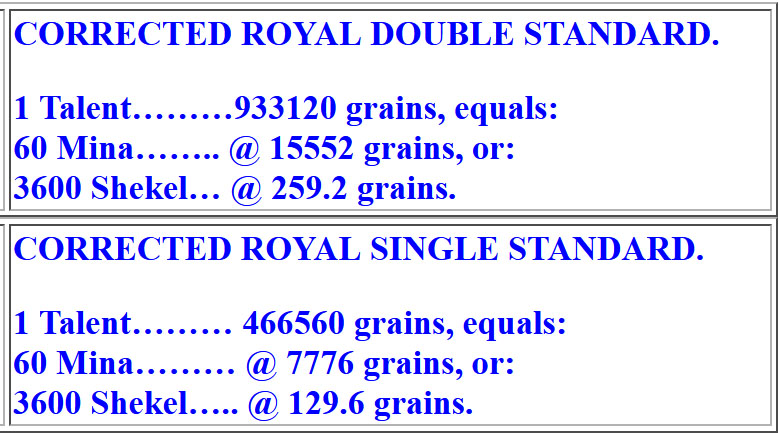
If the 933120 grain weight of a Babylonian Heavy talent was considered a distance, then 933120 ÷ 11.664 (the Roman foot) would equal 80,000. Also, 933120 ÷ 23.328 (the Swedish Rydaholmsalm & 2 Roman feet) = 40,000.
62.3cm
24.5" (to a tolerance of 0.02756" decrease), 49. This is of course simply 7 X 7 and does generate some useful values in a string, but one would think 24.75 would be a better choice ... (62.865cm) for the overall length of this Persian Drah Ell.
ANOTHER PERSIAN DRAH
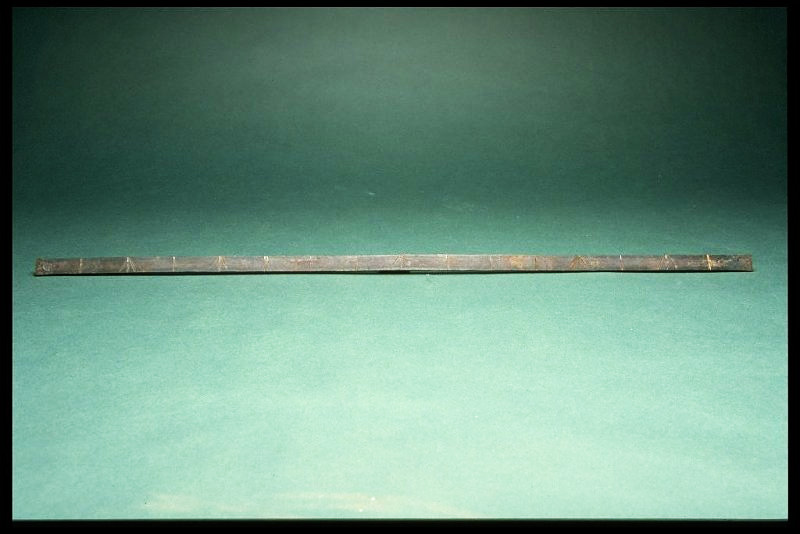
Persian Drah ... 19th century: Measurements supplied by the Smithsonian - National Museum of American History.
'This wooden rectangular rule is reported to be a Persian drah, or pic, and said to have been used for measuring dry goods. It is divided on two sides by roughly cut arrows and vertical lines. One side has Persian characters inside circles at both ends. On that side, the divisions are at: 4.5, 8.8*, 13.2, 17.4*, 21.5, 25.9, 30.0, 34.3*, 38.5, 42.7, 47.1, 51.2*, 55.5, 59.7*, and 64.1 cm. Divisions with an * are marked with an arrow rather than a line on the rule. These divisions are spaced apart 1 centimeter further than the divisions on another Persian drah, 1979.0991.01. On the other side, all of the divisions are vertical lines, at: 11.7, 23.0, 34.2, 45.5, and 57.0 cm.'
4.5cm
1.771875" (to a tolerance of 0.000225" increase) 3.54375, 5.315625, 7.0875, 8.859375, 10.63125, 12.403125, 14.175 ... 17.71875 ... 28.35 ... 35.4375 ... 56.7 ... 70.875 ... 85.05 ... 113.4 ... 141.75 ... 170.1 ... 177.1875 ... 226.8 ... 255.15 ... 283.5 ... 340.2 ... 354.375 ... 425.25 ... 453.6 ... 510.3 ... 567 ... 680.4 ... 708.75 ... 850.5 ... 1701 ... 3402 ...5103 ... 6804 ... 130636800.
This string is devoted to divisions within the lunar year of 354.375-days. It also identifies the length (708.75') of the Khafre Pyramid (a pyramid of the moon), as well as its perimeter length of all 4-sides (2835'), which, in days would be 8 lunar years or 96 lunar months @ 29.53125-days each.
The string goes on to identify the divisions of the 6804-day Lunar Nutation Cycle as 850.5-days (1/8th), 1701 (1/4th), 3402 (1/2), 5103 (3/4ths), and 6804 (the full duration). It then resolves on the value for the equatorial circumference of the Earth (130636800').
8.8cm
3.456" (to a tolerance of 0.00857" decrease), 6.92, 10.368, 13.824, 17.28, 20.736... 31.104, 34.56 ... 41.472... 51.84 ... 62.208... 69.12 ... 82.944, 86.4 ... 93.312 ... 103.68 ... 120.96, 124.416 ... 138.24 ... 155.52 ... 172.8 ... 186.664 ... 190.8 ... 207.36 ... 248.832 ... 259.2 ... 311.04 ... 345.6 ... 362.88 ... 414.72 ... 432 ... 466.56 ... 518.4 ... 604.8 ... 622.08 ... 653.184 ... 691.2 ... 777.6 ... 829.44... 864 ... 933.12 ... 950.4 ... 1036.8 ... 1209.6 ... 1244.16 ... 1296 ... 1306.368 ... 1382.4 ... 1555.2 ... 1728 ... 1866.24 ... 1900.8 ... 2073.6 ... 2160 ... 2332.8 ... 2488.32 ... 2592 ... 2851.2 ... 3024 ... 6048 ... 12441.6 ... 24883.2 ... 25920 ... 326880 ... 130636800.
This is a very dynamic string that relates directly to how the Great Pyramid's dimensions expand to clearly identify the divisions of the Earth, 12441.6-miles (1/2), 6220.8 (1/4th), 3110.4 (1/8th), 1555.2 (1/16th), 777.6 (1/32nd), etc. The string resolves to 130636800'of equatorial circumference or 24883.2-miles. one of the values that features prominently is 1036.8, which in large measure, had caused this article to be written due to the 103.68 cubic inch capacity of the Stirling Jug of Scotland. Interestingly, 1/24th division of the Earth under this navigational assignment is 1036.8-miles. Therefore, if we with to compute how fast the Earth spins it's 1036.8 MPH.
One of the 3 variations on the Jerusalem (Hebrew) Cab volumes of 3000-years ago, before the Hebrews were annihilated or enslaved and their population replaced by Babylonians, was 103.68 cubic inches, the same as the Stirling Jug of Scotland.
The string also identifies some divisions within the Precession of the Equinoxes cycle (25920-years).
13.2cm
5.184" (to a tolerance of 0.01285" decrease ), 10.368, 15.552, 20.736, 25.92, 31.104, 36.288, 41.472, 46.656, 51.84 ... 62.208 ... 77.76, 82.944 ... 93.312 ... 103.68 ... 124.416, 1296 ... 155.52 ... 186.624 ... 207.36 ... 233.28 ... 248.832 ... 259.2 ... 285.12 ... 311.04 ... 362.88 ... 388.8 ... 414.72 ... 466.56 ... 518.4 ... 544.32 ... 622.08 ... 648, 653.184 ... 777.6 ... 829.44 ... 907.2 ... 933.12 ... 1036.8 ... 1166.4 ... 1244.16 ... 1296 ... 1306.368 ... 12441.6 ... 24883.2 ... 25920 ... 362880 ... 130636800.
17.4cm
6.875 (to a tolerance of 0.024606" increase). 13.75, 20.625, 27.5, 34.375, 41.25, 48.125, 55, 61.875, 68.75, 75.625, 82.5, 89.375, 96.25, 103.125, 110 ... 123.75 ... 137.5 ... 151.25 165, 171.875 ... 185.625 ... 206.25 ... 220, 226.875, 233.75 ... 247.5 ... 275 ... 302.5 ... 330 ... 343.75 ... 371.25 ... 412.5 ... 440 ... 453.75 ... 495 ... 515.625 ... 550 ... 605 ... 618.75 ... 653.125, 660 ... 687.5 ... 742.5 ... 756.25 ... 770 ... 825 ... 880 ... 907.5 ... 990 ... 1100 ... 1320 ... 1375 ...1485 ... 1512.5 ... 1650 ... 1711.875 ... 1760 ... 1980 ... 2062.5 ... 2200 ... 2227.5 ... 2268.75 ... 2475 ... 2640 ...2750 ... 2970 ... 3025 ... 3300 ... 352 ... 3630 ... 3960 ... 6050 ... 7920 ... 22000 ...24750 ... 363000 ... 130680000.
This very important string contains all of the essential numbers for worldwide navigation using the 5280' mile or the 5940' mile. It is based upon one side length of the Great Pyramid being symbolically elongated from 756' to 756.25', thus 1minute of equatorial arc jumps from 6848' to 6050'; 1-degree of arc jumps from 362880' to 363000'; the equatorial circumference of the Earth jumps from 130636800' to 130680000'... 24883.2 shorter Greek miles to 24750 larger English miles or 22000 Scottish miles of 5940' each. The number 68.75 also occurs and 68.75-miles of 5280' was 1-degree of equatorial arc under this navigational system
The string also provides divisions for the diameter of the Earth, 1980-miles, 3960-miles or the full diameter @ 7920-miles.
In the string the number 371.25 occurs and 37.125" was the length of a Scottish Ell that went on to determine the lengths of a Scottish Fall, Furlong, Rood, Acre or Mile.
21.5cm
8.505" (to a tolerance of 0.040433" increase), 17.01, 25.515, 34.02, 42.525, 51.03, 59.535, 68.04 ... 85.05 ... 136.08 ... 170.1 ... 255.15 ... 272.16 ... 340.2 ... 425.25 ... 510.3 ... 544.32 ... 680 .4 ... 850.5 ... 1360.8 ... 1701 ... 2551.5 ... 3402 ... 5103 ... 6804.
This string relates to the Lunar Nutation Cycle, where the Moon circles the Earth each 354.375-days and the Earth circles the Sun every 365.25-days . The dance of circling bodies continues like this for 6804-days through Summers, Autumns, Winters and Springs, until the the dance starts anew.
Due to the gravitational attraction the Moon has on our oceans and atmosphere, each stage of the dance produces similar, repeatable weather conditions. Anyone living for their three score & ten allocation of a lifetime will go through the cycle 3.75 times. Anyone recording local or regional weather conditions each day would know what to expect weather-wise with each repeat of the cycle and "soothsayers" could advise farmers or mariners, etc., regarding what to expect in the months ahead.
The number 2551.5- days is very important for calculation within the Lunisolar Sabbatical Calendar system, where 7.2 lunar years (25512-days) was daily tracked on a parapegma plaque, alongside 7 solar years (2556.75-days) to the end of the Sabbatical Year (the 7th solar year). At that point, the lunisolar count would begin anew, fresh and correct.
25.9cm
10.24" (to a tolerance of 0.04315" increase ), 20.48, 30.72, 40.96, 51.2, 61.44, 71.68, 81.92, 92.16, 102.4 ... 204.8 ... 460.8 ... etc
The true equatorial circumference of the Earth is 24901-miles, however the ancient savants needed a factorable number that could be easily divided downwards to miles, feet and inches. They devised various "miles" that would work well in various number families for systems of navigation. Those linear distances had to provide a divisible value in a 360° circle when multiplied by PI (3.14159) so factorable forms of PI had to be devised as well to suit a particular number family.
For the Greek mile of 5250' they used PI @ 22/7 = 3.142857143. Therefore: 5250' X 22/7ths = 16500' (1 English league or 3.125 English miles of 5280') or 550" per degree.
For the English League they used PI @ 1728/550ths . Therefore: 16500' X 1728/550ths = 51840 or 144' per degree of arc.
For a factorable number that drew as close as possible to the true equatorial circumference they devised 12 X 12 X 12 X 12 X 1.2 X 5280' = 131383296' = 24883.2 -miles for a 17.8-miles shortfall on 24901-miles.
Under this reading there were 22118.4 Scottish miles of 5940' in the equatorial circumference.
1-degree of equatorial arc in the 24883.2-mile (of 5280') circumference was 69.12-miles.
This could be broken down to 6 X 11.52 miles or 6.75 X 10.24 miles.
11.52 miles was 1/2160th of the circumference and 10.24 miles was 1/2430th.
30cm
11.8125" (to a tolerance of 0.0015" increase), 23.625, 35.4375, 47.25, 59.0625, 70.875 ... 94.5 ... 118.125 ... 141.75 ... 177.1875, 189 ... 283.5, 295.3125 ... 354.375 ... 378 ... 472.5 ... 567 ... 590.625 ... 708.75 ... 756 ... 850.5 ... 945 ... 1134 ... 1417.5 ... 1512 ... 1701 ... 1890 ... 2126.25 ... 2268 ... 2551.5 ... 2835 ... 2953.125 ... 3024 ... 3402 ... 5310 ... 6048 ... 6804 ... 362880 ... 130636800 .
This is a very important string that provides all of the essential lunar cyclic information for the lunar month (29.53125-days), year (345.375-days) or divisions thereof. It provides the value for the length of the Khafre Pyramid (a pyramid of the moon) @ 708.75', as well as the increases for 2, 3, and 4 sides (1417.5', 2126.25' & 2835', respectively). The divisions for the 6804-day Lunar Nutation cycle are also included as, 850.5, 1701, 3402, 5103 & 6804-days respectively.
An interesting number that occurs is 2551.5 and, in days this would equate to 7.2 lunar years of 354.375-days each.
This value was very important for reconciling the difference between the solar year (365.25-days) and the lunar lunar year (354.375-days or 11-days shorter). The ancient savants needed to have a lunisolar calendar system that tracked the periods of both the sun & moon on a daily basis, so devised parapegma plaques for this purpose. They could reconcile the two periods by tracking 7-solar years (2556.75-days) alongside 7.2 lunar-years (2551.5-days) ... a difference of 5.25-days. Therefore, they commenced their solar count, then began their lunar count (mistletoe culling from an Oak tree) 6 days later, so that the Sabbatical year could end on the same day 7 solar years (or 7.2 lunar years) later.
For the Calendar of Coligny parapegma bronze plaque of 128 sections (2 X 64) the savants used the number 1890 to calculate the periods for a lunar month as opposed to a solar month. Therefore 1890 ÷ 64 = 29.53125-days (lunar month), then 1890 ÷ 63 = 30-days (solar month). The value 1890 also appears in the above string.
The string also generates the numbers for Great Pyramid divisions, as well as minutes and degrees of equatorial arc (6048' and 362880'), leading to the value for the full equatorial circumference (130636800').
34.3cm
13.5" (to a tolerance of 0.00394" decrease), 27, 40.5, 54, 67.5, 81, 94.5, 108, 121.5, 135, 148.5, 175.5, 189, 202.5, 216, 229.5, 243, 256.5, 270, 283.5, 297 ... 324, 337.5 ...364.5, 378 ... 405, 418.5, 432 ... 472.5, 486 ... 540 ... 567 ... 594 ... 607.5 ... 648 ... 675 ... 729 ... 742.5 ... 756 ... 810 ... 850.5 ... 864 ... 891 ... 904.5 ... 945 ... 972 ... 1012.5 ... 1080 ... 1134, 1147.5 ... 1188 ... 1215 ... 1296 ... 1350 ... 1417.5 ... 1458 ... 1485 ... 1512 ... 1687.5, 1701 ... 1728 ... 1782 ... 1890 ... 1944 ... 2025 ... 2227.5 ... 2268 ... 2376 ... 2551.5 ... 2592 ... 2700 ... 2835 ... 2916 ... 2970 ... 3024 ... 5940 ... 6048 ... 6804 ... 25920 ... 362880 ... 130636800.
This string provides all of the pertinent pyramid numbers for the equatorial circumference of the Earth, based upon the literal navigational system built into the Great Pyramid's perimeter dimensions. It also provides the divisions for the 6804-day lunar nutation cycle (850.5-days, 1701, 3402, 5103, 6804, respectively). There is reference in the string to the 25920 cycle of the Precession of the Equinoxes and to the base perimeter measurement of the Khafre Pyramid (2835'), as well as its height (472.5'). Many of the generated numbers, like 222.75 or 5940 were very important to ancient Scottish metrology related to the Ell of 37.125" or the Scottish Acre, etc.
38.5cm
15.12" (to a tolerance of 0.03748" decrease), 30.24, 45.36, 60.48, 75.6, 90.72 ... 120.96 .. 136.08, 151.2 ... 226.8 ... 272.16 ... 302.4 ... 362.88, 378 ... 453.6 ... 544.32 ... 6048 ... 680.4 ... 756 ... 907.2 ... 1134 ... 1209.6 ... 1512 ... 1844.64 ... 1890 ... 2268 ... 2721.6 ... 3024 ... 6048 ... 6804 ... 362880 ... 130636800.
This string is purely about the Great Pyramid's perimeter circuit dimensions and how they expand to encompass the equatorial circumference of the Earth. There is also mention of 6804, the duration of the Lunar Nutation Cycle in days.
42.7cm
16.8" (to a tolerance of 0.01102" decrease) 33.6, 50.4, 67.2, 84, 100.8, 117.6, 134.4, 151.2, 168 ... 201.6 ... 252, 268.8 ... 302.4 ... 336 ... 403.2 ... 420 ... 453.6 ... 504 ... 529.2 ... 537.6 ... 604.8 ... 672 ... 756 ... 806.4 ... 840 ... 907.2 ... 1008 ... 1209.6 ... 1260 ... 1134 ... 1152 ... 1680 ... 2016 ... 2100 ... 2268 ... 2520... 2688 ... 2721.6 ... 3024 ...3141.6 ... 3158.4 ... 6048 ... 362880 ... 130636800.
This again is purely about the Great Pyramid's side lengths and how they expand to identify the 130636800 equatorial of the Earth (756', 1512', 2268', 3024', 3780', 4536', 5292' & 6048'). The string also tells us the numbers for 1/3rd, 2/3rds, and the full value of 1-minute of equatorial arc (2016', 4032' & 6048' respectively). Also identifies is the value for 1-second of equatorial arc in the Earth's circumference (100.8'). The string then goes on to identify the value for 1-degree of arc.
47.1cm
18.54102"
This is the PHI Reciprocal number that was half a PHI-based Scottish Ell of 6 X 6.18034". The sum of 18.54102" was the ancient, correct number that should have been described in the formula for the bushel capacity tub under the Winchester Standard. Unfortunately, by 1696 AD the formula had drifted into an error of 0.04102, causing the cubic capacity to fall short of the 2160 in cu by 9.58 in cu.
'And to the End all His Majesties Subjects may know the Content of the Winchester Bushel whereunto this Act refers, and that all Disputes and Differences about Measure may be prevented for the future, it is hereby declared that every round Bushel with a plain and even Bottom, being Eighteen Inches and a Halfe wide throughout, & Eight Inches deep, shall be esteemed a legal Winchester Bushel according to the Standard in His Majesty's Exchequer.' ... 1696.
51.2cm
20.16" (to a tolerance of 0.00252" increase), 40.32, 60.48, 80.64, 100.8, 120.96, 141.12, 161.28, 181.44, 201.6, 221.76, 241.92, 262.08, 282.24, 302.4 ... 2016 ... 4032 ... 6048 ... 8064 10080 ... 12096 ... 362880 ... 130636800.
This string relates to the increments that build to 1-second of equatorial arc for the Earth (100.8'), then how that builds to 1-minute of arc (6048'). The string then grows to 1-degree of equatorial arc (362880') then to 360-degrees of arc (130636800') or 12 X 12 X12 X 12 X 1.2 Greek miles of 5250' each or 24883.2 Greek miles (adopted from the Egyptians by the fledgling Greek civilisation).
55.5cm
21.875" (to a tolerance of 0.02461" increase), 43.75, 65.625, 87.5, 109.375, 131.25, 153.125, 175, 196.875, 218.75, 240.625, 262.5, 284.375, 306.25, 328.125, 350 ... 437.5 ... 525 ... 590.625 ... 700 ... 787.5 ... 875 ... 1050 ... 1181.25 ... 1312.5 ... 1400 ... 1575 ... 1618.75 ... 1750, 1771.875 .... 2100 ... 2187.5 ... 2800 ... 2953.125 ... 3150 ... 3281.25 ... 3500 ... 3543.75 ... 130636800.
This is primarily a lunar cycle string displaying numbers that relate to 17.71875 (which in days would be half a lunar month of 29.53125-days). The sum of 59.0625-days would be two lunar months and 354.375-days is a lunar year. The string also displays 473.5, which in grains became the ounce weight. The sum of 7000 grains became the pound weight. the sum of 19.6875 grains was the Beqa gold standard weight of the Egyptians, Greeks and Romans. Also, there would be 1.5 X 19.6875-days in a lunar month of 29.53125-days.
The Greek measurement system is also touched upon, including divisions leading up to their mile of 5250' and ultimately to the equatorial circumference of the Earth.
59.7cm
23.625" (to a tolerance of 0.12106" increase), 47.25, 70.875, 94.5, 118.125, 141.75, 165.375, 189, 212.625, 236.25 ... 283.5 ... 354.375, 378, 472.5, 567, 590.625... 708.75 ... 756 ... 850.5 ... 945 ... 1134 ... 1181.25 ... 1417.5 ... 1512 ... 1701 ... 1771.875 ... 1890 ... 2126.25 ... 2268 ... 2362.5 ... 2551.5 ... 2835 ... 2953.125 ... 3024 ... 3402 ... 3543.75 ... 3750 ... 3780 ... 4158 ... 4536 ... 4725 ... 5103 ... 5670 ... 5906.25 ... 6048 ... 6804 .... 362880 ... 130636800.
This is a pretty-impressive string, packed with lunar month, lunar year and Lunar Nutation Cycle numbers, including the value for 7.2 lunar years (2551.5-days), which was essential to devising the lunisolar Sabbatical Calendar.
It also provides divisions of the equatorial circumference of the Earth though minutes and degrees of arc, resolving on the full equatorial circumference of 130636800' as encoded into the base dimensions of the Great Pyramid.
64.1cm
25.2" (to a tolerance of 0.03622" decrease), 50.4, 75.6, 100.8, 126, 151.2, 176.4, 201.6, 226.8, 252 ... 302.4 ... 378, 403.2 ... 453.6 ... 504 ... 604.8, 630 ... 680.4 ... 756 ... 8064 ... 907.2 ... 1008 ... 1134 ... 1209.6 ... 1260 ... 1360.8 ... 1512 ... 1890 ... 2016 ... 2268 ... 2520 ... 2721.6 ... 3024 ... 3150 ... 3402 ... 3628.8 ... 3780 ... 4032 ... 4536 ... 5040 ... 5670 ... 6048 ... 6300 ... 6804 ... 362880 ... 130636800.
This is another dynamic string that provides all of the essential values for reading the navigational codes of the Great Pyramid and the Lunar Nutation Cycle of 6804-days. Again the values 2016, 4032 and 6048 occur and these represent 1/3rd, 2/3rds and 1 full minute of equatorial arc respectively.
In these strings the numbers 453.6 and 9072 occur frequently. The Great Pyramid has, throughout all recorded history, had a flat floor altar at the top and was actually built as a truncated pyramid. The vertical height of the pyramid was coded to be 453.6' or 264 of the shortest Royal Cubits @ 20.61818182". The base length of the Great Pyramid @ 756' is 9072" or 2 X 453.6". This is 440 X 20.61818182" (the length of the Royal Cubit in the collection of the Turin Museum).
THE INCREMENTS ON THE OPPOSITE SIDE OF THIS PERSIAN DRAH
11.7cm
4.608" (to a tolerance of 0.001701" increase), 9.216, 13.824, 18.432, 23.04, 27.648, 32.256, 36.864, 41.472, 46.08 ... 69.12 ... 82.944 ... 92.16 ... 101.376 ... 115.2 ... 124.416 ... 138.24 ... 207.36 ... 230.4 ... 248.832 ... 345.6 ... 414.72 ... 460.8 ... 576 ... 622.08 ... 654.336 ... 691.2 ... 806.4 ... 829.44 ... 921.6 ... 1152 ... 1244.16 ... 1382.4 ... 1728 ... 1866.24 ... 2304 ... 2488.32 ... 364953.6 ... 12441.6 ... 24883.2 ... 131383296.
This string is particular dynamic. There were 3 main navigational systems in antiquity based upon 3 close-proximity concepts of the equatorial circumference of the Earth. Each of these was encoded into the length of a slightly different Egyptian Royal Cubit. These were:
1. 20.61818182" (an example is in the Turin Museum). This one, multiplied by 1200 (and the total read as miles of 5280') = 130636800' or 24883.2 Greek miles of 5250' or 12 X 12 X 12 X 12 X 1.2 Greek miles. Under this much used system, 1-second of equatorial arc was 100.8', 1-minute of arc was 6048' and 1-degree of arc was 362880'.
2. 20.625" (found by Sir William Flinders Petrie). This one, multiplied by 1200 (and the total read as miles of 5280') = 130680000' or 24750 English miles of 5280' ... or 22000 Scottish miles of 5940'. Under this much used system, 1-second of arc was 100.833333', 1-minute of arc was 36300' and 1-degree of arc was 363000'
3. 20.736" (found in the lengths of the paving stones at the base of the Great Pyramid ... 1.728', as well as Petrie's measurement of the length of the coffer in the Queen's Chamber ...5 X 20.736") X 1200 = 24883.2 English miles of 5280' or 22118.4 Scottish miles of 5940'. This 3rd system was for determining the TRUE size of the Earth, but seems to have been little used for navigation at sea. Its main purpose was probably to have factorable divisions that drew as close as possible to the Earth's TRUE equatorial circumference @ 24883.2-miles of 5280' each or 131383296'. This reading was only 18.2-miles short of the TRUE circumference. Under this reading 1-second of equatorial arc was 101.376', 1-minute of arc was 6082.56' and 1-degree of arc was 364953.6'.
23 cm
9.072" (to a tolerance of 0.01688" increase), 18.144, 27.216, 36.288, 45.36, 54.432, 63.504, 72.576, 81.648, 90.75 ... 136.08 ... 181.44 ... 226.8 ... 272.16 ... 362.88 ... 453.6 ... 544.32 .... 653.184 ... 680.4 ... 907.2 ... 1134 ... 1306.368 ... 1360.8 ... 2268 ... 130636800.
This is a fairly sparse string, mathematical progression based upon the inch length of the Great Pyramid (9072" or 756'). It generates numbers through to 1-degree of equatorial arc to resolve upon the 130636800' equatorial circumference that used the Greek mile of 5250.
One could also use the (symbolically) slightly enlarged length of the Great Pyramid (756.25' or 9075") and bring into play the navigational system that used the 5280'mile, for an equatorial circumference reading of 130680000' (24750-miles).
34.2cm
13.44" (to a tolerance of 0.02457" decrease), 26.88, 40.32, 53.76, 67.2, 80.64, 94.08 ... 120.96, 134.4 ... 201.6 ... 268.8 ... 336 ... 362.88 ... 2016 ... 4032 ... 6048 ... 12096 ... 362880 ... 130636800.
And yet again, a string leading through divisions of minutes and degrees of equatorial arc to resolve upon the 130636800' circumference of the Earth.
45.5cm
17.82" (to a tolerance of 0.09339" decrease), 35.64, 53.46, 71.28, 89.1, 106.92 ... 178.2 ... 267.3, 285.12 ... 356.4 ... 712.8 ... 891 ... 1782 ... 2227.5 ... 2673 ... 2851.2 ... 3564 ... 4900.5 ... 7128 ... 8910
This is a mathematical progression based upon the Ell of 37.125".
HOW THE ELL STRING WAS ENCODED INTO THE DIAMETER OF "Y" HOLES CIRCLE AT STONEHENGE
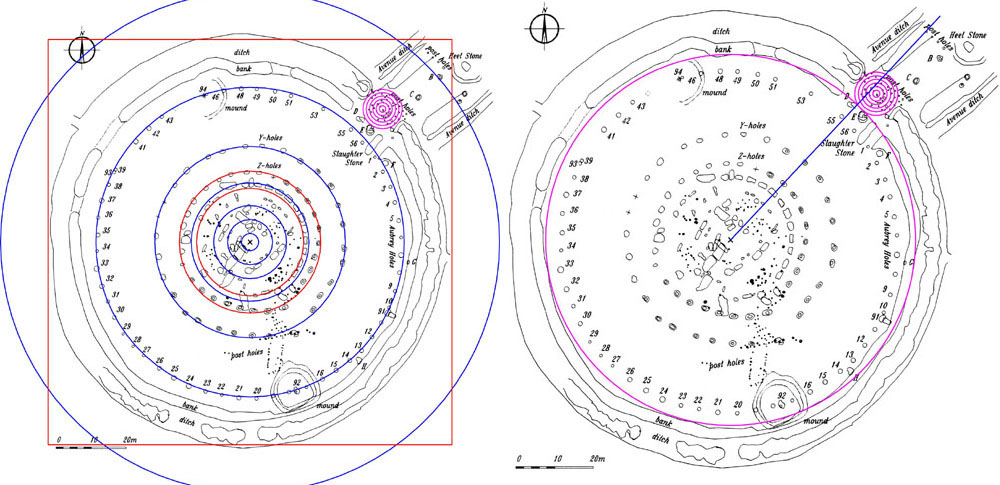
The image to the left shows how concentric circles within Stonehenge, marked by posts, stones or lintels are reducing by the PHI ratio of 1.6180339 to 1. An important marker-stone designated as B sits on the Avenue and, from the epicenter of Stonehenge, marks the outer rim of a blue circle with a diameter of 466.56'. This value occurs in the above string, based upon progressions of .729".
The outer blue circle has a red square overlaying it and the red square's diameter is based upon a 1/2 PHI (.80901695) reduction of the 466.56' diameter of the blue circle.
Note how the red square perfectly encompasses the outer embankment of the Stonehenge site, with one side brushing the Heel Stone bank on the Avenue.
Note: The 466.56' diameter of the Avenue Circle, if rendered as miles, would be 1/53.333333rd (1/53 & 1/3rd) of the 24883.2 mile circumference of the Earth. The diameter in English feet of 12" would be 480 (of what later became) Roman feet (of 11.664") or 240 Swedish Rydaholmsalm ... also rendered as 11.666666"and 23.333333"respectively for overland distance measurements. The circumference achieved by a diameter of 466.66666' would equate to 1466.666666' using PI @ 22/7ths.
The diameter of the square is read as 378' for a shortfall of about 6". The half length of the Great Pyramid of Egypt is 378', indicating that the embankment diameter extremity was based upon a half length Great Pyramid.
The outer blue circle is reduced by PHI @ 1.6180339 and creates the Aubrey Circle with a coded diameter of 288', having an excess of about 2-inches. The number 288 is one of the most dynamic in the parcel of numbers of civilisation
Note: The 288' diameter of the Aubrey Circle equated to 166.6666666 (166 & 2/3rds) of the largest Egyptian Royal cubits @ 20.736" (1.728').
The Aubrey Circle is reduced by PHI @ 1.6180339 and creates the "Y" Holes Circle with a coded diameter of 178.2'. This sets up a string of cumbersome looking numbers in feet of 12", which become fluidly decipherable when divided by 37.125. This was a string, leading, from 178.2' (2138.4") ÷ 37.125" = 57.6 (a much-used pyramid number in ancient metrology).
From this diameter, encoded into the diameter of "Y" holes, a string can be generated leading to identifying the equatorial circumference of the Earth as 130680000' of 12" each or 24750-miles of 5280' each or 22000-miles of 5940' each or 3520000 Ells of 37.125' each or 42240000 Ells of 37.125" each.
In this string, the values adopted by the ancient Scottish people for the Ell, Fall, Rood, Furlong , Acre or Mile can be precisely generated.
Inasmuch as the circle diameters at Stonehenge or elsewhere were generally slightly elliptical, a 90° opposed diameter was undoubtedly read as 177.1875' (177 & 3/16ths) and relate to half a lunar year of 354.375-days.
The "Y" Holes Circle is reduced by PHI @ 1.6180339 and the result is the outer rim circuit of the Lintels on the Sarsen Circle, achieving a diameter or 110', with no error. This is encoding for the "11" family of numbers, much used in navigation by the English mile of 5280' or the Scottish mile of 5940'.
Note: The 110' diameter of the outer rim of the Sarsen Circle Lintels was coded to have a circumference of 345.6' (using PI @ 1728/550ths) and relate to the 24883.2-mile circumference of the Earth. The sum of 345.6 miles X 72 = 24883.2. Also the circumference in feet of 12" of the Sarsen Circle outer rim would equate to 200 of the largest Egyptian Royal Cubits @ 20.736" each.
The inner rim of the slightly elliptical Sarsen Circle Lintels was coded to be 100' in diameter, inferring that the circumference measured 3.1416' (or other close renditions of PI in use). At 90° opposed the cross-measure was 100.8', (indicating 1-second of the Earth's equatorial arc under the literal navigation system encoded into the base dimensions of the Great Pyramid).
The "Z" Holes Circle was not a PHI reduction, but coded to have a diameter of 132' (1/40th of an English mile or 1/45th of a Scottish mile).
Note: The 132' diameter "Z" Holes Circle was coded to have a circumference of 414.72' (using PI @ 1728/550ths) and relate to the 24883.2-mile circumference of the Earth. The sum of 414.72 X 60 = 24883.2. Also the circumference in feet would equate to 240 of the largest Egyptian Royal Cubits @ 20.736" each.
The above image to the right shows a magenta circle circumnavigating the inner rim of the embankment. It has a coded diameter indicating PI (3.1416), but incorporating other much-used renditions (22/7ths, 1728/550ths, 3.15, 3.125, etc.), anciently used in differing calculations with different number families to achieve a full number, code-bearing circumference, perfectly divisible by 360°.
STONEHENGE WAS LARGELY DESIGNED AND BUILT ON A GREAT PYRAMID DIMENSONAL TEMPLATE
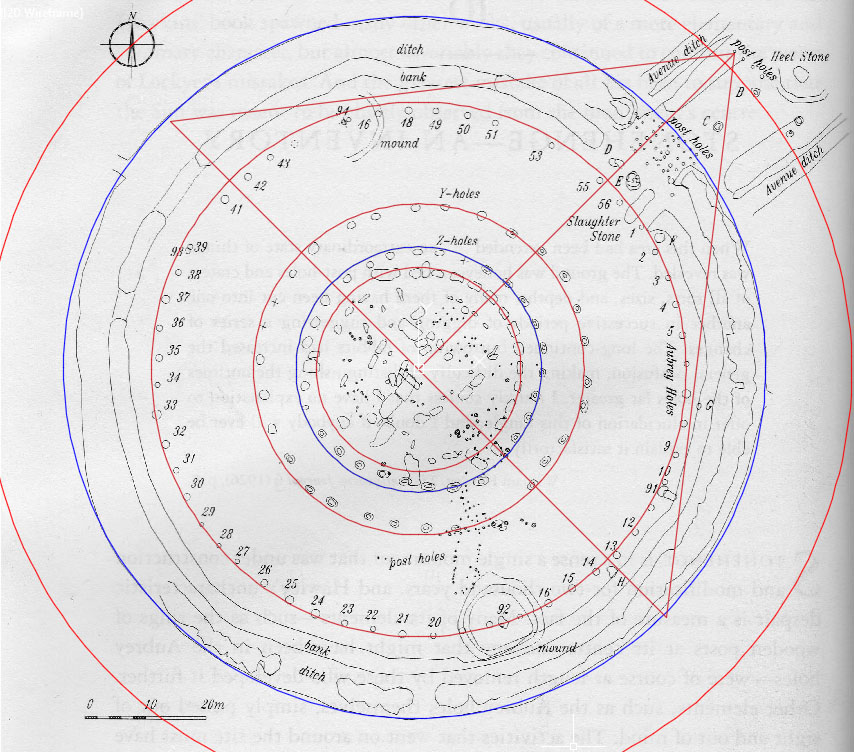
In this picture the PHI reducing circles are shown as red and a perfect, two-dimensional, half-replica of the Great Pyramid's side profile is marked into the Stonehenge site.
It is glaringly apparent that Stonehenge was originally laid out using a half-scale, Great Pyramid template. The above picture is in perfect scale.
As with many other megalithic sites, some circles within Stonehenge are slightly elliptical. However, a 378-feet diameter circle (blue) encases the Stonehenge site virtually perfectly from outer-ditch-edge to outer-ditch-edge across the entire site, excluding only the more extended Avenue and Heel Stone @ 45°.
A stone marker designated as “H” in the above scaled plan delineates how a pyramid base line goes from 135-degrees to 315-degrees from the edge of the outer ditch, across the embankment, through the site’s epicenter, across the opposite embankment to finally resolve at the outer ditch edge 378-feet distant (half the length of the Great Pyramid).
At the same time, a line commences centrally at 90-degrees opposed to the pyramid baseline and runs for 240.5-feet @ 45-degrees to resolve against a post on the Avenue. En-route it dissects a Sarsen obelisk, as well as post positions on the Z-Holes Circle, Y-Holes Circle, brushes a post on the Aubrey Circle, runs between stones D & E, dissects a post row and resolves upon an end post near the Heel Stone.
On the southwestern side, the pyramid hypotenuse line brushes past recumbent marker stones, now tumbled off the top of the embankment to lie slightly off-line, brushes the Aubrey Circle, at the position of post 10's adjacent large stone marker, then proceeds to brush stone C before resolving on the end post that designates the apex.
The pyramid's slope angle of 51.84-degrees is offset accordingly and the apex is marked by a post on the Avenue. A centerline for the pyramid runs from the baseline to stone D, then along a line of 6 posts to its resolving position on the apex post.
From this fact that Stonehenge has markers within the site that lay out a 2 dimensional, half-scale representation of the Great Pyramid and the diameter of the site is 378' to the outer extremities of the embankments, the accepted "official" date construction of the Great Pyramid (2589-2566 BCE) is clearly very wrong. The date for laying out the embankments at Stonehenge is estimated to be 3100 BCE ... 511 years before work supposedly (erroneously) began on the Great Pyramid.
RETURNING TO THE LAST RECORDED MEASUREMENT ON THE PERSIAN DRAH ROD.
57cm
22.4" (to a tolerance of 0.0409" decrease), 44.8, 67.2, 89.6, 112, 134.4, 156.8, 179.2, 201.6, 224 ... 268.8, 291.2 ... 336, 358.4... 403.2 ... 537.6 ... 560 ... 604.8 ... 672 ... 7168 ... 1008 ... 1120 ... 1209.6 ... 1680 ... 2240
The above string contains numbers that ended up being adopted into the English weights system. The value 6720' (2240 -Yards of 3-feet each) became the Irish mile. In the above line-up, 6048' (two circumnavigations of the Great Pyramid @ 756' per side) was 1-minute of arc for the equatorial circumference of the Earth. A second of arc was 100.8'.
The values mentioned here as 112 and 2240 may have a pedigree back to the ancient Egyptian Sep, Deben & Kite weights. A CWT or hundredweight was 112 lbs (pounds) of 16 ounces in a pound and 14 pounds in a Stone.
The ancient Egyptian Sep weight @7000-grains was the equivalent to the English Pound and the sub-divisions of the Deben & Kite also have a relationship to the Old English weights Standards of the 14th century.
THE ATTEMPT BY MEDIAEVAL GERMAN PROVINCES, PRINCIPALITIES, DUCHIES, OR CITY-STATES TO PRESERVE AN ANCIENT NUMBER AS THEIR "MILE".
A standard at the City Hall (Münster, Historisches Rathaus) described as a "Prussian Half Rod" (1.883 m) long (Preussische halbe Ruthe) ... The 18.883 metre length converts to 6.1778213434' or 0.0025186566 of a foot shortfall from 6.18034'. This is 1/400th of foot shortfall on 6.18034'. The Ell is set out in 6 segments of 12.36068" or 2 Prussian feet of 6.18034"each (PHI Reciprocal based value).
'Meile -'mile', a German geographische Meile or Gemeine deutsche Meile was defined as 7.420 km, but there were a wealth of variants':
The 7.420 km geographiche mile (7420 m) converts to 24343.83' . This would most assuredly have been read as 24300' under the ancient pyramidal values. The error or drift in this ancient standard is 13.36 m excess.
A mathematical progression string based upon 243 goes:
243, 486, 729, 972, 1215, 1458, 1701, 1944 ... 2430 ... 2916 ... 3402 ... 3888 ... 5103 ... 5832 ... 6804 ... 7776 ... 8505 ... 11664 ... 13608 ... 15552 ... 31104 ... 46656 ... 248832 ... 130636800.
 |
The Anhalt state was anciently assigned to preserve a mile that has, in more recent centuries, been estimated to have originally been 7532 metres. This converts to 24711.29'. The intended original number for preservation was assuredly 24750' of 12", encoding the navigational method that used the mile of 5280' x 24750 to represent the equatorial circumference of the Earth. The degree of drift or error that occurred over the centuries is 11 metres shortfall. |
 |
The Baden state was anciently assigned to preserve a mile that has, in more recent centuries, been estimated to have originally been 8889 metres. This converts to 29163.39'. The intended original number for preservation was assuredly 29160' of 12", encoding the Roman metrology system that used the foot of 11.664", the Pace of 58.32" and mile of 4860'. It also codes the Swedish Rydaholsalm measurement of 23.328". The degree of drift or error that occurred over the centuries is 3.39 metres excess. |
 |
The Bohem state was anciently assigned to preserve a mile that has, in more recent centuries, been estimated to have originally been 7498 metres. This converts to 24599.74'. The intended original number for preservation was assuredly 24609.375' of 12", encoding lunar cyclic information. In the 354.374-day lunar year the sum of 2.4609375-days was 1/144th or 1/12th of a lunar month of 29.53125-days.The degree of drift or error that occurred over the centuries is 2.9376 metres shortfall. |
 |
The Brabant state was anciently assigned to preserve a mile that has, in more recent centuries, been estimated to have originally been 5000 metres. This converts to 16404.2'. The intended original number for preservation was assuredly 16500' of 12", encoding the English League. In the 7.29", 5.5', 16.5', 66', 660', 1760', 5280' &, 16500' navigational system, the League was 3.125-miles. That system also included the Scottish mile of 5940' which was 1-furlong longer than the 5280' mile. The degree of drift or error that occurred over the centuries is 29.2 metres shortfall. |
 |
The Bayern state was anciently assigned to preserve a mile that has, in more recent centuries, been estimated to have originally been 7415 metres. This converts to 24327.43'. The intended original number for preservation was assuredly 24300' of 12", encoding the divisions, in days, that related to the 6804-day Lunar Nutation cycle, with 850.5 (1/8th), 1701 (1/4th), 3402 (1/2), 5103 (3/4ths) & 6804-days the full duration. The degree of drift or error that occurred over the centuries is 8.63 metres excess. |
 |
The Hamburg state was anciently assigned to preserve a mile that has, in more recent centuries, been estimated to have originally been 7532 metres. This converts to 24711.29'. The intended original number for preservation was assuredly 24750' of 12", encoding the navigational system based upon the 5280' mile and 16500' league, resulting in a 24750-mile equatorial circumference of the Earth. The degree of drift or error that occurred over the centuries is 11.8 metres shortfall. |
 |
The Hessen Kassel state was anciently assigned to preserve a mile that has, in more recent centuries, been estimated to have originally been 9206 metres. This converts to 30203.41'. The intended original number for preservation was assuredly 30240' of 12", encoding the navigational system based upon the 5250' mile adopted by the Greeks. One perimeter circumnavigation of the Great Pyramid is 3024' and that distance represents 1/2 a minute of arc in the Earth's equatorial circumference.. The degree of drift or error that occurred over the centuries is 11.152 metres shortfall. |
 |
The Lippe-Detmold state was anciently assigned to preserve a mile that has, in more recent centuries, been estimated to have originally been 9206 metres. This converts to 30393.7'. The intended original number for preservation was assuredly 30375' of 12", encoding the divisions, in days, that related to the 6804-day Lunar Nutation cycle, with 850.5 (1/8th), 1701 (1/4th), 3402 (1/2), 5103 (3/4ths) & 6804-days the full duration. Numbers generated also relate to divisions of the Earth and calculations within the lunisolar Sabbatical Calendar The degree of drift or error that occurred over the centuries is 5.7 metres excess. |
 |
The Oldenburg state was anciently assigned to preserve a mile that has, in more recent centuries, been estimated to have originally been 9894 metres. This converts to 32460.63'. The intended original number for preservation was assuredly 32400' of 12", encoding numbers relating to divisions of the Great Pyramid's perimeter lengths, the Precession of the Equinoxes and divisions of the Earth's equatorial circumference. The degree of drift or error that occurred over the centuries is 18.48 metres excess. |
 |
The Osnabruck state was anciently assigned to preserve a mile that has, in more recent centuries, been estimated to have originally been 5160 metres. This converts to 16929.13'. The intended original number for preservation was assuredly 17010' of 12", encoding the divisions, in days, that related to the 6804-day Lunar Nutation cycle, with 850.5 (1/8th), 1701 (1/4th), 3402 (1/2), 5103 (3/4ths) & 6804-days the full duration. The degree of drift or error that occurred over the centuries is 24.648 metres shortfall. |
 |
The Pfalz state was anciently assigned to preserve a mile that has, in more recent centuries, been estimated to have originally been 4630 metres. This converts to 15190.29'. The intended original number for preservation was assuredly 15120' of 12", encoding numbers that relate directly to divisions of the Great Pyramid's base perimeter and the equatorial circumference of the Earth under the 5250'mile. Two side lengths of the pyramid = 1512'. The degree of drift or error that occurred over the centuries is 21.424 metres excess. |
 |
The Rheinland state was anciently assigned to preserve a mile that has, in more recent centuries, been estimated to have originally been 4119 metres. This converts to 13513.78'. The intended original number for preservation was assuredly 13500' of 12", encoding numbers that relate the 360-degree compass, lunar cycle, Khafre Pyramid and Great Pyramid dimensions, the Roman overland Pace and the Scandinavian Rydahomsalm measurement, etc. The degree of drift or error that occurred over the centuries is 4.2 metres excess. |
 |
The Rheinland state was anciently assigned to preserve a mile that has, in more recent centuries, been estimated to have originally been 7500 metres. This converts to 24606.3'. The intended original number for preservation was assuredly 24609.375' of 12", encoding lunar cyclic information. In the 354.374-day lunar year the sum of 2.4609375-days was 1/144th or 1/12th of a lunar month of 29.53125-days.The degree of drift or error that occurred over the centuries is .9375 of a metre shortfall. |
 |
The Dresden state was anciently assigned to preserve a mile that has, in more recent centuries, been estimated to have originally been 9062 metres. This converts to 29730.97'. The intended original number for preservation was assuredly 29700' of 12". This distance would be 5 Scottish miles of 5940' each or 5.625 English miles of 5280'. It would also be 1.8 English leagues of 16500' or 45 furlongs of 660' each. The degree of drift or error that occurred over the centuries is 9.44 metres excess. |
 |
The Schleswig-Holstein state was anciently assigned to preserve a mile that has, in more recent centuries, been estimated to have originally been 8803 metres. This converts to 28881.23'. The intended original number for preservation was assuredly 28800' of 12", encoding many numbers that relate to the equatorial circumference of the Earth and its divisions. The Aubrey Circle at Stonehenge is 288' in diameter. The degree of drift or error that occurred over the centuries is 24.76 metres excess. |
 |
The Westfalen state was anciently assigned to preserve a mile that has, in more recent centuries, been estimated to have originally been 11100 metres. This converts to 36417.323'. The intended original number for preservation was assuredly 36450' of 12". This is 37500 Roman feet of 11.664"each or 7.5 Roman miles of 4860' (English feet of 12"). The degree of drift or error that occurred over the centuries is 9.96 metres shortfall |
|
The Westfalen state was also anciently assigned to preserve a mile that has, in more recent centuries, been estimated to have originally been 9250 metres. This converts to 30347.77'. The intended original number for preservation was assuredly 30375' of 12". This is 31250 Roman feet or 6.25 Roman miles of 4860' (of 12"). The degree of drift or error that occurred over the centuries is 8.3 metres shortfall. |
 |
The Vienna state was anciently assigned to preserve a mile that has, in more recent centuries, been estimated to have originally been 7586 metres. This converts to 24888.45'. The intended original number for preservation was assuredly 24883.2' of 12". This is the 12 X 12 X 12 X 12 X 1.2 coding for an Earth of 24883.2-miles in equatorial circumference, literally encoded into the Great Pyramid's base dimensions. The degree of drift or error that occurred over the centuries is 1.6 metres excess. |
 |
The Wiesbaden state was anciently assigned to preserve a mile that has, in more recent centuries, been estimated to have originally been 1000 metres. This converts to 3280.84''. The intended original number for preservation was assuredly 3281.25 of 12". This is simultaneously .625 of a Greek mile of 5250' or 3375 Roman overland-marching feet of 11.6666" (11 & 2/3rds). An ancient rule of 3.28125' (39.375") is 1/204th of an inch larger than the modern metre. The degree of drift or error that occurred in the Wiesbaden mile over the centuries is .41 of a metre shortfall. |
 |
The Württemberg state was anciently assigned to preserve a mile that has, in more recent centuries, been estimated to have originally been 7449 metres. This converts to 24438.98'. The intended original number for preservation was assuredly 24444.444 of 12". This is used for dividing 11-based numbers, like all those in the English mile series, into 9th divisions. The degree of drift or error that occurred over the centuries is 1.666 metres shortfall. |
TO THE FAR ISLES AT THE VERY ENDS OF THE EARTH.
It is evident that Viking ships, amongst many others from the ancient Mediterranean, Continental European seaboard and Britain, sailed successfully to the Antipodean Isles of New Zealand at the very ends of the Earth in antiquity. If these early mariners could reach such a remote place, the most distant habitable country in the world from Europe, then every other part of the globe lay within their reach.
To the left is seen a belt buckle, retrieved from a Viking burial ship at Sutton Hoo in England. To New Zealanders and others of the South Pacific Islands, the face is very recognisable as "Tiki" or "Rongo". He is seen to be wearing the "high hat", so typically displayed on the statuettes or totems of the Pacific Islands, ranging from Hawaii to Tahiti to the Cook Islands.
Although the elongated forehead or high hat design aspect is sometimes seen in New Zealand, "Tiki" or "Rongo" is generally depicted locally without his hat, as in the old photo to the right. Note how the Maori individual in the photo emulates the bulging eyes, protruding tongue and facial grimace of the totem figure and also holds a "mere" club (shaped like the Egyptian "SA" symbol hieroglyph, meaning "protection").
The origin of this cultural-religious expression is very ancient and, for both Scandinavia or the South Pacific totems, goes back to the dwarf god, Bes, of Egypt... who became Pan of Greece, Puck of Britain and Puge of Scandinavia.
Maori oral tradition states that the arts of carving, facial tattooing and (haka) dance were taught to them by the earlier inhabitants of New Zealand, who they described as kiri puwhero (light complexion, reddish skinned) and uru-kehu (light coloured, golden tinged or reddish hair).
For more information on the "world's-apart" relationship between "Bes" of Egypt and "Tiki"of the South Pacific or evidence of "Thor" in an ancient New Zealand totem and volcano, CLICK HERE.
By about 5000 BC and thereafter, the forebears of the European nations abandoned their increasingly arid homelands in Egypt and its environs and moved to the verdant new territories of Europe. In doing so, they brought their Weights, Measures and Volumes standards with them, as well as all of their astronomical and navigational sciences. These sciences they had encoded (by way of distance, area and angle numerical codes) into their early-epoch great edifices, like the many pyramids that they built in Egypt.
It must be realised that the Egyptian pyramids of the Giza Plateau or those at Saqqara are far older than "officially" recognised. The measurement standards found encoded onto these "Bureau of Standards" edifices survived for further millennia within the European nations and were, over time, carried abroad to far-flung locations like New Zealand, by European explorers and settlers such as the Vikings.
EGYPT, FORMER HOMELAND OF EUROPEAN NATIONS.
The commonly known and preserved measurements of ancient Europe, despite their wide variety, are a part of a single and widely versatile integrated mathematical system, with traceable root origins and pedigrees extending back to Egypt and its former Caucasoid peoples, who occupied Egypt and surrounding countries for many thousands of years. Skeletons, mummies, busts, etc., of the forebears to the Nordic Europeans, are still found there in profusion beneath the desert sands, attesting to their long occupation of the region.
Let us now look at the mathematical fingerprints of but one of the many European nations, the Swedish, and demonstrate how their oldest known Weights, Measures and Volumes standards have a direct pedigree to the Great Pyramid of Egypt or to its slightly smaller counterparts, the Khafre Pyramid, which was Egypt's Pyramid of the Moon, and Menkaure Pyramid.
SAVED BY AN INCH
It's very important to realise that the British Standard inch is not British at all, but has a very ancient pedigree back to the Eastern Mediterranean and beyond to yet more ancient Caucasian homelands. The so-called British Standard inch became the basis of many ancient "cubits" or "foot" measurements, ranging from Northern India to Egypt or wherever the forebears to the European nations settled and established long-term civilisations.
THE SWEDISH MILE.
'A Swedish "mil" (Sw. mile) was in the old days = 6000 "famn" (fathoms) = 18000 "aln" (ells) = 36000 "fot" (feet) = 10688 meters = 6.64 miles' (Hans Högman).
Hans Hogman speaks of a length equating to 10,688 metres as representing one of the many increments called "the mile" in use in various parts of old Scandinavia. The, now, slightly drifted length identified would translate to 35,066 British Standard feet.
By comparative analysis to a wide range of other Swedish measurements, which would all have been in direct ratio or factorable, smaller expressions of the larger increment, it is evident that the original intended distance of this particular "Mil" or "Mile" was 35000 standard British feet. Three such "Mils" equated to 105000 feet or 20 Greek miles of 5250 feet each. Alternatively, three such "Mils" (105000 feet) equated to 10,000 Hebrew Reeds of 10.5 feet each or 100,000 Greek feet of 12.6-inches each.
Note: The Great Pyramid was built to be 756 feet in length, which is 72 Hebrew Reeds or 720 Greek feet. This length also equates to 360 Assyrian cubits of 25.2-inches each.
Hogman states that the Swedish "Mil" was divided up into 6000 Famn, which would mean that a Famn was 5.83333 feet or 70-inches. This increment is related to the well known Roman "Pace" increment of 58.33333-inches (58 & 1/3rd). Therefore, 1.2 Roman Paces would equate to 1 Swedish Famn. At the same time there would be 7200 Roman Paces in a Swedish "Mil" or 36000 Roman feet of 11.66666-inches each. There would be 777.6 Roman feet in the 756 feet length of the Great Pyramid or 5400 Roman feet in a Greek Mile of 5250 feet.
Note: There were two readings of the Roman foot, depending on the calculation requirements. For certain calculations it was read as 11.664-inches, making a Pace, under that second system, equate to 58.32-inches. This second reading was used for lunar cycle calculations, as well as some volume measures
The Roman foot was found to be 11.664 inches by John Greaves, professor of geometry, who in 1639 went to Rome specifically to ascertain the length of an ancient Roman foot. Greaves located a monument of Roman architect, Stalius Asper and measured bas relief instruments used by him in the first century A. D. Greaves concluded, after careful investigation, that the Roman foot, 'contained 1944 such parts as the English foot contains 2000'. This means a Roman foot of 11.664 inches (11 & 83/125ths).
The Swedish "Aln" was 1.94444 feet or 23.3333-inches (23 & 1/3rd). This is very consistent with the report concerning the Rydaholmsalm:
'The first unit of length to all parts of Sweden was the Rydaholmsalm (the length of a prototype kept in the church of Rydaholm, Smaland, now lost. It is thought to have been 0.593 m.'
At exactly .593 m., the Rydaholmsalm would translate to 1.945 feet or 23.34-inches. We can safely call this a very slightly "drifted" increment that was known elsewhere as the "Aln", which was related to both the Swedish Famn and the Roman Pace. The degree of error at the estimated .593 m is so negligible that the 1.944444 feet (23 & 1/3rd inches) proves to be the intended value of the ancient measurement.
Hogman further states:
'The "mil" was divided into 4 "fjärdingsväg" (4 quarters) of 2672 meters or 4500 "aln" (ells).'
From this we can safely assign an original value of 8750 feet to a "fjärdingsväg" or 1.66666 (1 & 2/3rds) Greek miles of 5250 feet each.
'1 "steg" = 1/2 "famn" (fathom).'
A "Steg" was, therefore, 35-inches.
'1 "famn" = 6 "fot" (Sw. feet) = 3 "aln" (Sw. ells).'
From the above statement by Hogman, we get further verification that the ancient Swedish "foot" was 11.66666 (11 & 2/3rds) inches and was exactly the same length as the Roman foot.
It is significant that one ancient means for easily remembering the equatorial size of the Earth was to apply the formula:
12 x 12 x 12 x 12 x 1.2 = 24883.2-miles. If navigating by the Swedish-Roman-Greek method, those miles would be 5250 feet each (6&7 number family).
If navigating by the British method, those miles would be 5280 feet each (11 number family).
The length of the Great Pyramid is 756 British feet or 777.6 Swedish feet.
If the Earth is considered, by the above formula, to be 24883.2-miles in equatorial circumference, then 777.6-miles would represent 1/32nd segment. Therefore, one of the inbuilt codes of the Great Pyramid, extractable by use of a Swedish foot of 11.6666-inches (representing miles), would be to consider that 1 circumnavigation of the Pyramid mnemonically identified the distance value for 1/8th of the equatorial circumference of the Earth or 45-degrees of arc.
Hogman states:
'In the beginning 1 "kabellängd" [cable length] = 100 "famn".'
This means that the original "kabellängd" was 58.33333 feet or 60 Roman & Swedish feet. This also equates to 12 Roman Paces.
One of the concepts of ancient metrology, which survived into mediaeval times, was that 75 Roman miles represented 1-degree of arc for the world.
The Scandinavian system was, undoubtedly, adopted by the Romans and has its root origins much further back in remote antiquity. Under this system, the equatorial size of the Earth was considered to be, for navigational purposes, 25000-Greek miles in circumference or 131250000 British Standard feet of 12-inches. This distance would also be 135000000 Swedish-Roman feet of 11.6666 (11 & 2/3rds) inches.
Under this system, 1-degree of arc (1/360th of the equatorial circumference) was 375000 Swedish-Roman feet. Therefore, according to the oral tradition handed down from mediaeval times, the Roman mile should have been 5000 Roman feet or 1000 Roman Paces of 58.3333-inches. This equated to 3000 Swedish Alns of 19.4444-inches each.
Under this system 1-minute of arc (1/60th of a degree) was 6250 Swedish-Roman feet. This equated to 375 Swedish Alns.
Under this system, 1-second of arc (1/60th of 1-minute of arc) was 62.5 Swedish Aln's.
Hogman states:
1 "fot" = 2 "kvarter" = 12 "tum" (verktum) = 1/2 "aln"
From this we see yet further divisions to the Swedish foot and aln. There was also the "tvärhand", which was 4 "tum".It would appear that 1/16th part of the Swedish foot was the "fingerbredd".
As stated, both the Swedish and the Romans appear to have used two separate, but almost identical, "foot" rules. One "occasional use" calibration of the foot, set to 11.664-inches (1458/125ths) for lunar cycle tracking, was marginally shorter than the navigational foot rule of 11.6666-inches. The difference in the two rules would have been visually difficult to detect.
SO, HOW DID THE VIKINGS NAVIGATE AT SEA USING THIS MEASUREMENT STANDARD?
When sailing, one is at the mercy of the wind to a large degree and must tack at angles to the breeze to make forward progress. The preferred course is not always directly or easily achievable and tacking, first one way then another at an angle to the wind, is often the only way to stay on course. It was the ominous responsibility of the navigators to always be aware of the ship's position and distance from both point of departure or destination. The navigators had to be constantly aware of boat speed through the water, as well as heading.
Distances covered could be measured under several systems, such as the "11" family of numbers (leagues, miles, furlongs, etc.) or other increments of length within a "6&7" family of special navigational numbers. The Swedish, Romans and Greeks seemed to prefer the "6&7" family of numbers for "linear distances" covered or legs completed during a voyage.
The navigators would maintain a vigilant watch on boat speed and could, from time to time, feed out a knotted rope over the stern and count the time lapse between knots crossing the barrier aft. There would be tremendous co-operation between the helmsman and the navigator, who would work together to maintain the same course heading until a sought after distance had been traveled. The goal of the ever watchful navigator would be to complete segments of a voyage according to whole number distances for each leg in, say, Greek miles at known degree angles around from north. If full attention, related to boat speed and heading, as well as angle of tack and distance traveled were maintained, then relatively accurate "positional plotting" was mathematically achievable. The navigator would have a very good idea where the boat sat in the vastness of the ocean at all times.
Once a "straight-line" leg was completed, the navigator would rule a line on the chart (a slate stone?) and the end of the scaled line would represent the position where the boat now sat in the ocean. Each time a long or short leg was completed, this had to be done and a mathematical means had to exist to determine anew the degree angle back to the point of departure or onward to the port of destination
If the Viking navigators wished to achieve a "Mil" of travel (35000 British feet or 36000 Swedish feet) for each leg before changing to a new tack angle, then the result, in turning this linear distance leg (diameter) into a circle (using PI @ 22/7 or 3.142857143) would be: 35000 feet X PI = 110000 feet.
So, the navigator could now rule a much scaled down line representing 35000 feet of travel onto the plotting chart, then, using half the length of the line (radius), draw a circle at the end of the line at the position where the boat was estimated to be situated in the ocean. The circle created accurately depicted a circumference of 110000 British feet, in which 1/360th part (1-degree of arc) was 305.55555 feet (305 & 5/9ths feet) or 55.5555 British fathoms of 5.5 feet each.
Note: the original British fathom was 5.5 feet and not 6 feet).
It's obligatory that the Vikings used increments much shorter than 350000' when tacking over a leyline on the wind ... something more akin to 3500' or 7000' per leg of travel, unless they had a tailwind.
Another metrologist (researcher of measurement standards), Gary Anderson, who devoted 10-years to researching Viking measurements, states:
'Fot*: In doing the research for this I found that there were actually two measurements for the Fot. One was very early and ran at exactly 11 inches, the other was almost 1.03 feet.'
So, with this in mind, the navigator, using a scaled rule representing "11" inches would know that 333.3333 such increments would represent 1-degree of arc on the plotting chart for the circumference of a circle with a diameter of 1 Mil (35000 British feet). By this means, accurate angle fixing back to the point of departure or onward to the destination could always be known, despite many zigzag course changes during the voyage.
Alternatively, the legs of the voyage could be accomplished in multiples of "Greek miles" of 5250 feet, if desired. A circle based upon a diameter of 1 Greek mile would achieve a circumference of 16500 feet (1 ancient British league...3.125-British standard miles of 5280 feet each). In this circle, 1-degree of arc would equate to 550-inches (50 X 11 inches) or 8 & 1/3rd British fathoms per degree of arc. The so-called Greek mile was fully an increment within the ancient Swedish navigational system.
From the above, we can see that the Vikings, along with many other cousin nations, were in full possession of sophisticated manual methods to do accurate positional plotting at sea. They used one set of measurement increments, based upon a 6&7 family of numbers, for all of their linear distance calculations. After the PI formula was used to turn a leg of travel from a diameter into a circle, the circumference value achieved was easily divisible by 360-degrees and accurate angle determinations could then be made for positional plotting.
The measurements known to have been used in ancient Scandinavia show that they knew the equatorial circumference of the Earth and could grid reference it for accurate navigation and safe traversal using highly factorable numbers.
This basic rule applies: When traveling by the Swedish-Greek-Roman 6&7 number family, the circle derived therefrom will be based upon the number "11". When traveling by the British "11" family of numbers (League @ 16500 feet, Mile @ 5280 feet, Furlong @ 660 feet, Chain @ 66 feet, Rod or Perch @ 16.5 feet, Fathom @ 5.5 feet, Link @ 7.92-inches), the circle derived therefrom will be perfectly sexagesimal and divisible by 360-degrees.
These otherwise strange numbers, like 5250 feet for a Greek mile or 5280 feet for an English mile, were specifically created because of PI, so that a linear distance would convert to a very meaningful circumference that broke down easily into 360-degree divisions. Therefore, on the plotting chart one could always know the angle back to the point of departure or onwards to the destination.
ANCIENT SWEDISH VOLUMES FOR DRY GOODS.
Few things can cause more public discontent than "short measures" at the market place. When the buying public made a purchase of a "fjärding" of grain, they expected a full measure for their money. The "fjärding" had to be the correct cubic inch capacity. Right up until the middle of the 19th century one could face the death penalty in Sweden for falsifying weights and measures. It is probably for this reason that there were traditions like "the baker's dozen", which meant that when one purchased 12 bread rolls, the baker would include an extra roll to bring the tally up to 13. By such means there could be no argument that one had been "short changed" or "ripped off" by the deceitful merchant.
Like all of the other European cousin nations, the Swedish had a "volume" system with root origins that extended all the way back to the former homeland of Egypt. Every volume had to encode scientific information in the numerical value of its cubic capacity. These special inbuilt numbers, to do with navigation or astronomy, had to be remembered at all cost, as the concept of civilisation and abundant society depended on them. If everybody was using the special numbers every day in a length, volume or area calculation, based upon the selfsame inch, or in weights based upon counts of healthy wheat grains, then the sciences would never be forgotten. The old adage applies: "You either use it or lose it".
Hogman speaks of a Tunna (Barrel):
1 "tunna" = 2 "spann" = 8 "fjärding" = 32 "kappar" = 56 "kannor" (pitchers) = 146.6 liters leveled measure (struket mått).
Hogman also says that there was a slightly larger capacity Tunna.
'...or 164.9 liters full (good) measure (fast mått or med råge).'
So, there was a larger and a smaller Tunna, one at 164.9 litres capacity and another at 146.6 litres capacity. Let's now convert these ancient volumes back to cubic inches in an effort to identify the inbuilt, original codes obscured by metrification.
The larger Tunna, said to have been 164.9 litres would translate to 10062 cubic inches.
The smaller Tunna, said to have been 146.6 litres would translate to 8945.5 cubic inches.
These values are very close to highly significant numbers from the ancient parcel of scientific codes. It is quite obvious that the latter era "Tunna" values had drifted slightly off the accurate capacity numbers that the ancient forebears put in place. This can be demonstrated in a very practical sense in consideration of the smaller divisions or breakdown capacities associated with the Tunna.
It must be realised that the original architects of these cubic inch or cubic foot volume systems used highly factorable numbers. A smaller capacity was an exact division of a larger one. Moreover, the capacity system of one nation would be in an exact and easily calculable ratio to that of a trading cousin nation. Everything could be calculated out and transactions done with exactitude by applying simple ratios or fractions. By looking at the smaller divisions of the Swedish Tunna, we can easily see what the original volumes were supposed to be, despite small "drift" that has occurred to the standard within the last 2000 years.
Hogman states that the capacities of the smaller divisions were:
1 "fjärding" = 18.32 liters (117.9 cubic inches), 1 "kappe" = 4.58 liters (279.47 cubic inches), 1 "kanna" (pitcher) = 2.617 liters (159.69 cubic inches).
Hogman further states:
"Skäppa" is a very old measurement that was abandoned in Sweden in 1735. The size of a "skäppa" could be different in different parts of Sweden. In the province of Småland a "skäppa" was 1/6 of a "tunna" (barrel) but in the province of Bohuslän it was only 1/4 of a "tunna" (36.6 liters) and in the province of Västergötland it was 1/5 of a "tunna".
From this we can see that the Bohuslän "Skäppa" was approximately 36.6 litres (2233.3 cubic inches).
From this abundant accumulation of evidence, we are able to make the very minor adjustments necessary to restore the intended values put in place by the original architects of the system. We know full well that they would never have used such utterly meaningless and arbitrary values as 279.47 cubic inches for a "kappe", when the highly factorable and full number, 280 cubic inches was available. Likewise, the value of the "kanna" was not chosen by the Swedish forbears to be the non-factorable and non-divisible value of 159.69 cubic inches, but was set at the highly usable value of 160 cubic inches, etc.
So, let's now restore the original system:
| Swedish dry volumes (Heavy) | Swedish wet volumes (Heavy) |
| Large Tunna = 10080 cubic inches. | Fat (Barrel) = 9600 cubic inches. |
| Large Fjärding = 1260 cubic inches. | Tunna = 7680 cubic inches. |
| Large Kappe = 315 cubic inches. | Ankare = 2400 cubic inches.* |
| Large Kanna = 180 cubic inches. | Fjärding = 1920 cubic inches. |
| Large Skäppa (Bohuslän) = 2520 cubic inches. | Kannor = 160 cubic inches. |
| Large Skäppa (Västergötland) = 2016 cubic inches. | |
| Large Skäppa (Småland) = 168 cubic inches. |
| Swedish dry volumes (Light) | Swedish wet volumes (Light) |
| Small Tunna = 8960 cubic inches. | Fjärding = 1890 cubic inches. |
| Fjärding = 1120 cubic inches. | Kanna =157.5 cubic inches. |
| Kappe = 280 cubic inches. | Stop = 78.75 cubic inches. |
| Kanna = 160 cubic inches. | Kvarter = 19.6875 cubic inches. (19 & 11/16ths). |
| Skäppa (Bohuslän) = 2240 cubic inches. | Jungfru = 4.921875 cubic inches. (4 & 59/64ths). |
| Skäppa (Västergötland) = 1792 cubic inches. | |
| Skäppa (Småland) = 149.3333 cubic inches. |
Note: The Heavy Skäppa values are assumed to exist, based upon the Heavy Tunna value. This is consistent with the way many of the very ancient Mediterranean systems were structured, offering two differing capacities called "Heavy" & "Light" or "Single" & "Double" within a standard.
The Skäppa was considered to be a Swedish "Bushel" and, for the most-part, hovered quite close to the British Bushel, which was, anciently, 2160 cubic inches. The astronomical coding placed within the British Bushel related to the duration of the Precession of the Equinoxes (25920-years) and how the sun spends 2160-years in each of the 12 houses of the zodiac during the precessional cycle.
*Footnote: Hogman tells us that the "Ankare" was for volumes of 'Liquor, Wine & Beer'.
By the description Hans Högman gives of what we could term as the "light" capacity wet volumes, the values given make a great deal of sense, despite their visual complexity. The value of 1890 cubic inches was for "navigation", as well as for very accurate calendar calculation determinations, especially lunar, and the length of the Great Pyramid is 189 feet X 4 (756 feet).
The smaller division value of 19.6875 (19 & 11/16ths) was much used by the Egyptians, Greeks and Romans and their Beqa weight Standard for gold was set at 196.875 grains. Further verification and comparative analysis will be necessary to fully determine if that family of navigational and lunar numbers was being used within the Swedish wet volumes standard, but it is certainly looking very encouraging so far.
Note: the "Stop" volume for the Wet "Light" series appears to be 78.75 cubic inches. The Viking longship found at Oseberg, Norway (circa 1904) had a length of 78.75 Swedish feet of 11.666666-inches (11 & 2/3rds). Half the base length of the Great Pyramid (378 feet) is in a ratio of .7875 to 1 to the height (based upon where lines running up the faces would converge at a single point above the flat floor altar at the top of the Pyramid & coded to be at 480 feet of vertical height).
WHAT IS THE UNDERLYING SCIENCE ENCODED INTO THE OLD SWEDISH DRY VOLUMES?
To understand the significance of the numbers encoded into these cubic capacities, one must return to analysing the dimensions of the Great Pyramid of Egypt, situated in the former homeland of Nordic Europeans, but long ago abandoned to the encroachment of the desert sands.
The Great Pyramid was designed to be 756 feet per side length or 3024 feet for one circumnavigation. Under what, much later, became the Swedish-Greek-Roman method of world-traversing navigation, two circuits of the Great Pyramid were 6048 feet, which represented 1-minute of arc on the Earth's circumference. The full equatorial circumference under this method was 24883.2 "Greek" miles of 5250 feet each or 130636800 British standard feet. This meant that 1-degree of arc (1/360th of the Earth's circumference) was 362880 feet (note that one full circuit of the Great Pyramid, which means 756 feet x 4 or 3024 feet = 36288 inches). As stated, 1-minute of arc (1/60th of a degree) was 6048 feet and 1-second of arc (1/60th of 1-minute) was 100.8 feet. There would be 7.5 occurrences of 100.8 feet in one side length of the Great Pyramid.
Note: The Sarsen Circle at Stonehenge (made of upright Sarsen stones capped with lintels) was made slightly elliptical to achieve two sets of crossing codes. In one cross measurement the Sarsen Circle is 100.8 feet, or 1-second of arc diameter for the equatorial circumference of the world.
The value of 10080 cubic inches in the Swedish Heavy Tunna is a very important navigational value, alluding to the number used to describe 1-second of equatorial arc. It was placed into the standard for mnemonic recall of the size of the Earth. In each of the lesser divisions of the Large Tunna there are recurring progressions of numbers that can be exploited for world navigation.
There is insufficient room in this article to demonstrate all that these volume codes could do or mean and researchers are encouraged to refer to Weights, Measures and Volumes of the Ancient Mediterranean, within this website. To see that fuller article CLICK HERE.
A small glimpse of how far one could go in extracting meaningful codes is seen in the conversion of "1-second of arc" (100.8 British standard feet) into ancient Swedish units based upon their navigational foot of 11.6666-inches. Therefore, 100.8 feet x 12 = 1209.6 inches ÷ 11.6666 = 103.68.
Consider this: The ancient value for the equatorial size of the Earth was 24883.2-miles. There are 24 hours in a day so the rate of speed at which the Earth spins is 24883.2 ÷ 24 = 1036.8 Miles per hour.
Consider also: One half of 103.68 is 51.84. The slope angle of the Great Pyramid's 4 faces is 51.84-degrees. The azimuth angle from the altar of the huge Octagon earthworks complex of Newark, Ohio, dissecting the entire site in half and extending through the avenue out the end gate of the Octagon, is 51.84-degrees.
The Precession of the Equinoxes endures for 25920-years, which is 51.84 x 500. When one travels 1 British league of 16500 feet (3.125-miles), it converts to a sexagesimal navigational circle of 51840 feet (divisible by 360-degrees).
Consider also: The "Stirling Jug" of Scotland, dating to 1457 and possibly much earlier, had a capacity very close to 103.68 cubic inches, which was the same as the ancient Hebrew liquid volume called the Jerusalem Cab (predating the Babylonian conquest), etc., etc.
The smaller Tunna is 1.125 to 1 less in size to the large Tunna, so it's a perfectly ratioed down expression of the bigger one.
BUILDING A "TUNNA" ROUND BARREL OF PERFECT INTERNAL CAPACITY.
As stated earlier, up until the middle of the 19th century, one could face the death penalty in Sweden for falsifying weights and measures or conspiring to deliberately defraud the buying public. This meant that merchants in the market place had to have perfect capacity vessels, such that anyone purchasing a "Tunna" of grain received exactly what they had paid for. Market place inspectors periodically checked the accuracy of the merchant's measuring tubs. So, how did the ancient Swedes produce round barrels or tubs that they knew, with certainty, were of perfect, internal cubic inch capacity?
The answer to that question lies in the fact that the ancient people of Scandinavia had yet another measurement rule of 1.030 British Standard feet, which functioned specifically for creating all of the various volume vessels or tubs. Gary Anderson, who researched Viking measurements for ten years, concluded that there was a very old "Fot" (foot) that would equate very closely to .314 metres. This would translate to 1.03018 feet.
The manner in which the ancient scientists configured these highly specialised rules for constructing round volume vessels, was to base them on the PHI ratio of 1.6180339 to 1. The same ratio exists between the area covered by the base of the Great Pyramid in comparison to the area of its 4 side faces, including a symbolic capstone on top.
If one uses simple trigonometry to work out the side length of the full pyramid, including the theoretical, non-existent capstone, the length to the centre apex would be (Adj. ÷ 51.84 Cos.) = 611.7894615 feet.
Alternatively, if one used a PHI method of Adj. (378 feet) X PHI (1.6180339) = 611.6168142 feet.
It will be observed that the calculated PHI length is only about 2 inches less than the length achieved by straight trigonometry. The ancient astronomer/ mathematicians were coding a PHI related angle for the Great Pyramid simultaneously to the standard angle of 51.84-degrees. The whole edifice was designed to clearly code PHI relationships. For example:
Let's consider the Great Pyramid on the basis of PHI and the ratio relationship (in pyramid acres) between the 4 faces, compared to the ground area that the Great Pyramid covers.
The surface area of each face of the theoretical full pyramid, complete with a (symbolic) pointed capstone, = 611.6168142 feet of side length X 378 feet (1/2 the base length) = 231191.11558 square feet.
Because there are 4 faces, their combined square footage amounts to 924764.6231 square feet. This translates to 32.10988275 pyramid acres of 28800 square feet each.
The base area measured 756 feet X 756 feet or 571536 square feet, which equated to 19.845 pyramid acres of 28800 sq. ft each. A perfect PHI relationship exists between this (symbolic capstone included) total side acreage and that of the base area that the Great Pyramid covers: 32.10988275 ÷ 19.845 = 1.6180339 (PHI).
Because the Great Pyramid was a static "Bureau of Standards" for the Caucasoid family of scattered nations and civilisations, it was absolutely essential that it strongly encode the PHI ratio, as this was central to fabricating very accurate, circular"volume vessels" or tubs with ease.
Compelling evidence shows that all of the most ancient volume vessels were made by this simple method. The use of the PHI formula persisted through the epoch of the Druids until the dawn of the "Dark Ages", spawned by the coming of Roman Christianity and its brutal introduction of backwards, dogmatic religion. Prior to that time, all volume vessels had to contain profound codes in (1) the square inch area of the base, (2) internal side height and (3) cubic inch volume, all of which related to astronomical cycles or world navigation.
NOW, BACK TO HOW THE SWEDISH SCIENTISTS WERE USING THE PHI RATIO.
To make perfect capacity, round volume vessels for the Swedish Tunna of 10080 cubic inches the formula was:
10-inches ÷ 1.6180339 (PHI) = 6.18034-inches (this increment became the standard length for making all of the circular market place volume tubs, of widely varying capacity, for all of the cousin European nations.
The width of the Bush Barrow Lozenge of Southern England was very close to 6.18034-inches (the lozenge has suffered some edge damage, slightly obscuring the original codes) and two such widths equated very visually close to 12.36068-inches or 1.0300566 feet, seemingly the same as a Swedish long "Fot".
A primary purpose of the Bush Barrow Lozenge appears to have been for "market-place" inspectors to check the base width of "Bushel" barrels and tubs used by ancient merchants of the Neolithic Age. The very slightly "drifted" dimensions, for building a Bushel tub, are described in the old "English Winchester Standard".
The base floor of the British Bushel was 270 square inches, with walls rising above the base floor a total of 8-inches, for a cubic capacity of 2160 cubic inches.
The increment of 6.18034 X 2 = 12.36068-inches. This value equates to 1.03005666 feet and is the measurement identified by researcher Gary Anderson as the largest "Fot" utilised by the Vikings.
In the following I will show numbers set at decimal point refinement and tolerances beyond what was visually or manually achievable by humans, but do so only to demonstrate how perfect the ancient mathematical method was.
To make the Tunna tub base, take a large thin slab of flat smooth timber or tightly edge-splice several planks together to form a single piece of sufficient size.
Next take the 1.0300566 foot rule and mark double that length (2.0601132 feet) onto the wooden base as the total diameter.
Now create a circle from the halfway point of 2.0601132 feet diameter.
Because you have used a rule derived directly from the PHI formula, your base is exactly 480 square inches of surface area.
Your formula for determining the square inch area is PI X the radius squared, memorised by every schoolchild in the formative years of their education. So, the diameter of 2.0601132 feet ÷ 2 = 1.0300566 feet = 12.3606792-inches. This value "squared" = 152.7863903 X PI (3.14159) = 480 square inches of base.
The 480 number is a much-used coded value of antiquity and all aspects of ancient tub had to contain recognisable codes in the base surface area, internal side height and cubic capacity to be contained.
Because the tub needs to achieve 10080 cubic inches for this Swedish Tunna vessel, the internal height of the tub, from the top surface of the base to the brim of the side wall is 21-inches. This value (21-inches...sometimes called a Celtic Royal Cubit) is found in the base length of the Great Pyramid, which is 432 X 21-inches in length per side or 1728 X 21-inches for all four sides.
Note: A cubic foot (12 x 12 x 12) is 1728 cubic inches.
Note 2: A length of 100.8’ is one second of arc in the 24883.2 Greek mile (5250’) equatorial circumference of the Earth.
It's as easy as that to make all of the old Swedish volume vessels listed and have them achieve a perfect capacity. You have the option to use 1, 2, 3 or more of the 6.18034-inch PHI-derived increments in the base. A tub can be more squat than tall or vis-versa. A perfect capacity is always easy to create by this simple ancient method, which was used in the production of, seemingly, all the tub-type standard volume vessels of the Caucasian (European) civilisations in antiquity.
NAVIGATIONAL AIDS
The Scandinavian mariners are known to have used the Sun Shadow board of 32 calibrations for navigation and are theorised to have used a Sun Crystal for determining the sun's rise and set positions on cloudy days. Other than that not much has survived to tell us how they did "dead reckoning" or "positional plotting" to stay abreast of their location in the open sea. A very good clue, however, to the kinds of devices they would have used, is found in the Bush Barrow Lozenge or Clandon Barrow Lozenge artefacts of Southern England.
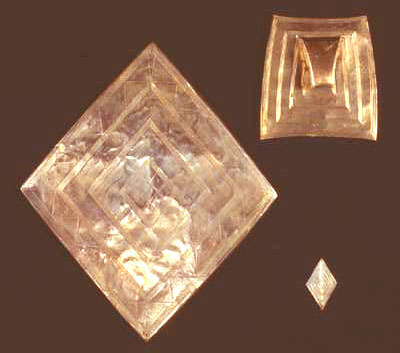
The Bush Barrow Lozenge and associated artefacts located in Southern England, very close to Stonehenge. The intricate pattern incising is far more than decorative and with a set of calipers and a precise rule, a wide variety of codes can be extracted from the main lozenge.
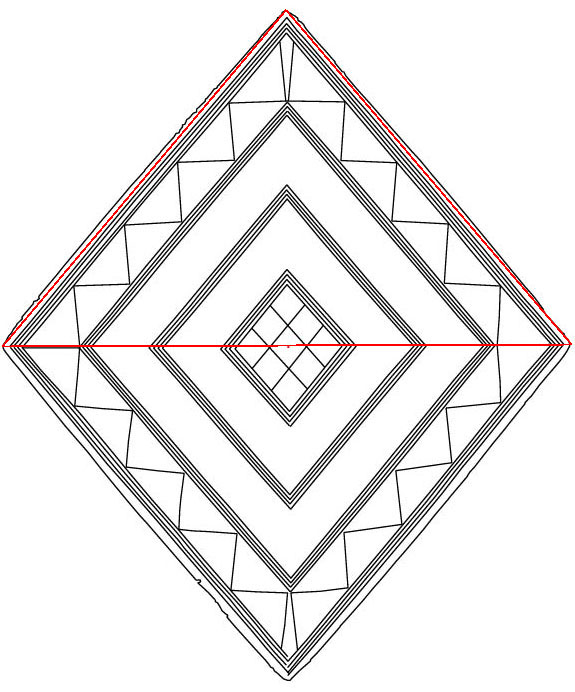
There were once, undoubtedly, a wide variety of "Lozenge" memory devices, used for a range of functions including navigation at sea. For the Viking navigator, remembering the coded dimensions and geometry of the Great Pyramid and that of the Khafre Pyramid, would have been sufficient.
If those encoded principles were committed to memory and the lozenge mnemonic devices were fabricated as precisely "scaled" rules in their side lengths or other internal reducing diamond patterns, then accurate positional plotting at sea was very achievable to the experienced navigator.
Consider the following:
-
The ancient coding for the equatorial size of the Earth, as found on the Great Pyramid is 12 X 12 X 12 X 12 X 1.2 = 24883.2 Greek miles of 5250 feet each. The height of the Great Pyramid is coded to represent 480 feet of vertical height at the point where lines coming up diagonally from each face side intersect in the air above the flat floor altar. The sum of 24883.2 ÷ 480 = 51.84, which just happens to be the slope angle of each face of the Great Pyramid (51.84-degrees).
-
The more difficult trigonometric method for finding the hypotenuse length of the Great Pyramid sides (378 feet Adjacent ÷ 51.84 COS = 611.789 feet is very easily accomplished by using the PHI formula. Therefore: 378 feet x PHI (1.6180339) = 611.6168 feet (a difference of about two inches in the hypotenuse lengths). What this tells us is that the angle 51.84-degrees, based upon a navigational triangle, the adjacent of which is scaled to represent 1/16th of 1-minute of equatorial arc, is created to very good relative accuracy by a simple manipulation of PHI (1.6180339). One could, thus, state that a 90-degree triangle with a hypotenuse angle of 51.84-degrees (as incorporated into the Great Pyramid geometry) has a hypotenuse length that is a PHI increase on the adjacent length. Therefore, the angle of 51.84-degrees, under such geometric design circumstances, could be called a PHI generated angle.
-
The sum of 51.84- miles would be 1/480th of the equatorial circumference under the Great Pyramid's geodetic system or .75 of 1-degree of arc.
-
We therefore can use a navigational triangle where the "Opposite" is considered to be 480 feet, where the "Adjacent" is in a ratio of .7875 to 1 to the "Opposite" and where the "Opposite" is in a ratio of .7854 (1/4th PI @ 3.1416) to 1 to the "Hypotenuse".
THE VIKINGS AND THEIR FOREBEARS KNEW THE EXACT SIZE OF THE EARTH.
The Red segment accentuated in this image from a book on "Positional Astronomy" demonstrates exactly what the Great Pyramid triangle was supposed to encode.
The Great Pyramid triangle taught spherical geometric and trigonometric principles for safe navigation, but also contained mathematically extractable information related to the EXACT equatorial circumference of the Earth.
The following is what early pre-Christian European navigators had to commit to memory and what they handed on generation after generation to their progeny, until the Roman Christian Church finally destroyed their old scientific knowledge:
-
In the coded navigational triangle of the Great Pyramid the "Adjacent" (half the base length) was 378 feet and this distance was 1/16th of 1-minute of arc under the Swedish-Greek-Roman method of reading the Earth's equatorial circumference.
-
The Great Pyramid triangle, however, had to demonstrate to the student of navigation the ratio that existed between the earth's radius and its outer curved face. This was, quite obviously, taught (in view of the Great Pyramid's triangular design configuration, coupled with its scaled geodetic attributes) by using a quarter segment of the Earth's circumference, as shown in the red segment in the picture. The horizontal line X to C represents the radius of the Earth, from the equator to the centre of the Earth. On the Great Pyramid triangle this world dimensional radius was represented by the vertical height (Opposite), coded to be 480 feet. If we consider the Earth's diameter to be 7920-miles, then its radius is 3960-miles. The reduced sum of 480-miles would, therefore be in a scale of 1 to 8.25 against the true radius.
-
The 480 feet Opposite, however, had to be in a ratio of .7854 to 1 to the distance measurement of the face (Hypotenuse) of the Great Pyramid triangle. The PI ratio for converting a circle's diameter to a circumference is 1 to 3.1416, thus the .7854 to 1 value is 1/4th of PI. In the above picture the curve red line represents 1/4th part of the sphere or 1/4th PI.
-
To achieve a distance on the Great Pyramid's Hypotenuse or face that demonstrated a ratio to the Earth's radius, compared to its curved outer or spherical surface, either a PHI (1.6180339 to 1) increase on the Adjacent was used or else the Opposite (480 feet) ÷ 1/4th PI (.7854) was used. So, 378 feet X 1.6180339 = 611.6168142 feet (the length of the Great Pyramid's faces to where all diagonally upward lines resolve to a common apex point). If this Hypotenuse length is multiplied by .7854 (1/4th PI @ 3.1416) then the value achieved for the Opposite or vertical height is 480.3638459 feet or very close to 480 & 4/11th feet. By this means a wonderful tutorial is available to teach the ratio difference between the radius of a sphere (like the Earth) and quarter of it's circumference. It should be noted that trigonometry dictates that the apex height of the Great Pyramid would have sat between 480 and 481 feet of vertical height, in consideration of a half base length of 378 feet and a slope angle of 51.84-degrees. There was, of course, never a capstone on the pyramid only an flat floor altar on top, but the geometric principles of a "full" pyramid still applied.
-
The "Official" equatorial diameter of the Earth is 7926-miles of 5280 feet each. The radius of the Earth is, therefore, 3963-miles and its official equatorial circumference is 24,900.26337-miles.
-
If the above 480 & 4/11th feet were called (coded as) miles, then that would be in a ratio of 1 to 16.5 on the Earth's diameter or 1: 8.25 to its radius. Therefore: 480.36363636-miles X 16.5 = 7926 miles for a precise reading of the Earth's equatorial circumference of 24900-miles.
-
For navigational convenience, this value was anciently set at the highly factorable number of 24883.2-miles (12 X 12X 12 X 12 X1.2), which, depending on navigational method preference, could be miles of 5280 feet ("11" family) or 5250 feet (6&7 family). In all, there were several navigational methods, exploitable within different number families and the Great Pyramid geodetic or navigational geometry was adaptable and applicable to them all.
-
In this study, we have seen how the PHI formula was used by ancient Caucasoid civilisations in a very dynamic way and practical sense for creating highly accurate volume vessels for the marketplace or tutorials in spherical geometry.
-
The exactness of the Great Pyramid equatorial coding suggests a former age of very advanced technology that was lost because of a cataclysmic event, in the aftermath of which only some very specialised knowledge survived. The parcel of numbers describing the duration of cycles and the equatorial dimensions of the Earth was used to re-establish and preserve "civilisation".
Other Great Pyramid attributes that would be committed to memory include:
-
The 378 feet increment X 12 = 4536-inches. It just so happens that the flat floor altar atop the Great Pyramid (which has always been there throughout recorded history) sits at a height of 453.6 feet. The equatorial size of the Earth, according to the main Great Pyramid coding is 24883.2 Greek miles or 130636800 feet. This divided by 453.6 = 288000.
-
Late era Egyptian Priests told Herodotus that each face of the Great Pyramid represented 8-Pyramid acres. Given the literal dimensions of the Great Pyramid with its flat floor altar on top, each face equals 400 feet (756 feet of base length with an altar floor on top that is 44 feet long) X 576 (the length up the face to where the altar floor begins) = 230400 square feet. This ÷ 8 = 28800 square feet. Note: the Aubrey Circle at Stonehenge has a diameter of 288 feet and the Hypotenuse length up the Menkaure Pyramid was intended to be 288-feet. Note: Menkaure Pyramid was abandoned before it was completed... probably about 5000 BC... the Pyramids of Giza are far older than we're led to believe and there's no real evidence to suggest that they were built during the Dynastic period. Menkaure Pyramid (misnamed like the rest) was intended to have a slope angle of 51.84-degrees, just like the Great Pyramid.
-
The literal sum total of "pyramid acres" in the 4 faces and area that the Great Pyramid occupies = 756 x 756 of base area = 571536 square feet + 921600 of side area =1493136 square feet. This divided by 28800 (pyramid acre value) = 51.845 pyramid acres all up...coding 51.84 yet again
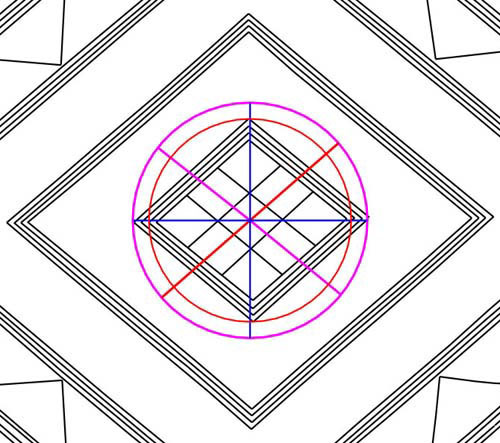
The Bush Barrow Lozenge centre section, based upon an accurately scaled drawing of the lozenge done within the exacting confines of AutoCAD. Scaling was completed by reference to dimensions supplied by Mr. Paul Robinson, Curator of the Devizes Museum, Wiltshire, England.
-
The red line running diagonally up to the right is on an angle of 51.84-degrees...the same as the inscribed line on the Clandon Lozenge's centre arm of the St. Andrew's Cross.
-
The magenta line running diagonally up to the left is on an angle of 311.04-degrees...the same as the inscribed line on the Clandon lozenge's centre arm of the St. Andrew's Cross. Under the 24883.2-mile equatorial circumference, the sum of 3110.4-miles would be 1/8th of the equatorial circumference or 45-degrees of arc.
-
Several mnemonic codes interplay herein...311.04-degrees minus 51.84-degrees = 259.2-degrees. The Heel stone outer face at Stonehenge sits 259.2 feet from site centre at an angle of 51.84-degrees to its south facing side. There are 25920-years in the Precession of the Equinoxes. The sum of 311.04-degrees is 360-degrees minus 48.96-degrees. If the value of 48.96-degrees is added to 51.84-degrees, then the total is 100.8-degrees. The value of 100.8 feet was 1 second of Earth equatorial arc under the Great Pyramid "6&7" geodetic assignment, which sized the Earth to 24883.2-miles of 5250 feet. At Stonehenge's Sarsen Circle inner rim one of the cross measurements between lintels was 100.8 feet, coding 1-second of arc.
The foregoing represents just some of the coding that the Scandinavian navigator (or any late era Druidic Priest, Seidr wise woman, teaching navigation, for that matter) would have committed to memory for the fluid reading of navigational devices ... (like the code-bearing Seidr wands or staffs).
He or she had the option of using a range of cubits or feet measures, including Hebrew Reeds of 10.5 feet, Assyrian cubits of 25.2-inches, Celtic or Hebrew Royal Cubits of 21-inches, Celtic common cubits of 18-inches, older Hebrew and Babylonian feet of 17.5-inches or 16.8-inches, Greek feet of 12.6-inches, Swedish-Roman feet of 11.6666-inches, a measurement identified by Egyptian Priests to Herodotus of 11.34-inches (lunar...3 sides of the Great Pyramid = 2268 feet or 1134 feet x 2), etc., all of which would fit the literal dimensions of the Great Pyramid.
The best known Egyptian Royal Cubit (one of 3 types), which is simply a memory device for remembering the equatorial circumference of the Earth, is 1/440th of the Great Pyramid's length or 20.61818182-inches (20 & 34/55ths).
There was, of course, another geodetic system built into the Great Pyramid, which meant extending it's length by 3-inches (756.25 feet per side) by this means the equatorial circumference could be read in miles of 5280 feet (under an "11" family of numbers...League, 16500 feet, Mile , 5280 feet, Furlong or Furrowlong, 660 feet, Chain, 66 feet, Rod or Perch, 16.5 feet, Fathom, 5.5 feet, Link, 7.92-inches). This second method was preserved in Britain and Germany, but the existence of an "11"-inch rule amongst the Viking measurements attests to the fact that this navigational system was also used, at times, in Scandinavia.
THE OTHER NAVIGATIONAL TRIANGLE
Along with the main navigational triangle incorporating a scaled Adjacent that was .7875 the value of the Opposite and in a PHI relationship between the Adjacent and Hypotenuse, etc., there was yet another very important one for following the cycle of the moon.
Obviously, the moon's position every night is a very good indicator of ship's position, provided the navigator knows the cycle of the Moon on a daily basis during the lunar year or its larger duration cycle over 18.613 solar years (anciently set at 6804-days). All of the scientific information necessary is found on the Khafre Pyramid, Egypt's Pyramid of the Moon.
The way to find the exact intended dimensions of the Khafre Pyramid is to realise that it's 15/16ths the base length of the Great Pyramid. Therefore: 756 ÷ 16 = 47.25 feet x 15 = 708.75 feet.
If one dissects the Pyramid in half from the centre base to the apex, then a 3,4,5 triangle is the result. Half the base length is therefore 354.375 feet and it just so happens that there are 354.375-days in a lunar year. The dimensions are Adjacent, 354.375 feet (3 x 118.125), Opposite, 472.5 feet (118.125 x 4) and Hypotenuse, 590.625 feet. All of these numbers are dynamic lunar values. The inch count around the pyramid is 708.75 x 4 x 12 = 34020-inches (1/2 of 68040 inches).
Note there are 6804-days in the ancient calibration describing the lunar nutation cycle. Also the Adjacent value of 354.375 (354 & 3/8ths days) ÷ 12 = 29.53125-days (29 & 17/32nds days or 708 & 3/4ths hours). The lunar month is 29.53125-days to a precision of less than a minute.
OSEBERG BURIAL SHIP AND THE 354.375-DAY DURATION OF THE LUNAR YEAR, AS ENCODED INTO THE BASE LENGTH OF THE KHAFRE PYRAMID.
Excavation of the ship from the Oseberg burial mound (Norwegian: Oseberghaugen ved Slagen from the Old Norse word haugr meaning kurgan mound or barrow) was undertaken by Swedish archaeologist Gabriel Gustafson and Norwegian archaeologist Haakon Shetelig in 1904–1905. The grave also contained two female human skeletons as well as a considerable number of grave goods. Scientific dating of the ship suggests it was buried no earlier than 834, although certain parts of its structure date from as early as 800, while other parts may be even older. See: https://en.wikipedia.org/wiki/Oseberg_Ship
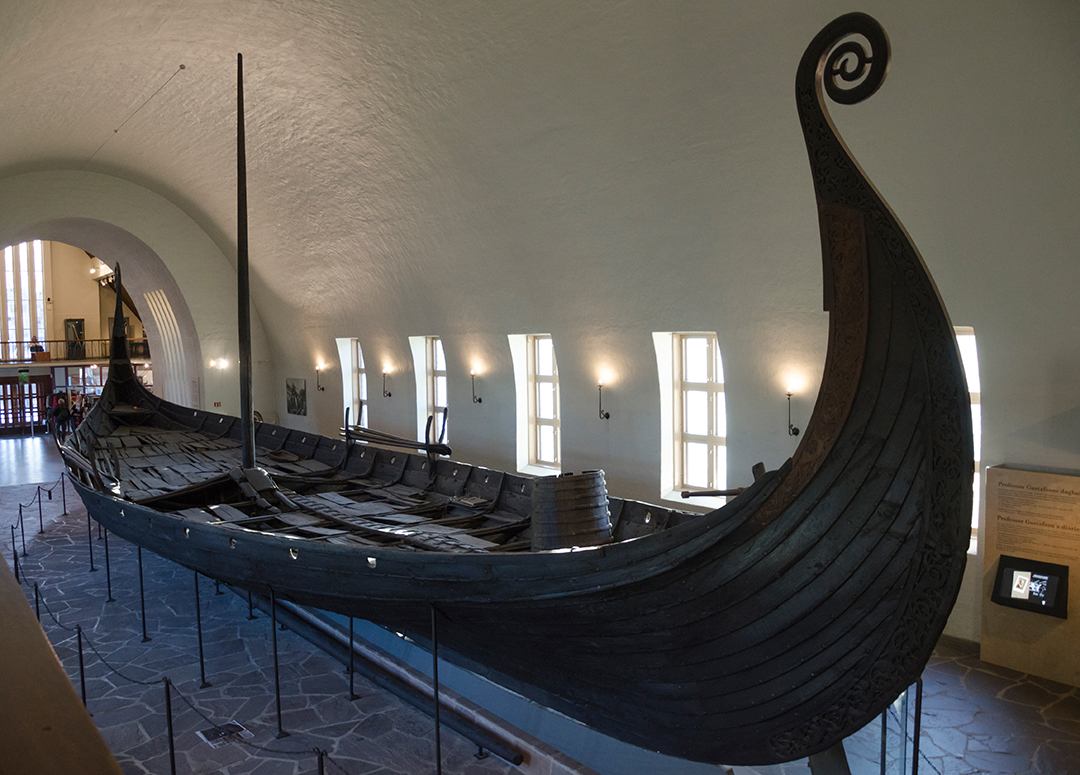
The length of the Oseberg ship seems to have been intended to code the the length of the Khafre Pyramid (708.75') at 1/10th scale ... It is officially said to be measured to be 21.6 m, which is 70.86613968' (70.875'). Other "Viking" burial ships will undoubted carry similar codes in the lengths and beam widths.
The ship is a Karve, clinker built, almost entirely of oak. It is 21.58 metres (70.8 ft) in length and 5.10 metres (16.7 ft) broad, with a mast of approximately 9–10 metres (30–33 ft) in height. With a likely sail area of 90 square metres (970 sq. ft).
The Oseberg ship (Norwegian: Osebergskipet) is a well-preserved Viking ship discovered in a large burial mound at the Oseberg farm near Tønsberg in Vestfold og Telemark county, Norway. This ship is commonly acknowledged to be among the finer artifacts to have survived from the Viking Era. The ship and some of its contents are displayed at the Viking Ship Museum at Bygdøy on the western side of Oslo, Norway.[1]
It can be readily seen that merely by memorising the dimensions of code-bearing edifices, sea-going vessels or specially fabricated memory devices, then working from precisely scaled rules, navigational mathematics would be kept at the forefront of memory..
Added to that, the boat itself would be coded according to length and breadth with navigational measurements, so that a forgotten principle could be recalled by measurements on board. This would include the volumes contained within the food storage tubs and barrels, the dimensions of sailor's sea chests that they sat upon when rowing, the length of oars, the height of the dragon head prow, etc., etc. Rest assured that no opportunity to build codes into internal positions of the boat would be missed.
Added to the above, if a boat was swamped and wrecked, but the navigator and others survived, sufficient to build a raft or patched up boat on which to limp home, all of the navigational aids could be restored if the navigator retained a rule or even a belt buckle that was a true inch wide. The fact of the matter is that the ancient navigational methods are so sophisticated that, with the aid of an abacus, an adept, well trained, ever alert and clever navigator could work out Longitude with relatively good accuracy based upon zenith stars and Latitude with little else but a shadow pole.
Although it has been stated by several authors that nothing has survived to indicate Viking navigational knowledge and methods, a huge amount has, in fact, survived. The researchers, unfortunately, have been looking in the wrong places. They should have delved deeply into the most ancient "Weights, Measures & Volumes" used and preserved by the Scandinavians to find the navigational mathematics. Those special numbers are based upon Great Pyramid, Khafre and Menkaure pyramid numbers.
Many more of the ancient European-Mediterranean standards can be identified, then categorised as to function and number family. The same processes identified herein will apply to any long-established European nations or their colonies over several continents.
A Celtic Torque, taken from the grave of the Princess of Vix, (circa 5-600 BC). It weighs 480 grams, which converts fluidly to 16.875 ounces (16 & 7/8ths). Its carefully fabricated and coded weight is, therefore, in direct ratio to both the Greek Commercial Talent or Tridrachm (Beqa) gold standard Talent and it represents 1/80th of the Talent weight in both standards.
The Torque depicts the rising and setting orb of either the Sun or Moon and shows a "Greek Pegasus" flying horse ascending upwards on the orb to the East (right) and downwards on the orb to the West (left). In terms of the grain weights inherent within the artefact or Greek Commercial & Tridrachm standards, the numbers produced are lunar and 16.875-days (504-hours) would be 1/21st-part of the lunar year of 354.375-days duration.
A mathematical progression string based upon 16.875 goes:
16.875, 33.75, 50.625, 67.5, 84.375, 101.25, 118.125, 135, 151.875, 168.75, etc. However, as the progression increases, the following larger expressions of 16.875 are generated:
354.375 ... 472.5 ... 590.625 ... 708.75 ... 1417.5 ... 2126.25 ... 2835, etc. These are numbers that relate directly to the dimensions (in feet of 12-inches) to the Khafre Pyramid of Egypt (a pyramid of the moon).
We can analyse the ancient Swedish "Weights" system, based upon "grains". A cursory assessment shows it to be using the same mathematical progression as the Hebrew "Desert Heavy Weight" standard, where the Talent, Mina and Shekel are in direct proportion to the ancient Swedish "Skeppspund". The internal coding of these related (ancient Hebrew & Swedish) systems of weights refers directly and dynamically to the lunar cycle and navigation.
Remember, no pre-Christian weights, measures and volumes standards used by the European nations were arbitrary and meaningless and all were in perfect ratio, either within the provinces of the same nation or to the standards of other cousin nations. The perfect ratios that existed between provincial or national standards allowed everyone to trade in the same market places around the Mediterranean or Atlantic and easily convert quantities mathematically.
All original standards, put in place then maintained by overseer scientist-astronomers like the Druids or their forebears, always contained profound scientific information, very essential to continued abundant living and optimised society. That scientific information came from a solitary parcel of highly specialised numbers, handed down from remotest antiquity and it is still found in the geometry of standing stone circles or via the dimensions and angles found upon the most ancient edifices of the Mediterranean and Europe.
The sophisticated astronomical and navigational sciences embraced by all the nations surrounding the Mediterranean Basin, throughout continental Europe and the British Isles allowed them to sail, at will, to any reasonably temperate zone on the globe ...even unto the very ends of the Earth.
Martin Doutré, September 30th 2025. ©