WHY IS THE GAOGOULI PYRAMID OF JIÁN, JILIN, CHINA
BUILT TO ENCODE ASTRONOMICAL NUMBERS IN TRADITIONAL, WESTERN FEET & INCHES?
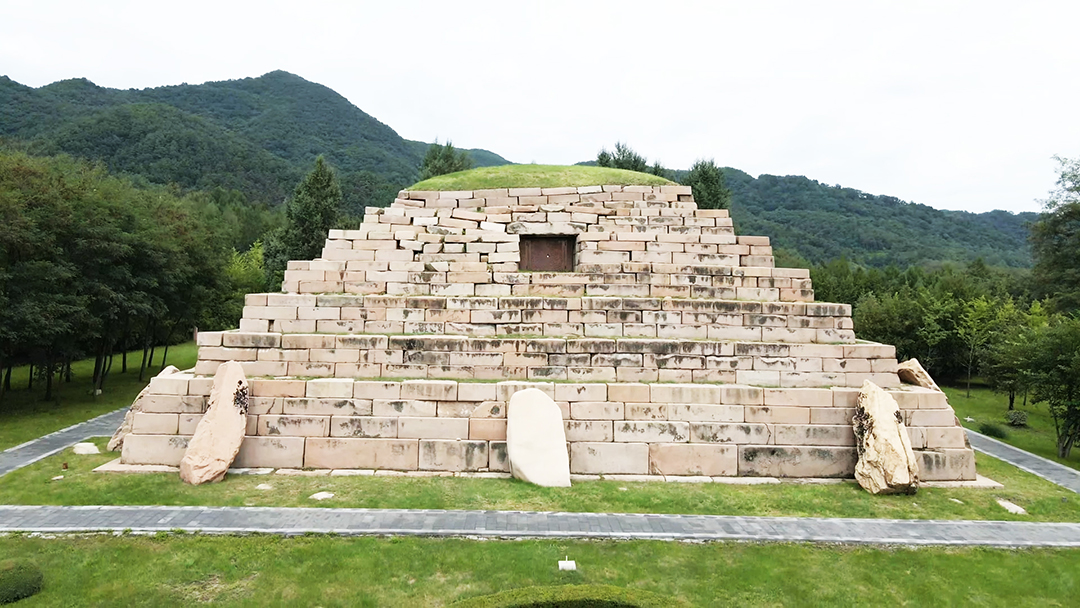
This very impressive stepped stone pyramid is called variously the Gaogouli Pyramid or the Tomb of the General. It is situated to the North of Korea at Ji'an, Ji'lin, China at coordinates 41° 09' 27" N 126° 13' 34" E

This Chinese-Korean Pyramid is officially said to have a square base measurement of 31.58 metres per side. The pyramid's square base is offset from the cardinal points of the compass and its eastern side appears to orientate towards north at an intended azimuth angle of 314.16-degrees (coding PI @ 3.1416).
This outstanding stepped pyramid edifice is so impressive that it has been dubbed The Pyramid of the East.
The origins and claims as to who, in fact built the Gaogouli Pyramid (also called the Tomb of the General) are hotly disputed between Korea and China, with both countries submitting their claims and evidence to UNESCO for recognition of historical ownership and cultural heritage status.
With such determined efforts proclaiming ownership at high government levels, it's improbable that there'll be any consensus agreement arrived at in the foreseeable future.
The impressive stone-block edifice is now situated in Chinese territory. Since 1949 the Yalu River has been deemed as the border, separating Ji'an, China from North Korea. Historically, however, Jián (Gungnae) was anciently the capital of Goguryeao, one of three rival Korean kingdoms and remained so until 3 CE, when the capital was moved southwards to Pyongyang in 427 CE by King Jangsu. It is theorised that either King Jangsu or his father were buried in the Gaogouli Pyramid tomb.
Constructing this edifice was no small feat of engineering and great efforts, to lock the stonework immovably in place, have resulted in its overall preservation for 1500-years or realistically, much longer. However, many centuries or millennia of abandonment resulted in the pyramid becoming an earth and tree covered mound and the immense forces of root pressure have dislodged and jostled many stone blocks, especially in the upper regions.
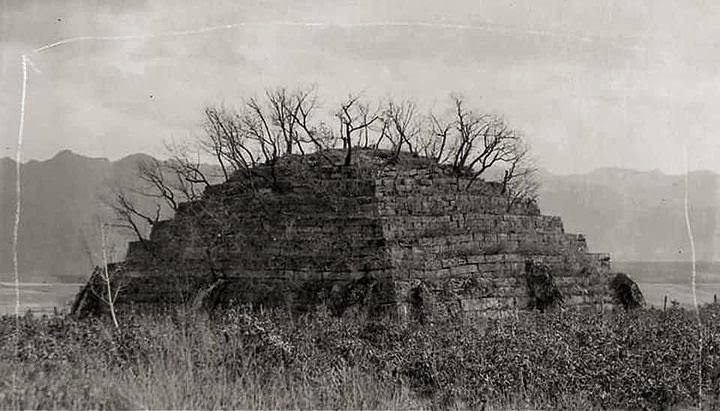
A 19th century photograph of the pyramid before work to clear its terraces of plant growth and debris. The high hill range in the background once served as the outer-marker alighting points for the equinoctial and solstice sunsets. The Gaogouli Pyramid functioned as a solar observatory.
SO, HOW DID IT MANAGE TO HOLD TOGETHER SO WELL FOR SO LONG?
The answer lies in an interlocking construction method, where each massive block of granite was grooved to sit into a recess of a block above or below. By this very labour-intensive locking method of carving out the blocks, the sheer weight of the seven tiers and twenty-two courses would not allow slumping or spreading to occur.

Here's a picture of a foundation course stone block, where root pressure has lifted and dislodged an upper block, raising it from the carved-out recess that locked it into position. The raised edge-wall, flat top of the base block was measured to be 9 cm wide, with the recess depth of the laboriously hogged-out granite behind being 5 cm deep.
Here we're starting to see the beginning of the measurements used, with hundreds of others yet to be considered in the course-heights and step-widths, etc. The sum of 9 cm converts to 3.54375" to a tolerance of 0.00044 of an inch or about 1/2400th and unable to be detected by the human eye. The sum of 354.375-days is 1 lunar year.
Likewise, the sum of 5 cm of recess converts to 1.96875" to a tolerance of 1/4000th of an inch. The Beqa gold standard of the Egyptians, Greeks and Romans was 19.6875 grains weight for assaying gold dust. This value, adopted from the Egyptians by the Greeks and Romans, is a lunar code and 19.6875-days = 1/18th of the 354.375-day lunar year.
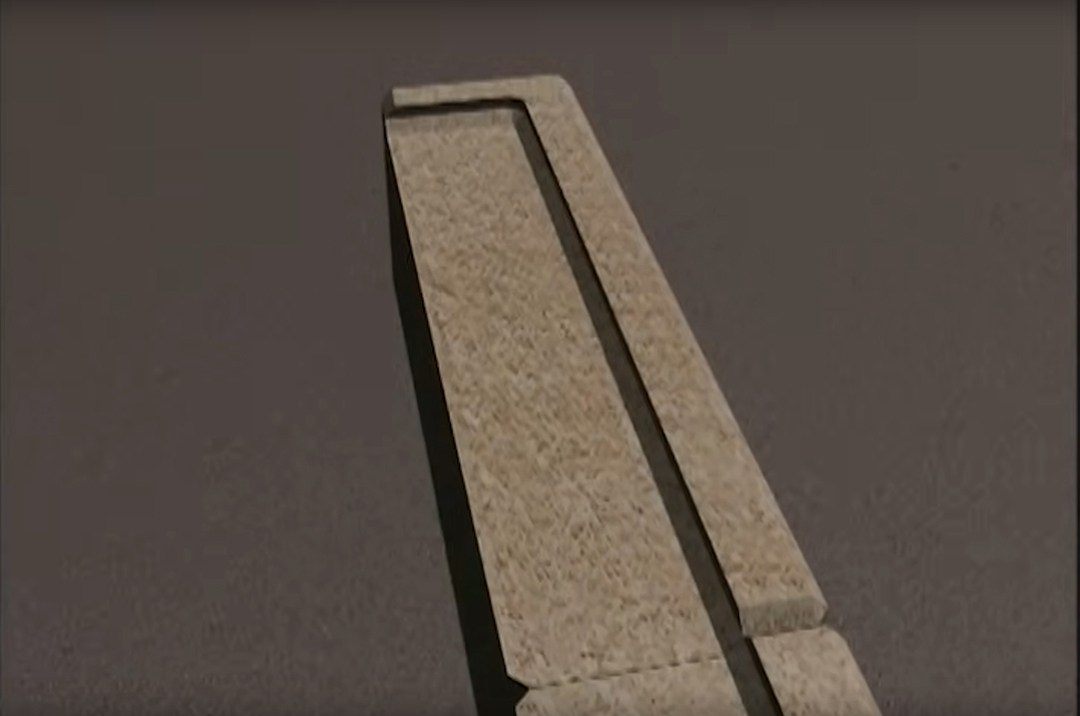
Here's a depiction of how the blocks had to be laboriously edge-carved and hogged-out with extreme precision. Just quarrying, then cutting blocks to length and width was hard enough, but then carving them so uniformly for precise edge-wall width and an even, uniform depth to the rear, constitutes precision-engineering that would be horrendously difficult to achieve ... and carved into over 1100 hard granite blocks.
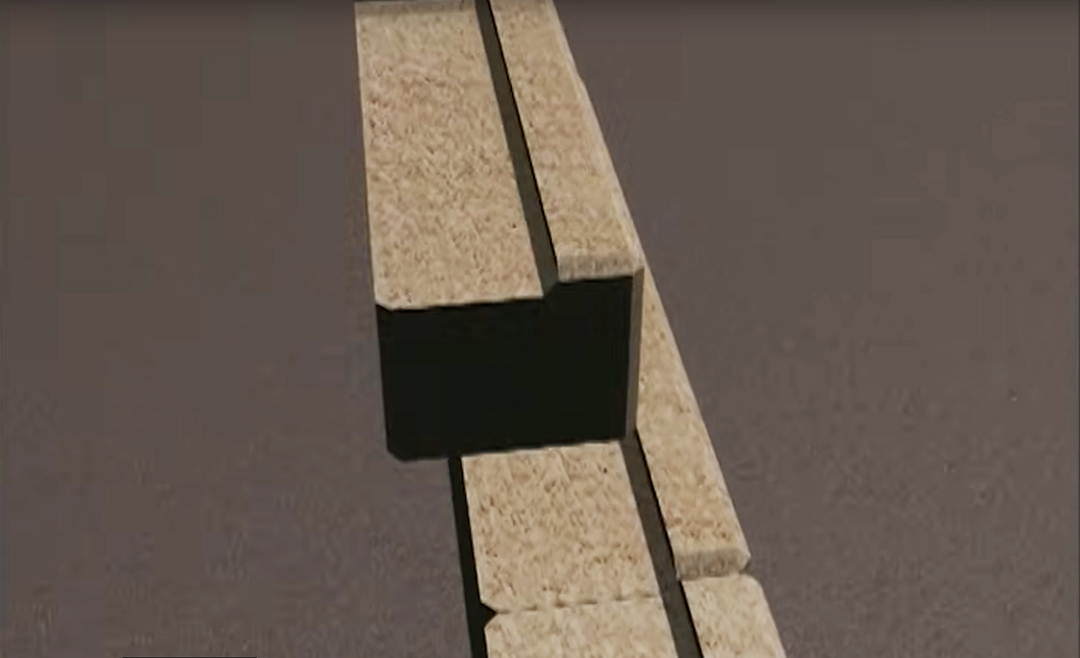
Here, an upper block sits down in the recess of the under-block and is locked into an immovable position by the thick outer retaining wall.
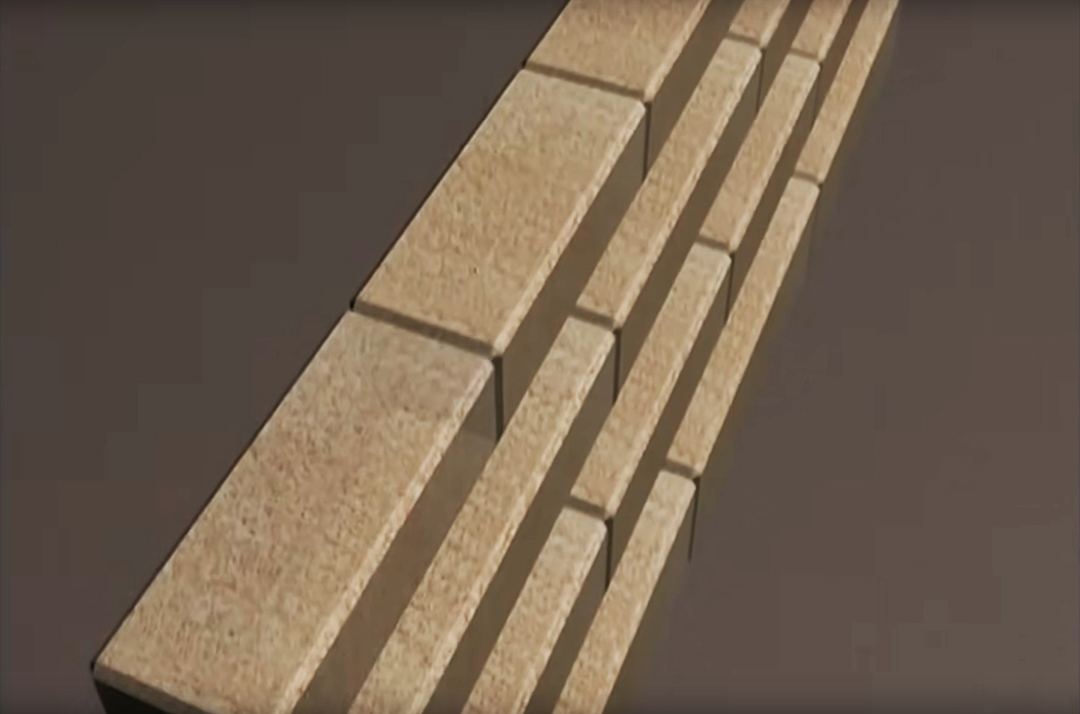
And so the edifice rises up, solidly locked together course-by-course. It's little wonder that the building largely survived the ravages of time and didn't get pushed apart by its own immense, spreading weight, into a pile of cascading rubble.
SO NOW LET'S LOOK AT THE CODE-BEARING THICKNESSES OF EACH COURSE OF BLOCKS, AS WELL AS THE STEP WIDTHS.
In a 1995 Korean documentary there was a segment where measurements were discussed in the office of a surveyor, drawing up plans of the Gaogouli Pyramid layout and dimensions.
Fortuitously, the TV camera glossed quickly over some scribbled numbers relating to the thickness of each course of blocks, as well as the measured widths of each rising step.
All of the measurements were in millimetres, which could, of course, be converted into the ancient Mediterranean, Continental European and British Isles inch and foot standards, used on the pyramids of Egypt, as well as the Megalithic Age - Bronze Age , etc., sites of Europe since time immemorial.

The scribbled overall measurements of the course and step widths. Thankfully the camera also did a close-up, where the numbers were readable.
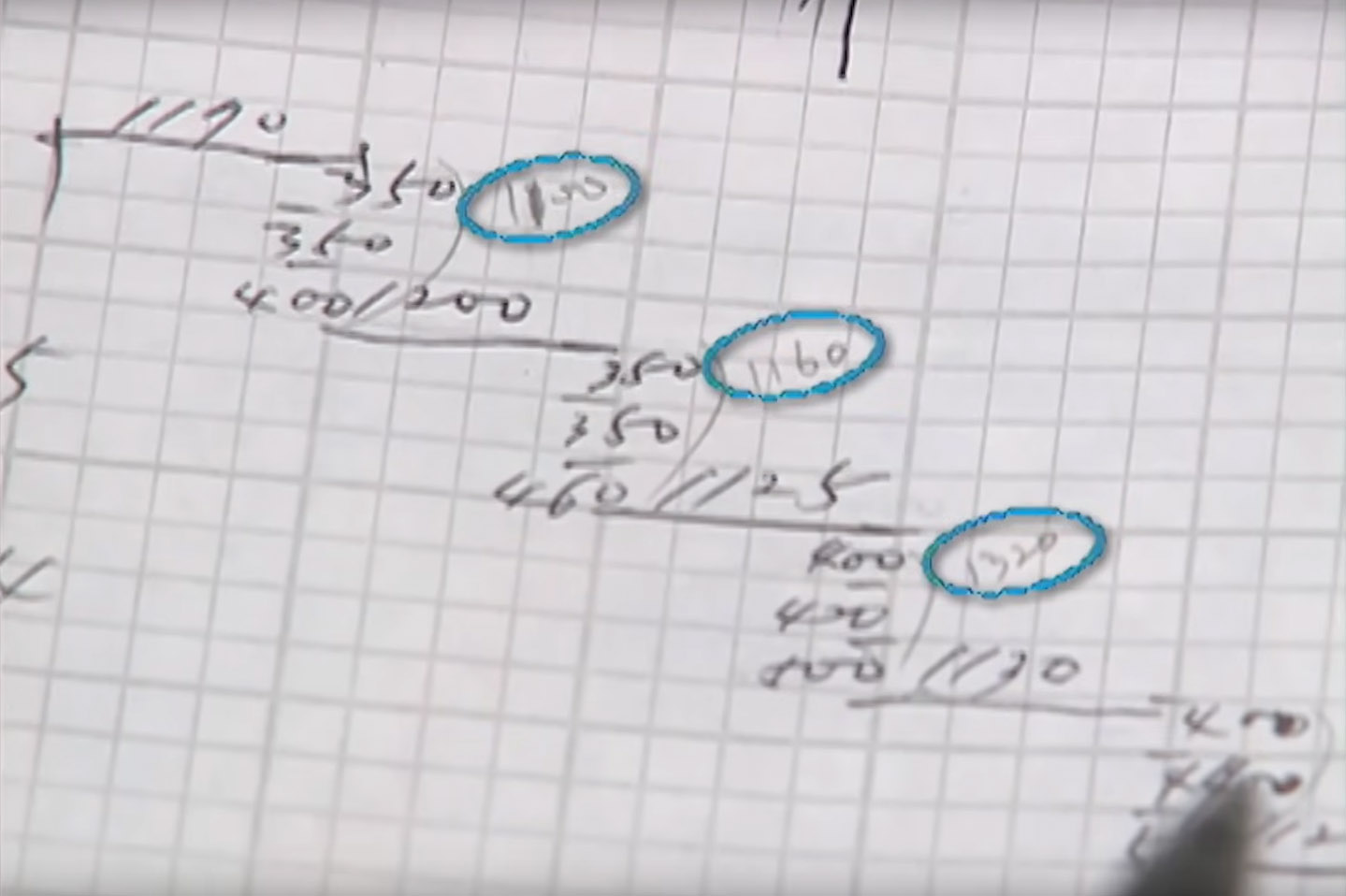
A section of the architect's scribbled rough notes, showing the carefully measured thicknesses of the courses in each rising tier, as well as the step widths. The surveyor has shown the total height of each tier (circled), which helped in deciphering some of the almost illegible numbers for the course widths in the scribbled rough notes.
It appears that the surveyor measured the top of tier 7 to have a circuit of edge blocks around the perimeter @ 1190 mm of width. This would equate to 46.875" (a navigational & grain-weight number) to a tolerance of about 1/3rd of an inch excess.
All of these "official" measurements will be identified as we proceed.
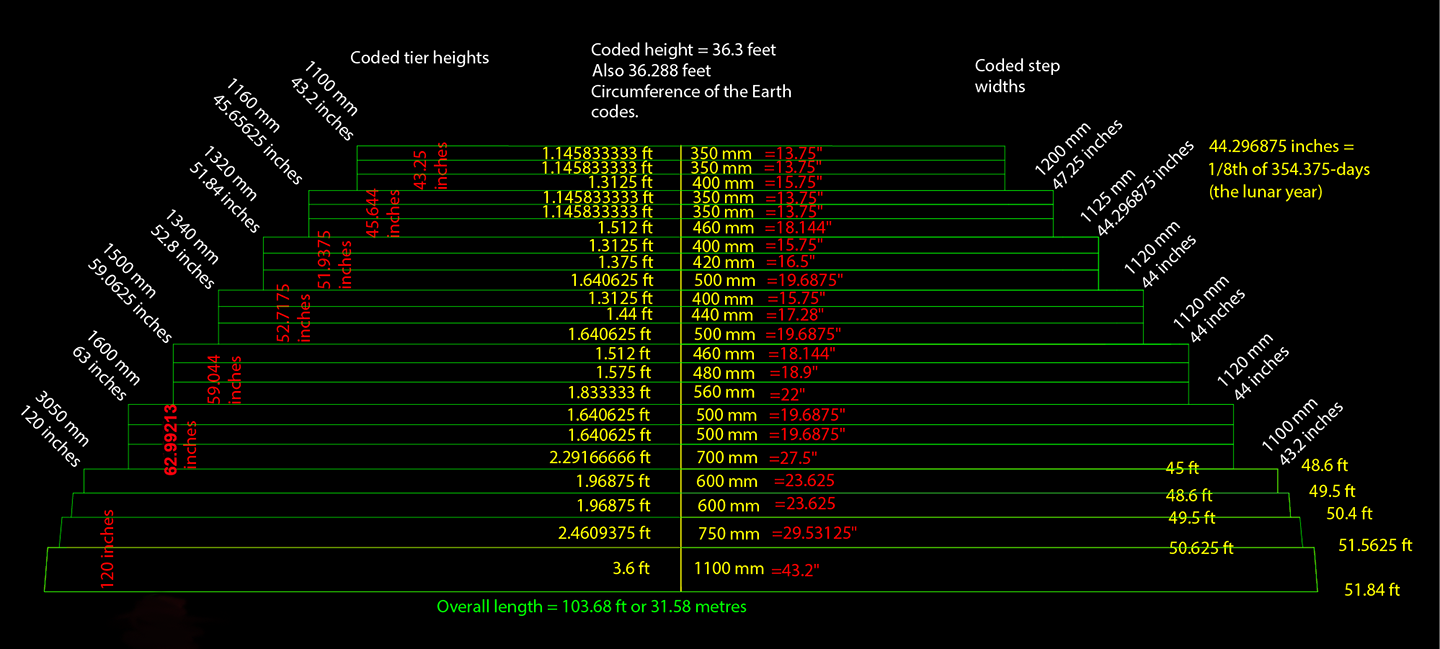
The yellow numbers, to the right of the vertical, centre-line base, are the millimetre widths of each course and the red coloured numbers adjacent are the converted inch totals for the millimetre readings.
To the far left of the picture are white numbers on a diagonal angle at each step corner. These provide the measured millimetre heights for each tier and that measurement has been converted for readings in inches.
To the far right of the pictures are also numbers on a diagonal angle at each step corner. These provide the step widths in millimetres for each tier and that measurement has been converted for readings in inches.
In the middle section at the top floor of the pyramid the coded inch totals for each tier are added together to give the height of the pyramid, which is 36.3 feet.
In a world configured to be 24883.2-miles of 5250-feet each, the segment for 1-second of equatorial arc would be 100.8-feet, a minute of arc 6048, a degree of arc 362880, and the equatorial circumference 130636800-feet.
In a world configured to be 24750-miles of 5280-feet each, the segment for 1-second of equatorial arc would be 100.833333-feet, a minute of arc 6050, a degree of arc 363000, and the equatorial circumference 130680000-feet.
The Korean surveyors have measured the 6th tier, made up of 3 courses, as 1160 mm. This converts to 45.65625" to a tolerance of 1/76th of an inch. This is 45 & 21/32nds -days.
The sum of 45.65625-days (1095.75-hours) would equate to 1/8th of the Solar year of 365.25-days. This division of the year into 8 parts ... Summer solstice - Lughnasa - Autumn equinox - Samhain - Winter solstice - Imbolic - Spring equinox - Beltane is an ages-old, "Wheel of the Year" tradition, practiced by Celtic civilisations for millennia.
Here is the read-out of the base-to-summit number codes, built into each subsequent course of the pyramid, bottom-to-top:
COURSE 1.
(1). 1100 mm = 43.2" to a tolerance of about 1/10th of an inch.
A number-string based upon 43.2 goes:
43.2, 86.4, 129.6, 172.8, 216, 259.2, 302.4, 345.6, 388.8, 432 ... 518.4, 604.8, 648, 691.2 ... 777.6 ... 864, 907.2, 950.4 ... 1036.8, 1080... 11664, 1209.6 ... 1382.4 ... 1512, 1555.2 ... 1900.8, 1944... 2073.6 ... 2376 ... 259.2 ... 2851.2 ... 3024 ... 3110.4 ... 3240 ... 3628.8 ... 5400... 5443.2 ... 5832 ...6048 ...7560 ... 8294.4 ... 9072 ... 9331.2 ... 9720 ... 11880 ... 12441.6 ... 24883.2.
Note: The Great Pyramid of Egypt @ 756' per side equals 70 X 43.2' for one circuit around the Pyramid (3024'). In the 25920-year duration of the Precession of the Equinoxes, 4320-years is 1/6th. The sun spends 2160-years in each House of the Zodiac (half of 4320-years).
Also 43.2" = 3.6' and one side length of the Great Pyramid @ 756' = 3.6' X 210.
COURSE 2.
(2). 750 mm = 29.53125" to a tolerance of 1/280th of an inch, which is visually undetectable by the human eye.
A number-string based upon 295.3125 goes:
295,3125, 590.625 ... 1181.25 ... 1771.875 ... 3543.75 ... 4725 ... 5906.25 ... 7087.5 ... 9450 ... 14175 ... 18900 ... 28350 ... 34020 ... 68040 ... 130636800.
The sum of 29.53125-days (29 & 17/32nds) is a lunar month to a tolerance of under 1-minute in time. Under the 3-4-5 triangle-coding for half the base length of the Khafre Pyramid of Egypt, the increment used was 118.125-feet X 3 (base), 118.125-feet X 4 (vertical height to the apex) and 118.125-feet X 5 (diagonal face hypotenuse).
The sum of 118.125-days is 4 lunar months of 29.53125-days each.
In the above progression we have expanded values for 29.53125, 354.375, 472.5 and 590.625. Under the design architecture of the Khafre Pyramid of Egypt, half the base length is 354.375-feet, the vertical height is 472.5-feet and the hypotenuse face is 590.625-feet. Note: 590.625-feet is 295.3125-feet X 2.
The design-length of the Khafre Pyramid is 708.75-feet (15/16th of the 756-feet length of the Great Pyramid). The full perimeter-circuit length for Khafre is 2835-feet @ 708.75-feet per side.
In the above progression we have 3402 & 6804 represented in enlarged values. This of course refers to the half-period and full period of the Lunar Nutation Cycle of 6804-days.
Also occurring is the number 18900. Under the lunisolar Sabbatical Calendar system, when doing calculations for the duration of a solar month compared to a lunar month the formula was: 1890 ÷ 63 = 30 (the solar month); 1890 ÷ 64 = 29.53125 (the lunar month). Note: the ancient Calendar of Coligny bronze plaque of France was a parapegma device, with peg holes to track the daily calendar positions of both the sun & moon.
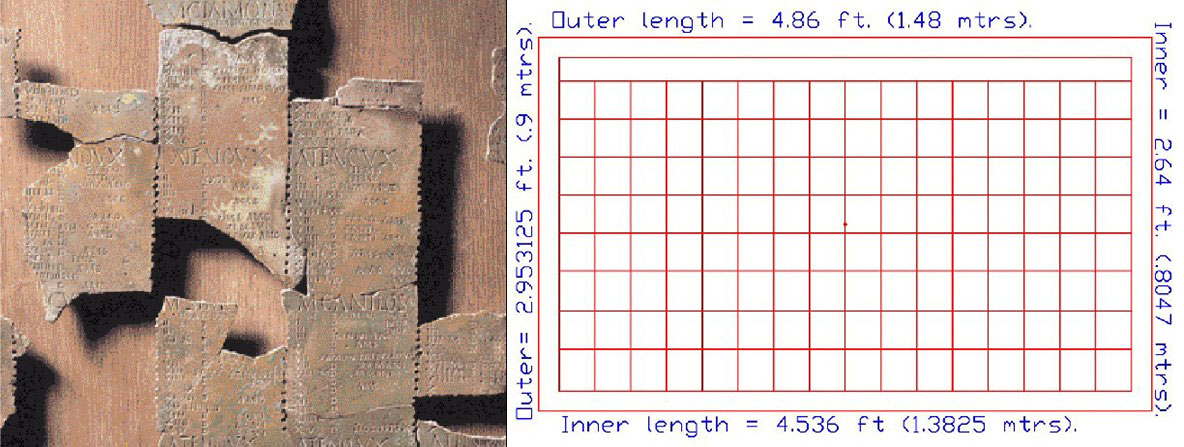
Under this lunisolar Sabbatical Calendar system, the lunar period was tracked throughout 7.2 lunar-years alongside 7 solar years. The larger 6804-day count for the Lunar Nutation Cycle was simultaneously tracked.
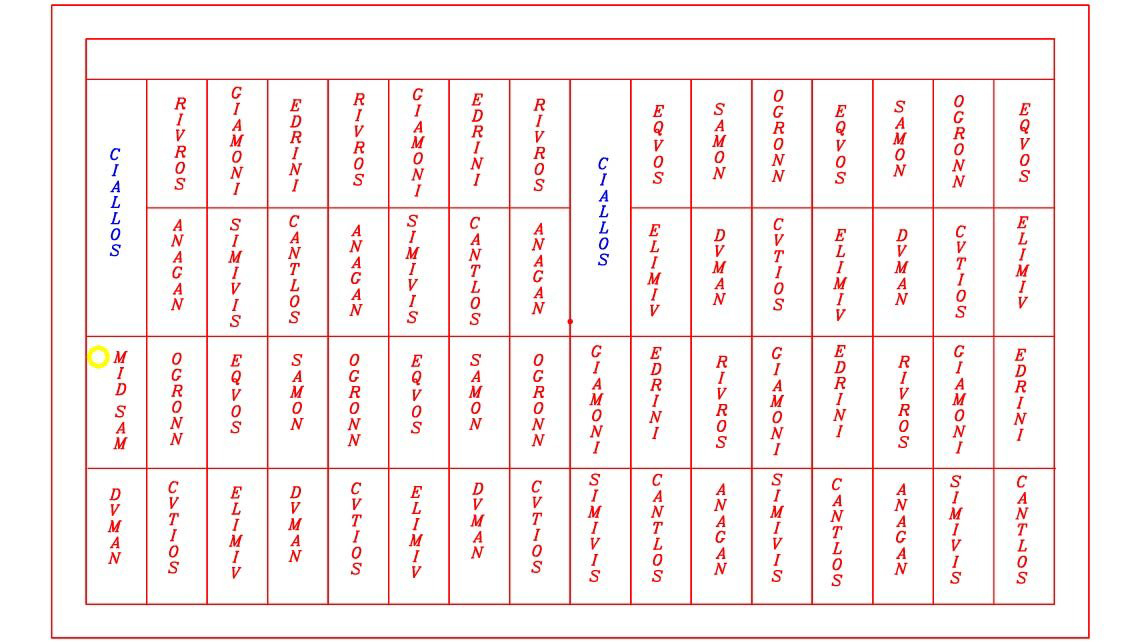
All of the named segments seen were divided into two parts, and all had small peg holed on the vertical dividing lines. The peg for the solar count and the peg for the lunar count were moved to a new slot daily.
COURSE 3.
(3). 600 mm = 23.625" to a tolerance of about 1/330th of an inch, which is visually undetectable to the human eye.
A mathematical progression based upon 23.625 goes:
23.625", 47.25, 70.875, 94.5, 118.125, 141.75, 165.375, 189, 212.625, 236.25, 259.875, 283.5, 307.125, 330.75, 354.375, 378 ... 472.5 ... 567, 590.625 ...708.75 ... 756 ... 850.5 ... 945 ... 1134 ... 1181.25 ... 1417.5 ... 1512 ... 1701 ... 1771.875 ... 1890 ... 2268 ... 25515 ... 2835 ... 2953.125 ... 3024 ... 3402 ... 3543.75 ... 3780 ... 4536 ... 4725 ... 5103 ... 5670 ... 5906.25 ... 6048 ... 6804 ... 362880 ... 130636800.
This string relates to the lunar codes of the Khafre Pyramid and the 3-4-5 triangle method of its construction. The value 118.125' (which in days would equate to 4 lunar months of 29.53125-days was used for the 3-4-5 triangle. The half-base length was 354.375' (note: 354.375 -days is 1 lunar year; the vertical height to the apex was 472.5'and the sloping side was 590.625'... forming a 3-4-5 triangle based upon 118.125' X 3, 4 & 5. The value 2835 represents 1 full perimeter circuit of the Khafre Pyramid.
The string also identifies the dimensions of the Great Pyramid, as well as 1-minute and 1-degree of equatorial arc, culminating in the full equatorial circumference. Also represented are 1/8th, 1/4th, 1/2, 3/4ths and the full duration of the 6804-day lunar Nutation Cycle.
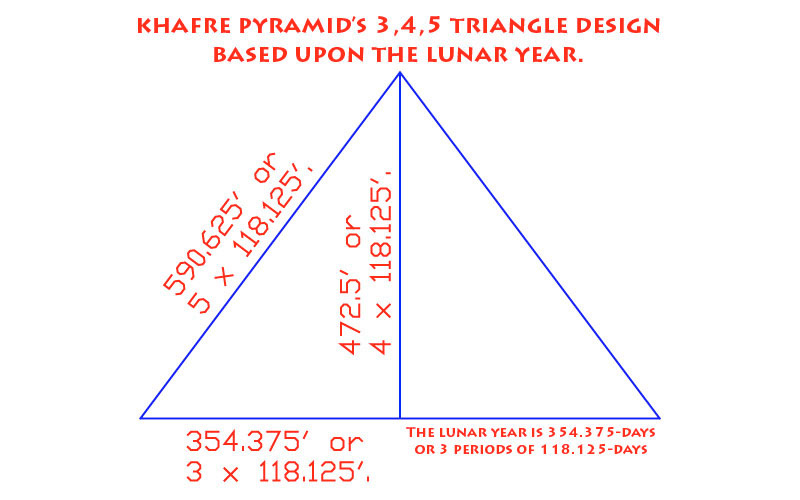
The dimensions of the Khafre Pyramid of Egypt (a pyramid of the moon), showing its lunar number coding and 3-4-5 triangle geometry design configuration.
COURSE 4.
(4). Again, the thickness of course number 4 of the Gaogouli Pyramid of Jián is 23.625".
Inasmuch as the first tier or foundation of the Gaogouli Pyramid is made up or 4 courses or layers, we have now arrived at the first step or terrace. The accumulated course thicknesses, as measured and recorded by the Korean surveyors in millimetres is therefore 1100 + 750 + 600 + 600 = 3050 millimetres ... = 120.07869" or 10.0065575'
If we add the same 4 courses set to the perfect code bearing "inch" measurements, the course thicknesses equate to 43.2 + 29.53125 + 23.625 + 23.625 = 119.98125 inches or 9.9984376 feet of 12 inches or 1/11th of an inch shortfall on the measurement in millimetres.
Under the ancient western system, the built-in code for the stack of 4 code-bearing courses would have been read as 120" or 10 feet of 12", for a shortfall of 1/640th of a foot or 1/64th of an inch.

The Korean surveyors rounded their measurements to the nearest centimetre, but achieved excellent results, inasmuch as anyone well-acquainted with in-built pyramid numbers of the Gizeh Plateau of Egypt or Megalithic British sites like Avebury Henge, etc., etc., could immediately recognise what the builders of the Gaogouli Pyramid were endeavoring to encode number wise.
Due to the fact that this face of the Gaogouli Pyramid, with the entrance to the so-called tomb, is in the most pristine condition in comparison to the 3 other sides, we can realistically speculate as to the intended code-bearing lengths of this tier's 4 courses.
(A). The base length is officially 31.58 metres, which converts to 103.608920884'of 12-inches. The intended code for this length is recognisable as 103.68' for the following reasons:
WHY IS 103.68 SUCH AN IMPORTANT ANCIENT VALUE, OCCURING IN WEIGHTS, MEASURES AND VOLUME STANDARDS OF MANY COUSIN NATIONS?
The Great Pyramid @ 756 per side is 7.5 seconds of arc (100.8'). Two full circumnavigations of the Great Pyramid (8 sides) = 6048' for 1-minute of equatorial arc. The 6048' value X 60 = 362880' for 1-degree of arc. This value multiplied by 360 = 130636800' or 12 X 12 X 12 X 12 X 1.2 miles of 5250' (the mile adopted by the Greeks from the Egyptians). This equals 24883.2-miles under that navigational system for the equatorial circumference of the Earth, literally encoded into the base dimensions of the Great Pyramid of Egypt.
Therefore, if one wishes to know how fast the Earth spins in a 24-hour period under this navigational assignment for the equatorial circumference reading, it's 24883.2 ÷ 24 = 1036.8 MPH.
A number string based upon 103.68 goes:
103.68, 207.36, 311.04, 414.72, 518.4, 622.08, 725.76, 829.44, 933.12, 1036.8 ... 1244.16 ... 1555.2 ... 1866.24 ... 2073.6 ... 2488.32 ... 2592 ... 3628.8 ... 4665.6 ... 5184 ... 6531.84 ... 7776 ... 12441.6 ... 24883.2 ... 130636800
In the above line-up we have 207.36 and the largest of the 3 Egyptian Royal Cubits is 20.736"; 51.84-degrees is the slope angle of the Great Pyramid and 5184-years is 1/5th of the 25920-year duration of the Precession of the Equinoxes; there are 3110.4 miles in 1/8th of the equatorial circumference of the Earth; according to the literal perimeter length coding of the Great Pyramid; the sum of 18662.4-miles would be .75 of the Earths circumference.
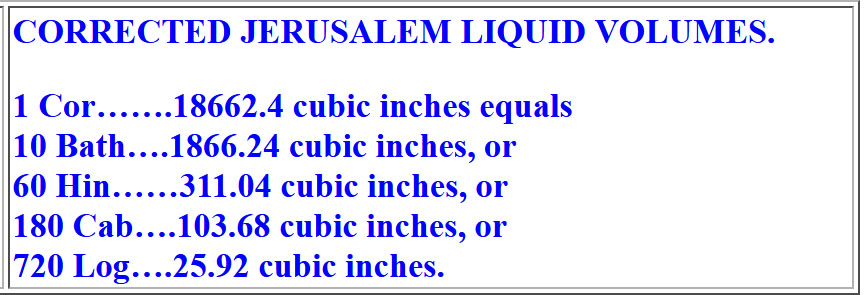
It can be seen that the ancient Jerusalem Standard for liquid volumes carries all of the essential numbers which, if placed in number strings, will generate everything necessary to identify the equatorial circumference of the Earth and its divisions:
Julius Caesar was an avid historian and writer who lived contemporaneously with the Druids of Britain and Continental Europe. He recorded the following observation concerning what the Druids taught in their open-air universities:
"The magnitude of the Earth and its divisions"... or ... "astronomy, mathematics, geometry, medicine, jurisprudence, poetry and oratory were all proposed and taught-natural philosophy and astronomy with severe exactitude". (See: De Bello Gallico, VII, 15, 16.. See also: Strabo I IV, page 197. Caesars Comm. Lib V. Sueotonius, V Calegula. E. Campion, Accounts of Ireland, pg. 18.).
(B).The top of the first course (3.6' thick) angles back slightly to the retaining notch into which the 2nd course is locked. The full length of the 2nd course of blocks at the base-line was undoubtedly 103.125'. This length would equate to 60 Egyptian Royal Cubits of 20.625"each.
There were 3 main navigational systems in antiquity based upon 3 close-proximity concepts of the equatorial circumference of the Earth. Each of these was encoded into the length of a slightly different Egyptian Royal Cubit. These were:
1. 20.61818182" (an example is in the Turin Museum). This one, multiplied by 1200 and the total read as (what became) English miles of 5280 = 24741.818184 such miles or 24883.2 (of what became) Greek miles of 5250' or 12 X 12 X 12 X 12 X 1.2 Greek miles. Under this much used system, 1-second of equatorial arc was 100.8', 1-minute of arc was 6048' and 1-degree of arc was 362880", with a full 360-degrees being 130636800'.
2. 20.625" (found by Sir William Flinders Petrie). This one, multiplied by 1200 (and the total read as miles of 5280') = 130680000' or 24750 English miles of 5280' ... or 22000 Scottish miles of 5940'. Under this much used system, 1-second of arc was 100.833333', 1-minute of arc was 6050' and 1-degree of arc was 363000' ... for a total equatorial circumference of 130680000'.
3. 20.736" (found in the lengths of the paving stones at the base of the Great Pyramid ... 1.728', as well as Petrie's measurement of the length of the coffer in the Queen's Chamber ...5 X 20.736") X 1200 = 24883.2 English miles of 5280' or 22118.4 Scottish miles of 5940'. This 3rd system was for determining the TRUE size of the Earth, but seems to have been little used for navigation at sea. Its main purpose was probably to have factorable divisions that drew as close as possible to the Earth's TRUE equatorial circumference @ 24883.2-miles of 5280' each or 131383296'. This reading was only 18.2-miles short of the TRUE circumference. Under this reading 1-second of equatorial arc was 101.376', 1-minute of arc was 6082.56' and 1-degree of arc was 364953.6'.
(C).The bottom of the 2nd course should comply to 101.25'.
A number-string based upon 101.25 goes:
101.25, 202.5, 303.75, 405, 506.25, 607.5, 708.75, 810, 911.25, 1012.5 ... 1215 ... 1417.5 ... 1620 ... 2126.25 ... 2430, 2531.25 ... 2835 ... 3240 ... 3543.75 ... 4860 ... 5670 ... 7290 ... 8100 ... 8505 ... 8910 ... 9720 ... 11340 ... 12960 ... 1701 ... 34020 ... 51030 ... 68040.
In the lunar year of 354.375-days there would be 35 intervals of 10.125-days (243-hours) and 672 such intervals in the 6804-day Lunar Nutation Cycle.
In the 25920-year cycle of the Precession of the Equinoxes, there would be 256 intervals of 101.25-years.
(D). The top of the 2nd course should be 100.8.
A number-string for 100.8 goes:
100.8, 201.6, 302.4, 403.2, 504, 604.8 ... 806.4, 907.2, 1008 ... 1209.6 ... 1512 ... 2016 ... 2520 ... 3024 ... 3628.8 ... 4536 ... 5443.2 ... 6048 ... 7560 ... 9072 ... 10080 ... 130636800.
The 100.8-feet length is 1-second of equatorial arc in the Earth's circumference and this terrace would, therefore, be 1296000th of the Earth's equatorial circumference under the navigational method encoded into the base dimensions of the Great Pyramid.
(E).The bottom of the 3rd course should be 99' , but let's look at a mathematical progression that starts at 1/3rd of 99, to get an appreciation of just how significant this number is:
The 24883.2 number was used to describe the equatorial circumference under two different mile readings, 5250' (Greek) or 5280' (English).
If using the 5250'-mile that the late era Greeks adopted from the Egyptians, 1-degree of equatorial arc for the world was 69.12-Greek miles or 362880' or 345600 Greek feet of 12.6"each (130636800'of 12"each)..
If using the 5280'-mile adopted in Britain and some other Continental European nations, 1-degree of equatorial arc for the world was 69.12 English miles or 363000' of 12" each (130680000'of 12"each).
Amongst European nations we are very aware of the 5280'mile, but where did it come from and are numbers derived from it represented in ancient weights, measures and volume standards?
By elongating the Great Pyramid's side length of 756' to 756.25' (3" longer) the 5280' mile system of navigation is created and numbers derived from that system show up in some weights, measures & volumes standards of antiquity.
All this would take is an etched line marked into the paving stone base of the Great Pyramid, symbolically elongating the edifice by 3" per side ... then the 5280' mile navigational system would come into play.
Let's consider the Sextarius volume of Alexandria @ 33 cubic inches and what it would generate in a number string:
33, 66, 99, 132, 165, 198, 231, 264, 297, 330, 363, 396, 429, 462, 495, 528, 561, 594 ... 660 ... 792, 825 ... 1056 ... 1485 ... 1584 ... 1650 ... 1980 ... 2475 ... 5280 ... 5940 ... 7920 ... 24750 ... 363000 ... 130680000
Under this navigational system the equatorial circumference of the Earth was read as 24750-miles of 5280'each.
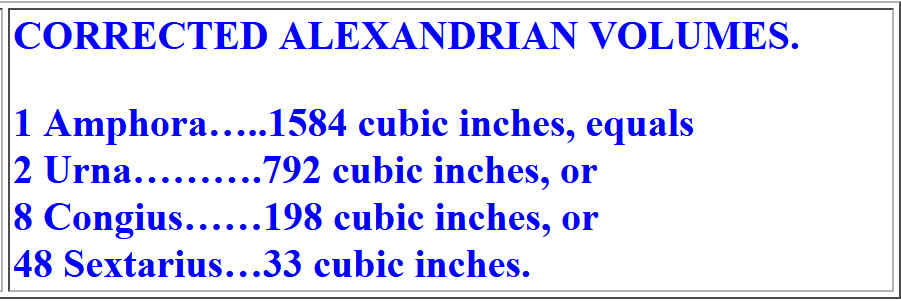
These ancient cubic inch volumes lead on to understanding where the following, much-used European measurements, used for centuries, originated. Parts of the ancient system still survive in the USA:
7.92" (the link), 5.5' (the Merchant fathom ... still in use in the early 20th century), 16.5' (the rod or perch), 66' (the chain), 660' (the furlong or furrowlong), 1760' (1/3rd of a mile), 5280' (the English mile), 5940' (the ancient Scottish mile, which was 1-furlong greater than the English mile), 16500' (the ancient English league or 3.125 English miles). In the above line-up, 3 Sextarius would equate to 99 cubic inches.
(F). The bottom of the 4th course should comply to 97.2'.
A number-string based upon 97.2-feet goes:
97.2, 194.4, 291.6, 388.8, 486, 583.2, 680.4, 777.6 ... 972 ... 1166.4...1360.8, 1458, 1555.2 ... 1944 ...2332.8, 2430 ... 3110.4 ... 3402 ...4665.6 ...54432 ... 6804 ...7290 ... 9331.2 ...12150 ...12441.6 ... 24883.2.
Traditionally through the ages, the 360-degree compass was halved, quartered and read in divisions of 8ths, 16ths, 32nds, 64ths, 128ths and 256th divisions. The sum of 97.2-miles is 1/256th of 24883.3-miles, or 1.40625-degrees.
This is equivalent to 360-degrees reducing to 180, 90, 45, 22.5, 11.25, 5.625 (5 & 5/8ths), 2.8125 (2 & 13/16ths), 1.40625 (1 & 13/32nds)-degrees respectively.
The progression is also useful in simultaneously tracking the divisions of the 6804-day Lunar Nutation Cycle, within a 360-degree circuit being halved, quartered, etc.
THE FIRST STEP OR TERRACE
(G). We've now reached the first step, which was wide enough for anyone to walk upon safely and circumnavigate the entire pyramid. It's possible the end face of 4th course block wasn't angled, so it might've also carried the same 97.2' code for its top length as the bottom length?
The Korean surveyor measured this step at the base of the 2nd tier (made up of 3 courses) as 1100 mm wide or 43.2 ", the same as the thickness or height as the bottom course. In feet this equates to 3.6'.
The value 3.6' infers reference to the 360-degree, Sumerian compass system.
THE THICKNESSES OF THE UPPER COURSES, FROM TIER 2, CONTINUED.
COURSE 5.
(5). 700 mm = 27.5" to a tolerance of 1/17th of an inch excess.
The range of numbers generated by a mathematical progression of 27.5' relate to navigation using the mile of 5280', as well as all associated increments of length within that system:
A mathematical progression based upon 27.5 goes:
27.5, 55, 82.5, 110, 137.5, 165, 192.5, 220, 247.5, 275, 302.5, 330 ... 412.5, 440 ... 495 ... 550 ... 605 ... 660, 687.5 ... 742.5, 770 ... 880, 907.5 ... 990 ... 1320 ... 1485, 1512.5 ... 1650 ... 1760 ...1980 ... 2227.5 ... 2475 ... 2640 ... 2970 ... 3025 ... 3520 ... 3630 ... 3960 ... 5280 ... 5940 ... 7920 ... 16500 ... 24750 ... 130680000.
This string introduces the 5280' mile system of navigation, based upon the Great Pyramid's side length being symbolically increased from 756'' to 756.25". Under this reading, 1-minute of equatorial arc was read as 6050'and a degree of arc as 36300', for a full equatorial circumnavigation equating to 24750 English miles or 22000 Scottish miles. The string also identifies the diameter of the Earth as 7920-miles, dividing it into half (3960-miles); quarter (1980-miles) and eighth (990-miles). It uses PI @ 3.125 to convert the diameter of the Earth to its circumference, thus 7920 X 3.125 = 24750-miles or 130680000' in equatorial circumference. The increments for this navigational system are:
7.92" (the Link); 5.5' (the Merchant Fathom); 16.5' (the Rod or Perch ... 3 Merchant Fathoms); 66' (the Chain); 660' (the Furlong or Furrowlong); 1760' (the Yard); 5280' (the English Mile); 5940' (the Scottish Mile); 16500' (the League ... 3.125- Miles).
COURSE 6.
(6). 500 mm = 19.6875".
19.6875" (to a tolerance of 1/400th of an inch excess ... beyond human vision to detect), 39.375, 59.0625, 78.75, 98.4375, 118.125, 137.8125, 1575, 177.1875, 196.875, 216.5625, 236.25, 255.9375, 275.625, 295.3125 ... 354.375.
This string is purely lunar and identifies fractions of the lunar month (29.53125-days = 1.96875-days X 15) & the lunar year (1.96875-days X 180). The sum of 1.96875-days would be 47.25-hours. Also the ancient Beqa weight for gold dust was 19.6875-grains. This was the gold standard for the Egyptians and was adopted by both the Greeks and Romans.
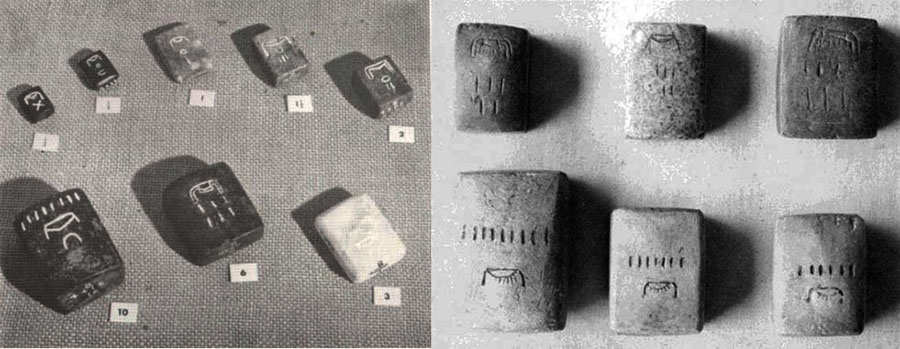
Left: The 8 stone weights shown are "Beqa weights", which were formerly used in the Nubian gold fields and inscribed with the "Nub" sign (the hieroglyph for gold). Right: These Egyptian "Beqa" weights are all marked to indicate that they were used for weighing quantities of gold dust, as each bears the "gold" insignia. This, seemingly, complete set was found at Khartoum.
The Egyptian Talent was 393750 grains and their Beqa Shekel was 196.875 grains. The Greek Attic Talent was 393750 grains also.
The Greek Commercial Mina was 9843.75 grains and their Didrachma or Tridrachm for gold dust were 196.875 grains. A yet smaller weight Drachma was 98.4375 grains (98 & 7/16ths).
By consequence, the Roman Uncia was 393.75 grains or 2 Egyptian Beqa @ 196.875 grains. They also had a Semuncia of 196.875 grains.
COURSE 7.
(7). 500 mm = 19.6875" (a repeat of the course thickness below).
We have now arrived at the top of tier 2, which was made up of courses @ 2.75", 19.6875" and 19.6875", respectively.
THE SECOND STEP OR TERRACE
The Korean surveyors measured the width of this step or terrace to be 1120 mm or 44" wide to a tolerance of 1/11th of an inch shortfall.
A mathematical progression based upon 44 goes:
44, 88, 132, 176, 220, 264 ... 352, 396 ... 440 ... 528 ... 660, 704 ... 792... 1056, 1100 ... 1584 ... 1760 ... 1980 ... 2112 ... 2376 ... 2640 ... 3168 ... 3300 ... 16500 ... 29700 ... 36300 ... 52800 ... 59400 ... 89100 ... 22000 ... 247500.
All of these increments are very recognisable as belonging to the 5280-feet English-mile or 5940-feet Scottish mile, 16500-feet English league, 7920-mile diameter of the Earth or 24750 English mile equatorial circumference and 22000 Scottish mile equatorial circumference.
COURSE 8.
(8). 560 mm = 22" to a tolerance of 1/21st of an inch shortfall.
A mathematical progression based upon 22 goes:
22, 44, 66, 88, 110, 132 ... 176, 198, 220, 242, 264 ... 330, 352 ... 396 ... 440 ... 528, 550 ... 594 ... 660 ... 704 ... 770, 792 ... 880 ... 990 ... 1056 ... 1100 .. 1188 ... 1320 ... 1584 ... 1650 ... 1760 ... 1980 ... 2112 ... 2376 ... 2640 ... 2750 ... 2970 ... 3168 ... 3300 ... 3520 ... 3564 ... 3630 ... 3960 ... 4400 ... 4752 ... 4950 ... 5280 ... 7920 ... 130680000.
Again, this string relates to the 5280' English mile and the 5940' Scottish mile, as well as the 7920-mile diameter of the Earth and its divisions. The 130680000' circumference of the Earth value ÷ 5940 = 22000.
COURSE 9.
(9). 480 mm = 18.9" to a tolerance of 1/420th of an inch ... beyond human vision to detect.
A mathematical progression based upon 18.9 goes:
18.9, 37.8, 56.7, 75.6, 94.5, 113.4 ... 151.2, 170.1, 189, 226.8 ... 283.5, 3024 ... 340.2 ... 378 ... 453.6, 472.5 ... 510.3 ... 567 ... 604.8 ... 680.4 ... 756 ... 850.5 ... 907.2 ... 1209.6 ... 1417.5 ... 1512 ... 1701 ... 1890 ... 2268 ... 3024 ... 3402 ... 5103 ... 6048 ... 6804 ... 11812.5 ... 362880 ... 130636800
This mathematical progression delivers up all of the base perimeter numbers for the Great Pyramid of Egypt (for the equatorial circumference of the Earth), as well as the Khafre Pyramid of Egypt (for reading the lunar cycles including the 6804-day Lunar Nutation cycle).
For the Great Pyramid we have: 189' (1/4th of a side length), 378' (1/2), 756' (one side length), 1512', (two side lengths), 2268' (three side lengths), 3024' (four side lengths), 6048' (two full perimeters and 1-minute of equatorial arc), 9072" (the 756' side length in inches).
For the Khafre Pyramid we have : 472.5' (its height in feet), 1417.5' (2 side lengths @ 708.75'), 8505' (its side length in inches and, in days, 1/8th of the Lunar Nutation Cycle), 1701 (the number of days in 1/4th of the Lunar Nutation Cycle), 3402 (1/2 the cycle), 5103 (3/4th of the cycle) and 6804 (the full cycle in days).
In the lineup is 453.6 (the height of the Great Pyramid to its flat altar floor) ... also we have 9072 ( the side length of the Great Pyramid in inches).
The expanded value of 11812.5 occurs and 118.125-days would equate to 4-lunar months of 29.53125-days.
Ultimately, the progression grows to 130636800-feet ... the equatorial circumference under the Greek-mile and lunar count numbers.
COURSE 10.
(10). 460 mm = 18.144" to a tolerance of 1/30th of an inch.
A mathematical progression for 18.144 goes:
18.144, 36288, 54.432 ... 90.72 ... 181.44 ... 272.16 ... 453.6 ... 653.184 ... 362880 ... 130636800.
This string of numbers relate to increments that lead to 1-degree of arc in the equatorial circumference of the Earth (362880'), then 362280' X 360-degrees = 130636800' or 12 X 12 X 12 X 12 X 1.2 Greek miles of 5250' each. This is the literal Earth circumference number encoded into the base dimensions of the Great Pyramid @ 756' per-side or 6048' for 8 sides (1-minute of equatorial arc) X 60 X 360 = the full circumference of the Earth.
In the line-up, 1814400' would be 172nd division of the Earth or 345.6 Greek miles of 5250' (5000 Greek feet of 1.26"each). Also, 453.6' is 264 X the length of the shortest Egyptian Royal cubits @ 20.61818182". The number 653184' = 1/200th of 130636800'.
THE THIRD STEP OR TERRACE.
We have now arrived at the 3rd terrace step, which the Korean surveyors measured to be 1120 mm wide. This equates to 44".
The measured width of this terrace is 44" and a number-string based upon 44 goes:
44, 88, 132, 176, 220, 264 ... 352, 396 ... 440 ... 528 ... 660, 704 ... 792... 1056, 1100 ... 1584 ... 1760 ... 1980 ... 2112 ... 2376 ... 2640 ... 3168 ... 3300 ... 16500 ... 29700 ... 36300 ... 52800 ... 59400 ... 89100 ... 22000 ... 247500.
All of these increments are very recognisable as belonging to the 5280-feet English-mile or 5940-feet Scottish mile, 16500-feet English league, 7920-mile diameter of the Earth or 24750 English mile equatorial circumference and 22000 Scottish mile equatorial circumference.
COURSE 11.
(11). 500 mm = 19.6875" to a tolerance of 1/400th of an inch excess. This is a repeat of courses 3 & 4 of Tier one.
COURSE 12.
(12). 440 mm = 17.28" to a tolerance of 1/24th of an inch shortfall.
A mathematical progression based upon 17.28 goes:
17.28" (to a tolerance of 0.12157" decrease ), 34.56, 51.84, 69.12, 86.4, 103.68, 120.96, 138.24, 155.52, 172.8, 190.08, 207.36 ... 259.2 ... 311.04 ... 345.6 ... 362.88 ... 414.72, 432 ... 466.56 ... 518.4 ... 604.8, 622.08 ... 691.2 ... 777.6 ... 829.44 . 864 ... 933.12, 950.04 ... 1036.8 ... 1209.6 ... 1244.16 ... 1296 ... 1382.4 ... 1555.2 ... 1728 ... 1866.24 ... 1900.8 ... 2073.6 ... 2160 ... 2488.32 ... 2592 ... 3024 ... 6048 ... 362880 ... 24883.2 ... 130636800.
This is a dynamic string relating to the navigational method encoded into the base dimensions of the Great Pyramid. The paving stones at the base of the pyramid measure 1.728' (20.736") The largest Egyptian Royal Cubit was 20.736" and the formula for remembering the equatorial circumference of the Earth, encoded into that Mnemonic device was 20.736 X 1200 = 24883.2 (read as Miles).
The string includes divisions of the size of the Earth in miles, like 777.6 (1/32nd), 1555.2 (1/16th), 311.04 (1/8th), 6220.8, (1/4th ), 12441.6 (1/2), 24883.2 (full circumference). It also includes divisions in the 25920-year Precession of the Equinoxes, like : 2160-years (1/12th) 4320 (1/6th), 8640 (1/3rd) 25920 (the full duration of the cycle). There's also 1296-years (1/10th) or 5184 (1/5th), etc.
COURSE 13.
(13). 400 mm = 15.75" to a tolerance of 1/500th of an inch excess ... beyond human vision to detect.
A mathematical progression based upon 157.5 goes:
157.5, 315, 472.5, 630, 78.75, 945 ... 1260, 1417.5, 1575... 1890 ... 2520 ... 2835 ... 3150 ... 3780 ... 5040 ... 5670 ... 6300 ... 7087.5 ... 7560 ... 8505 ... 10080 ... 11340 ... 11812.5 ... 15120 ... 17010 ... 18900 ... 19687.5 ... 20160 ... 25515 ... 28350 ... 30240 ... 35437.5 ... 51030 ... 68040 ... 130636800.
This line-up is composed of values that were incorporated into the so-called Greek metrology system, which had existed for thousands of years before there was a Creek civilisation There would be 3&1/3rd increments of 157.5-feet in a Greek mile of 5250-feet. The sum of 630-feet would be a Greek Stadium and was the distance of the Olympic sprint race.
The length of 12.6-inches was the Greek foot and 126-inches was a Hebrew Reed, used by the Greeks (10.5 English feet).The Stadium length is 60 Reeds or 1.2 Greek miles.
The line-up is also very representative of Great Pyramid and Khafre Pyramid numbers. There would be 72 Reeds of 10.5-feet in the 756-feet length of the Great Pyramid or 67.5 Reeds in the 708.75-feet length of the Khafre Pyramid. The lengths of each pyramids are, therefore, 720 Greek feet and 675 respectively. On the Khafre Pyramid,inch value per side is 8505-inches, with two sides amounting to 17010-inches and the full circuit equaling 34020 -inches. This is mnemonic coding to remember the 1701-day (1/4th), 3402-day (1/2), 5103-day (3/4ths) duration of the 6804-day Lunar Nutation Cycle. There would be 432 intervals of 15.75-days (378-hours) in the 6804-day cycle.
The Great Pyramid numbers, in inflated values are represented as, 189, 378, 756, (1/4th, 1/2 and one full side value). Similarly, the Khafre Pyramid numbers are represented in inflated value for 354.375, 708.75 & 2835 (1/2, full side length and full perimeter).
The value 2016-feet would be 1/3rd of 1-minute of equatorial arc; The lunar month @ 29.53125-days is 1.5 X 19.6875-days and the number of 196.875-grains was the "Beqa" grain-weight standard of the Egyptians, Greeks and Romans.
The progression leads to the number 130636800-feet, which was the equatorial circumference of the Earth under the Great Pyramid's base dimensions of 100.8-feet for a second of arc, 6048-feet for a minute of arc and 362880-feet for a degree of arc X 360.
THE FOURTH STEP OR TERRACE
We have now arrived at the top of the 4th tier. The width if this step or terrace was measured by the Korean surveyors to be, again, 44" wide.
COURSE 14.
(14). 500 mm = 19.6875" (to a tolerance of 1/400th of a inch excess).
This code has been explained for courses 6, 7 and 11.
COURSE 15.
(15). 420 mm = 16 .5" to a tolerance of 1/29th of an inch.
A mathematical progression based upon 16.5 goes:
16.5", 33, 49.5, 66, 82.5, 99, 115.5, 132, 148.5, 165 ... 198 ... 247.5 ... 264 ... 297 ... 330 ... 363 ... 396, 412.5 ... 528 ...594 ... 660 ... 792 ... 825 ... 891 ... 1056 ... 1188 ... 1584 ... 1650 ... 1782 ... 1980 ... 2112 ... 3168 ... 3960 ... 4125 ... 5280 ... 5940 ... 6336 ... 6534 ... 7128 ... 7920 ... 9075 ... 36300 ... 24750 ... 130680000.
This string introduces the 5280' mile system of navigation, based upon the Great Pyramid's side length being symbolically increased from 756'' to 756.25". Under this reading, 1-minute of equatorial arc was read as 6050' and a degree of arc as 36300', for a full equatorial circumnavigation equating to 24750 English miles or 22000 Scottish miles. The string also identifies the diameter of the Earth as 7920-miles, dividing it into half (3960-miles); quarter (1980-miles) and eighth (990-miles). It uses PI @ 3.125 to convert the diameter of the Earth to its circumference, thus 7920 X 3.125 = 24750-miles. The increments for this navigational system are:
7.92" (the Link); 5.5' (the Merchant Fathom); 16.5' (the Rod or Perch ... 3 Merchant Fathoms); 66' (the Chain); 660' (the Furlong or Furrowlong); 1760' (the Yard); 5280' (the English Mile); 5940' (the Scottish Mile); 16500' (the League ... 3.125- Miles).
COURSE 16.
(16). 400 mm = 15.75" to a tolerance of 1/500th of an inch excess ... beyond human vision to detect.
We have already identified this coded thickness for course 13.
THE FIFTH STEP OR TERRACE
We have now arrived at the top of tier 5. The Korean surveyors measured this terrace to be 1125 mm wide or 44.296875" to a tolerance of 1/184th of an inch excess.
The sum of 44.296875-days would equate to 1/8th of a lunar year of 354.375-days. There would be 153.6 intervals of 44.296875-days in the 6804-day Lunar Nutation cycle. The sum of 44.296875-days = 1.5 lunar months of 29.53125-days.
COURSE 17.
(17). 460 mm = 18.144" to a tolerance of 1/30th of an inch.
We have already identified this same coding on course 10.
COURSE 18.
(18). 350 mm = 13.75" to a tolerance of 1/34th of an inch shortfall.
A mathematical progression based upon 13.75 goes:
13.75", 27.5, 41.25, 55, 68.75, 82.5, 96.25, 110, 123.75, 137.5, 151.25, 165 ... 206.25, 220 ... 247.5 ... 302.5 ... 330 ... 371.25 ... 440 ... 495 ... 550 ... 605 ... 618.75 ... 660 ... 687.5 ... 756.25, 770 ... 880 ... 9075 ... 990 ... 1100 ... 1320 ... 1375 ... 1485 ... 1512.5 ... 1650 ... 1760 ... 1980 ... 2062.5 ... 2475 ... 2640 ... 2970 ... 3025 ... 3520 ... 3630 ... 3712.5 ... 4125 ... 4950 ... 5156.25 ... 5280 ... 5940 ... 6050 ... 7040 ... 7920 ... 27450 ...130680000.
This string relates directly by the navigational method that used the 5280' English mile and 5940' Scottish mile, leading to an equatorial circumference of the Earth of 130680000' (24750 English miles or 22000 Scottish miles).
The Egyptian Royal cubit that was for mnemonic reference to this equatorial circumference was 20.625" and the formula used for mnemonic recall was 20.625 X 1200 = 24750 ... (read as miles of 5280'). Included in the string are the values, in expanded numbers for the "Link" (7.92"), Merchant Fathom (5.5'), Chain (66'), Rod or Perch (16.5'), Furlong or Furrowlong (660'), English Mile (5280'), Scottish Mile (5940') & English League (16500').
The string also identifies the symbolic 3" elongation of the base length of the Great Pyramid to create this second navigational system ... from 756' to 756.25', making 1 perimeter circumnavigation of the pyramid's base go from 3025' to 3025'. Also 1-minute of equatorial arc moved from 6048' to 6050' under this second system of navigation that used the "11" family of numbers. Similarly, 1-degree of arc went from 362880' to 363000'.
The value for the diameter of the Earth (7920 English miles) is also generated, along with divisions thereof.
COURSE 19.
(19). 350 mm = 13.75" to a tolerance of 1/34th of an inch shortfall.
This is a repeat of the last course thickness.
THE SIXTH STEP OR TERRACE.
We have now arrived at the 6th terrace, which was measured by the Korean surveyors to be 1200 mm or 47.25" wide.
The value 47.25 is simply 2 X 23.625", which was the thickness of courses 3 & 4 of the bottom tier.
23.625, 47.25, 708.75, 94.5, 118.125, 141.75, 165.375, 189, 212.625, 236.25, 259.875, 283.5 ... 354.375, 378 ... 425.25 ... 567, 590.625... 756 ... 850.5 ... 1134 ... 2268 ... 2551.5 ... 2953.125 ... 3024 ... 6804.
It can be readily seen that the progression is strongly lunar and provides all the periods leading up to the 2551.5-days (7.2 lunar years) monitored within the Sabbatical Calendar system, all the way to the end of the 6804-day lunar nutation cycle. Also, navigational numbers associated with the base dimensions of the Great Pyramid are represented, including a minute, degree of arc and all the way up to the equatorial circumference of the Earth @ 130636800'.
COURSE 20
(20). 400 mm = 15.75" to a tolerance of 1/500th of an inch excess ... beyond human vision to detect.
This is the same thickness as course 13.
(21). 350 mm = 13.75" to a tolerance of 1/34th of an inch shortfall.
(22). 350 mm = 13.75" to a tolerance of 1/34th of an inch shortfall. ... again a repeat of the same coding, occurring 4 times in the rising courses.
THE SEVENTH STEP OR TERRACE.
We've now arrived at the top floor of the Gaogouli Pyramid, however, the recorded width or half width number that the surveyor scribbled in his notes for this section is not clearly recognisable. Added to that , this top tier of blocks is somewhat jumbled or disjointed, so some careful work, related to measuring the block lengths for each course by archaeologists, will be necessary before we can confidently extract the length codes intended by the builders.
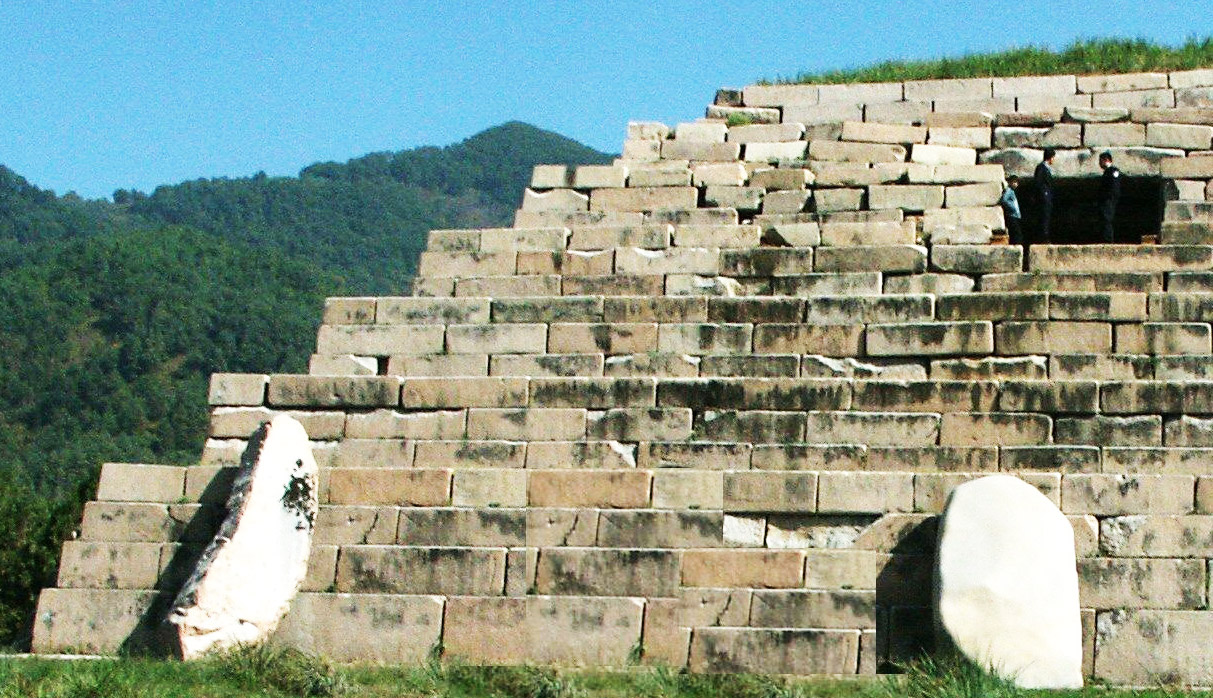
Although the Korean surveyor, in his rough-notes outline, has been content to simply show the top 6 tiers to have vertical faces, while recording the thicknesses of each course, the photographic evidence clearly shows that these courses are slightly staggered. With each of these 3-course, upper tiers the base block sits slightly forwards of the one above and the middle block is slightly forwards of the next one up.
This diminishing length per course was obviously for creating diminishing horizontal length codes for each course as they rose. We can say with confidence that every course and tier carried profound codes, right down to the lengths of individual blocks.
With such a huge amount of labour going into the fabrication of each block, it seems obligatory that they were carefully fashioned to individually carry a code of length, with each side-to-side accumulation of coded length blocks culminating into an overall code for the entire length per course.
Although root pressure at the block joints has pushed some blocks sideways, the key knowing an overall length of a course would be to measure the side-to-side lengths of each blocks, add up the totals, then read the result in feet and inches to understand what tutorial the builders wished to encode.
The overall purpose of the entire edifice was to teach students, by rote & repetition, all of the special numbers necessary to know in order to establish and maintain the concept of civilisation and abundant, functioning society. The students who would become the leaders of tomorrow, needed to know how to establish and read a lunisolar calendar system (the Sabbatical Calendar) that traced the positions of the Earth's orbit around the sun and the moon's position in relation to the Earth throughout the year, as well as the 6804-day Lunar Nutation cycle. This long, repetitive cycle, with 3 celestial bodies dancing out of synchronicity through all the seasons, for 18.61-years, then back into synchronicity to start the dance again, foretold what the weather and living conditions would be at each part of the cycle. The main dance partner in this dance was the moon with its gravitational tug on Earth's oceans & atmosphere.
Anyone who lived for their allotted "three score & ten years" of lifetime would go through the cycle 3.76 times and the accrued knowledge gained at every stage of the cycle could be recorded. One could know with reasonable confidence about expected weather patterns, droughts, stormy seas, heavy rains, famines or pleasant and abundant living conditions in their region of the globe.
The coded values, extractible by measurements, relate to navigation and the ability of ancient mariners to do positional-plotting at sea so that they can acquire much needed resources from far off locations, then return with those goods to the port of departure. In the Bronze Age one such commodity was copper, as well as tin, from which bronze weaponry was fashioned for the defense of the nation. Those nations that did not have sufficient bronze were often overwhelmed and became the vassal states of other nations or conquerors, to which they had to pay tribute.
The entire edifice will be a repository of codes from top-to-bottom, including the side-to-side, lengths of the courses or dimensions within the so-called tomb.
THE TOP FENCE
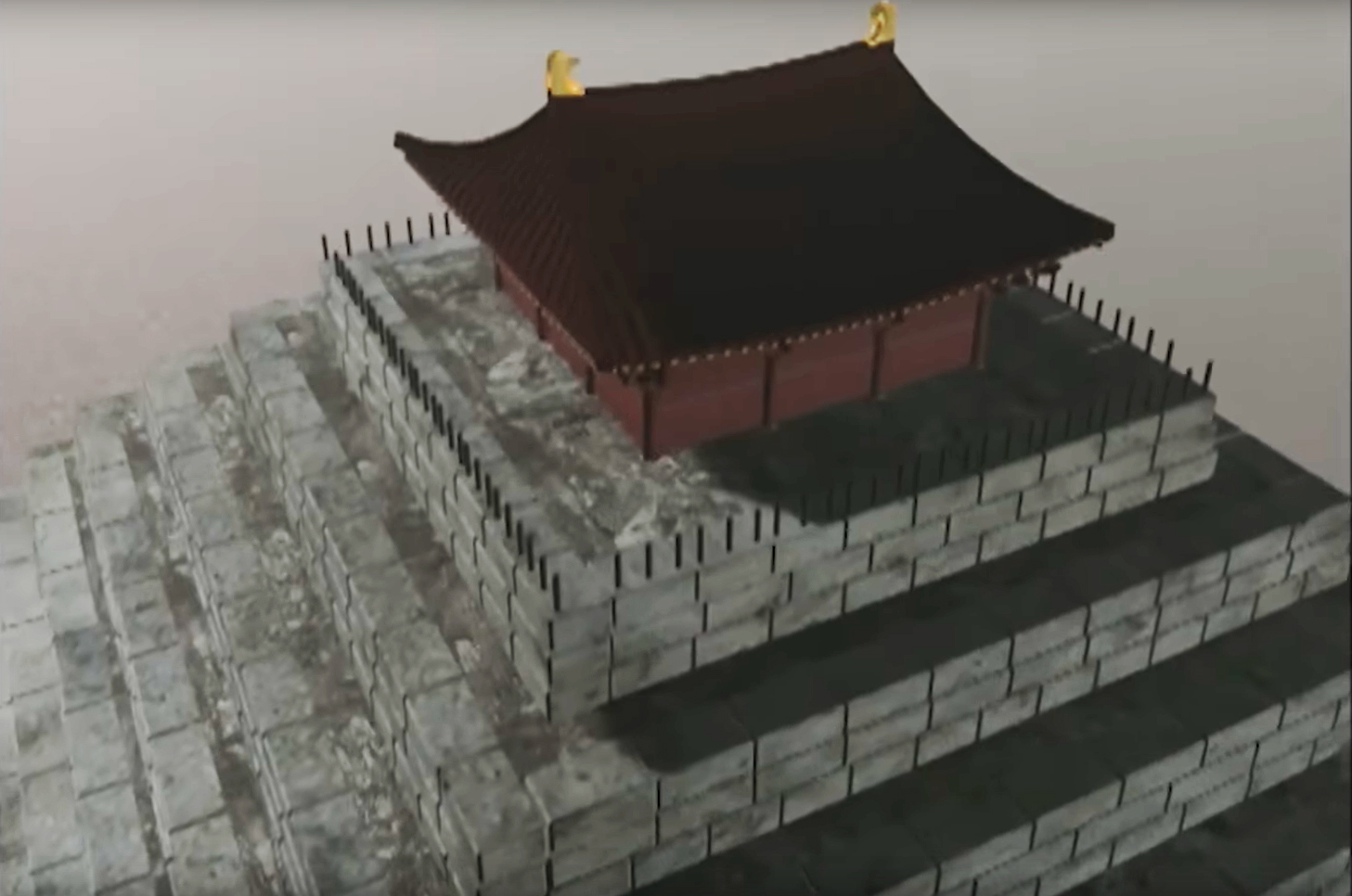
The evidence shows that the Gaogouli Pyramid once had a fenced building atop the 7th tier, and the perimeter granite blocks were evenly bored at 500 mm centres to receive posts that were 90 mm wide. Also, broken ceramic roof tiles were found at the base of the pyramid during initial archaeological excavations, attesting to the existence of a former building occupying the top of the pyramid.
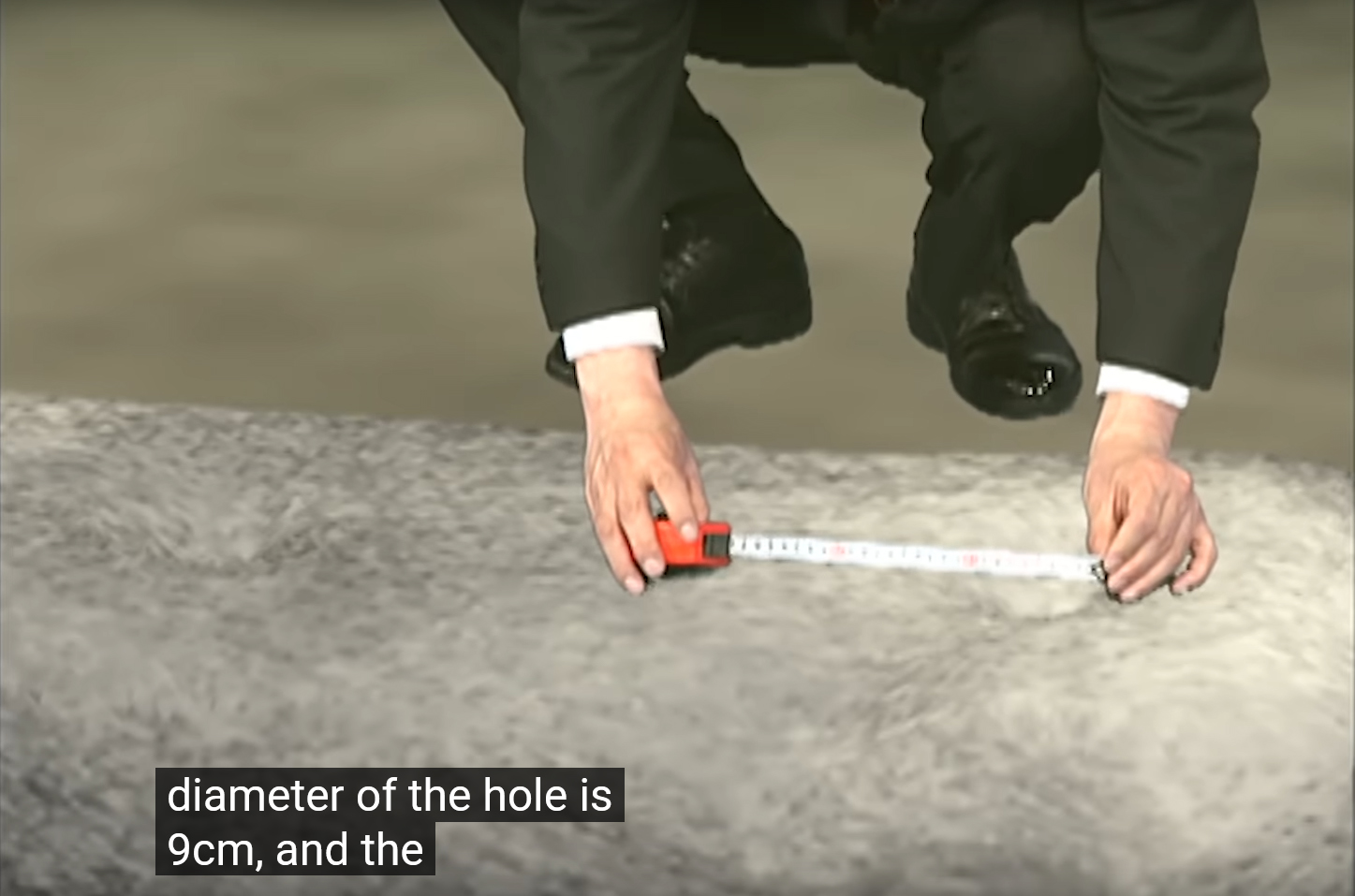
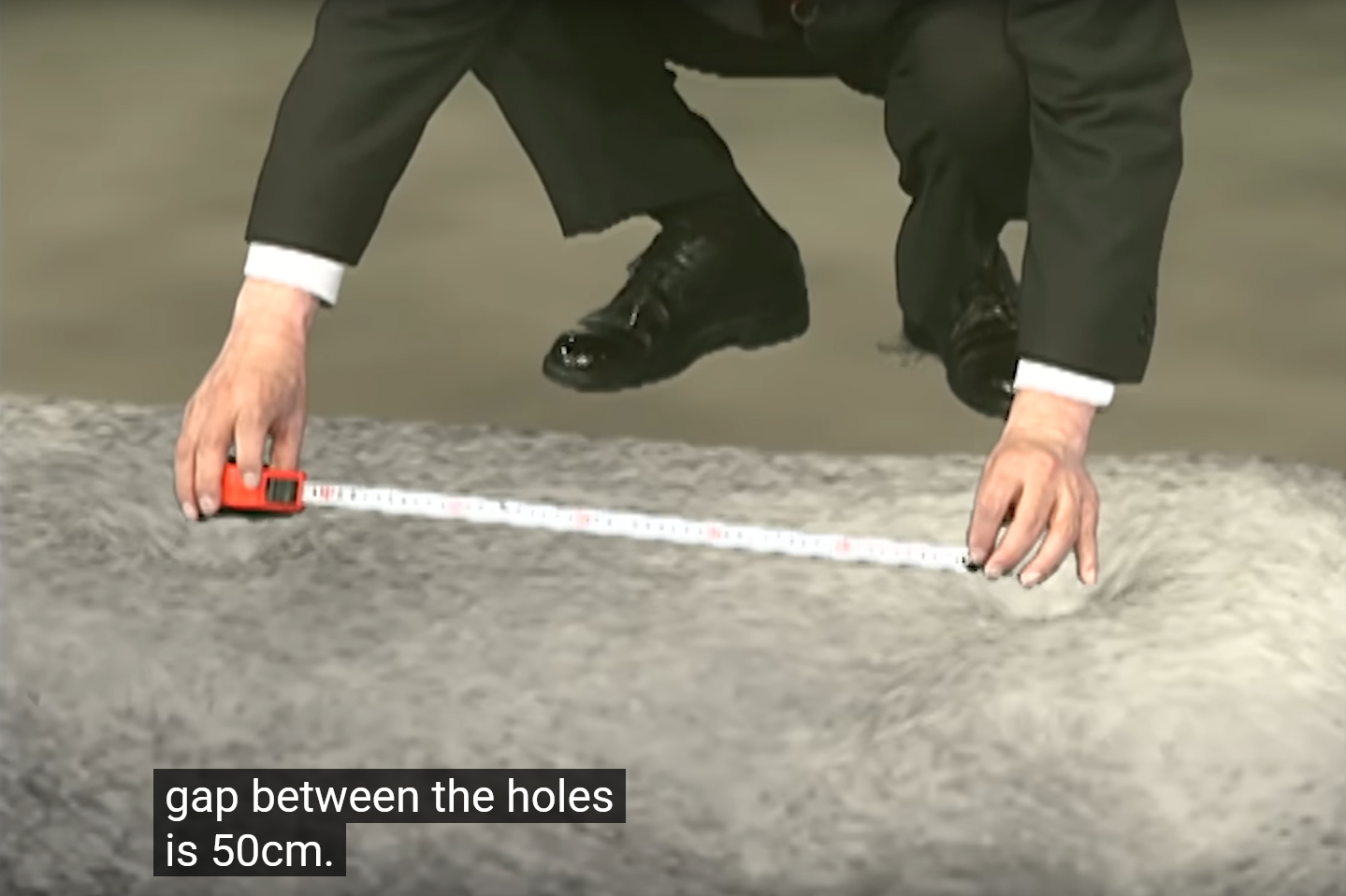
Again these hole widths and spacing in centimetres, converted to inches, produce very dynamic lunar codes.
(1). The sum of 9 cm = 3.54375" to a tolerance of 1/2250th of an inch. The lunar year is, of course, 354.375-days.
(2). The sum of 50 cm = 19.6875" to a tolerance of 1/400th of an inch. The sum of 19.6875-days would be 1/18th of the 354.375-day lunar year or there would be 1.5 X 19.6875-days in a lunar month of 29.53125-days. Also, 19.6875 grains was the ancient Beqa standard for weighing gold dust, adopted by the Egyptians, as well as the later Greeks and Romans.
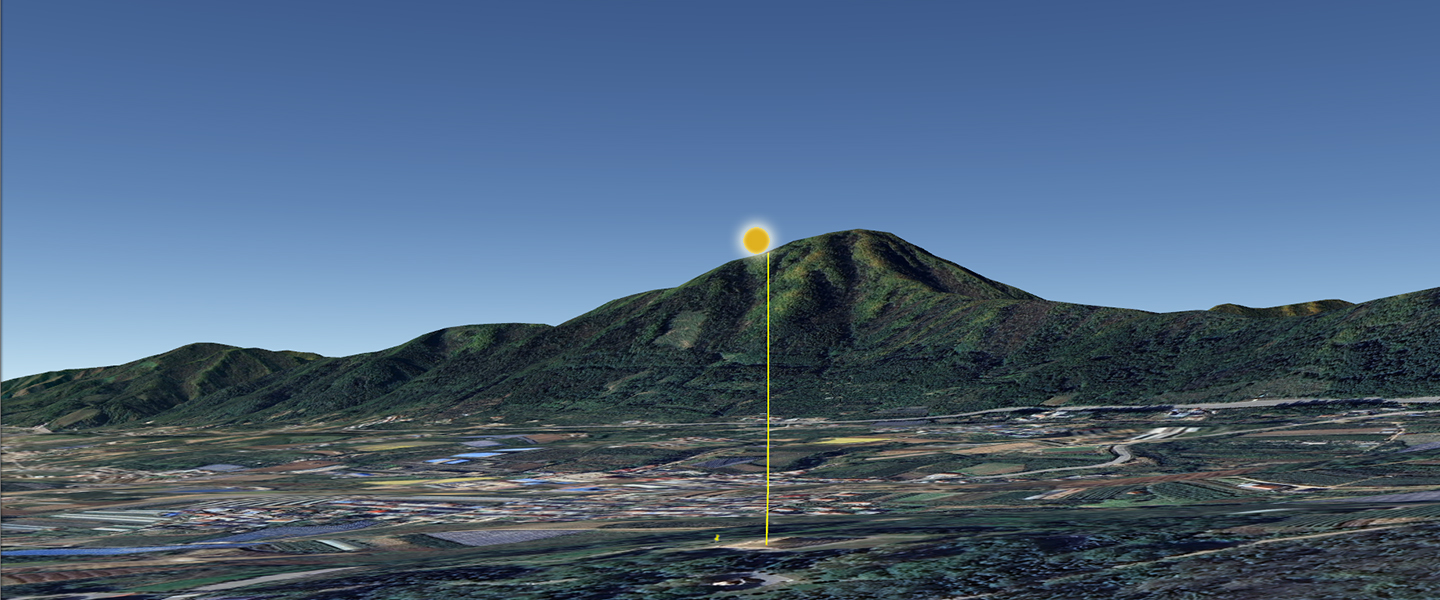
From the summit of the Gaogouli Pyramid, the equinoctial sun will descend and alight upon the high hill crown. It will sink into the Earth fairly directly over the kingly tombs in the valley beyond the mountain, in a gesture of homage to the Royal dead interred there in remote antiquity.
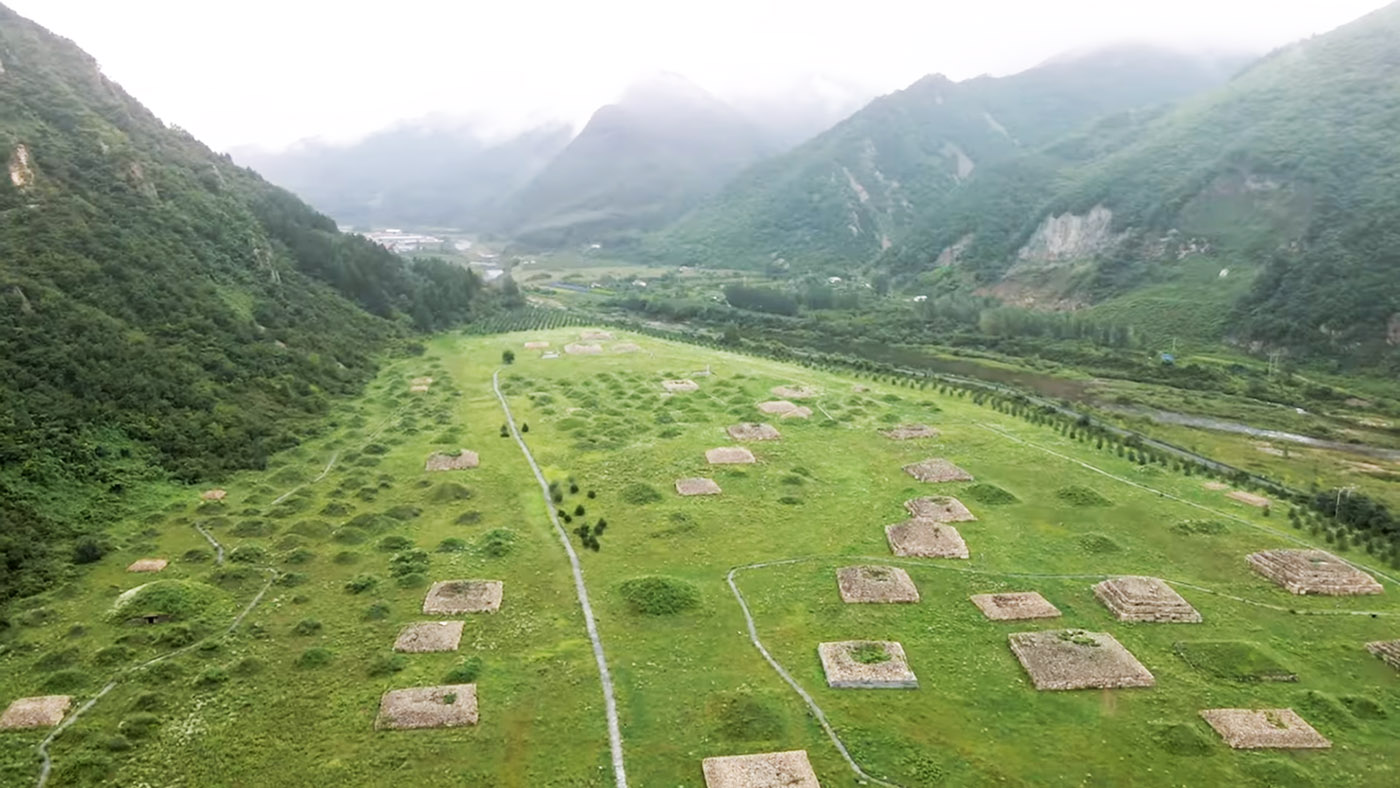
Many thousands of very ancient graves are found in the Valley of Tombs, including the imperial dead in elaborate stone burial chambers. From the top of the Gaogouli Pyramid, the equinoctial sun will be seen to alight onto the crown of the adjacent mountain and sink below the horizon into the Valley of Tombs.
SCALED DRAWINGS OF THE GAOGOULI PYRAMID AS SEEN IN ITS PRESENT CONDITION.
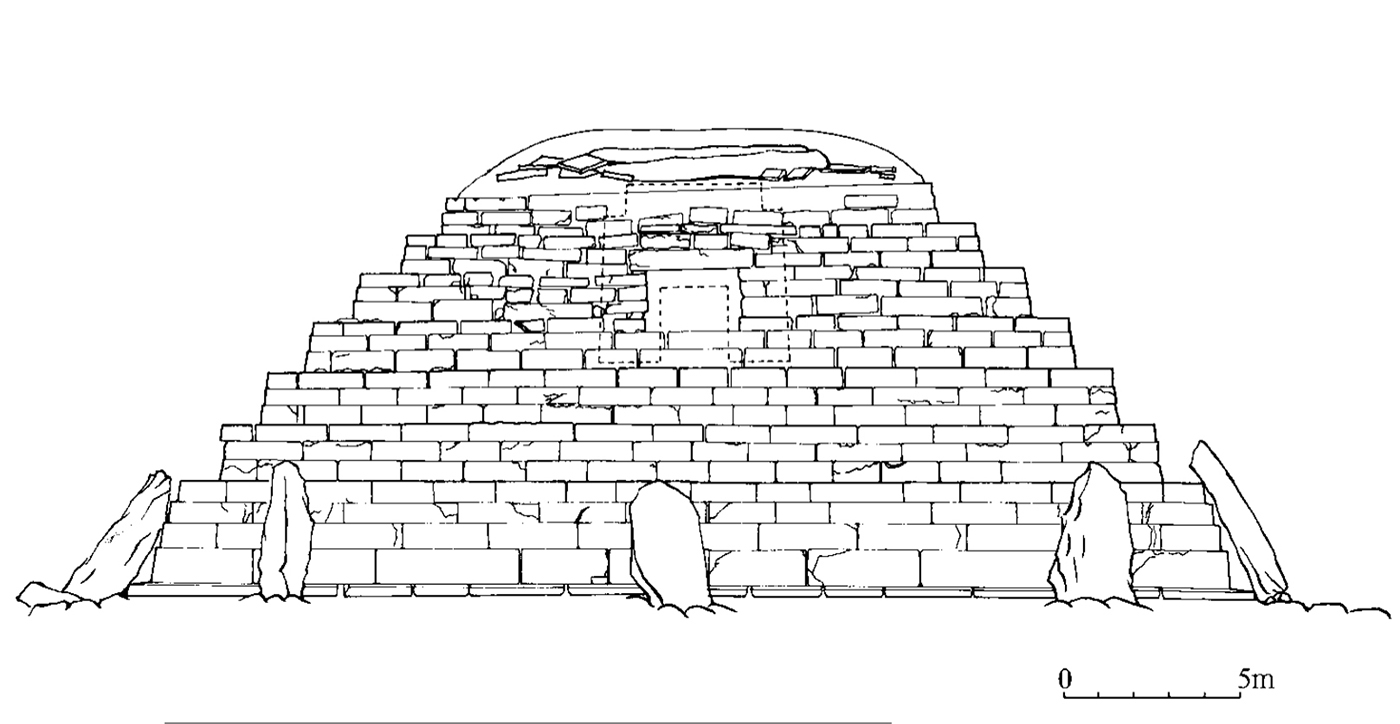
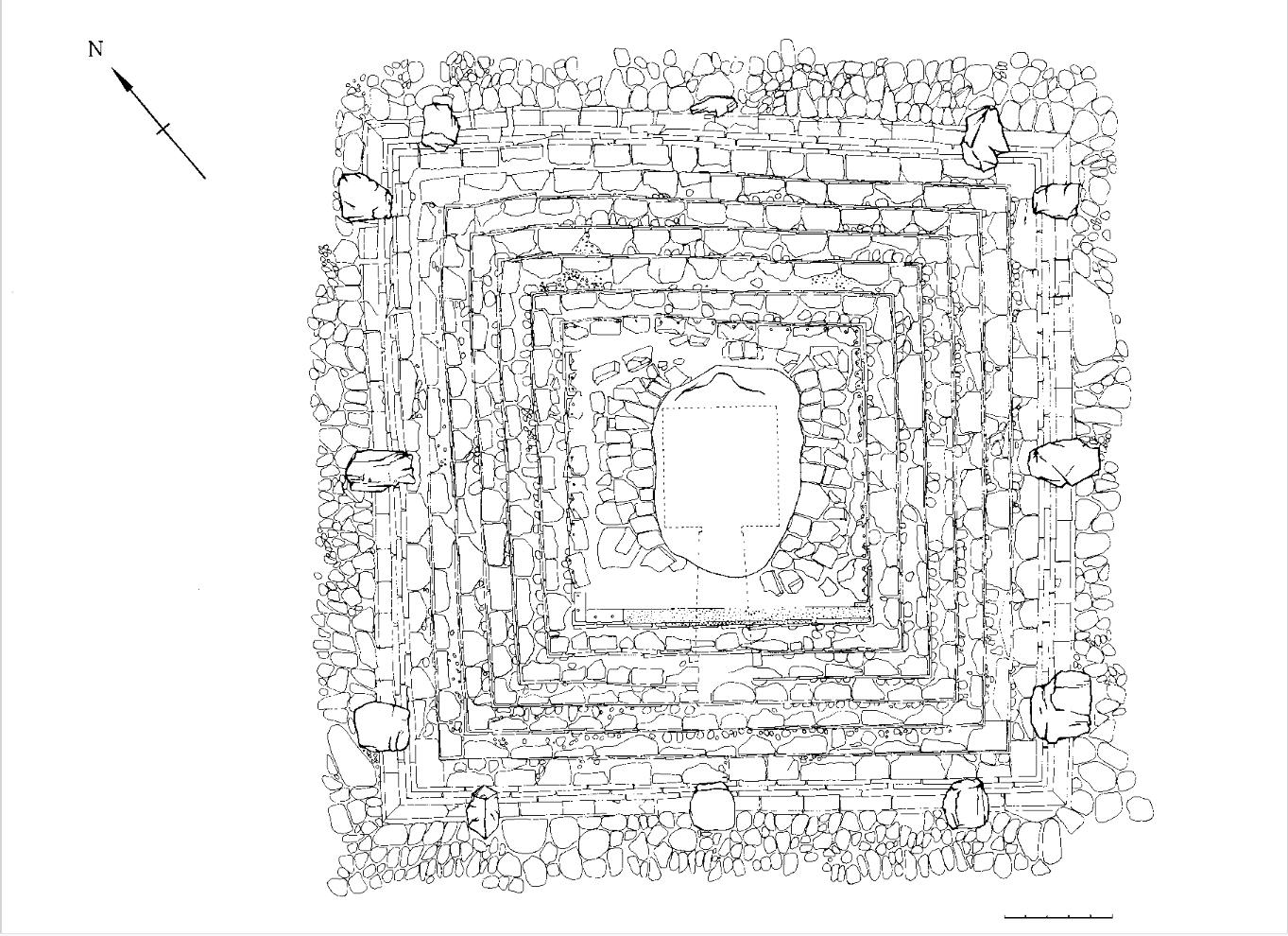
ANCIENT CHINESE/KOREAN MEASUREMENTS.
According to scholars, knowledgeable about the history of Chinese measurements, the ancient Chinese developed and used their own unique system of measurement units, which included the chi (尺) and cun (寸), often translated into English as "Chinese foot" and "Chinese inch" due to their similar function and basis on body parts, but having different actual lengths.
In its ancient and modern forms, the chi is divided into 10 smaller units known as cun (the "Chinese inch"). 10 chi are equal to 1 zhàng.[1]
Historical values
Until such a time when we can settle on a definitive value for the ancient chi that is in direct ratio to the ancient Mediterranean-European inch, we cannot conclude that the encoded, cyclic-astronomical and navigational values, that were deliberately built-into the Gaogouli Pyramid course-widths and lengths, are based upon a known Chinese/ Korean measurement standard.
There are hundreds of stone tombs, and thousands of very impressive monuments in this region of southeastern China and further down the Korean Peninsula, stemming from the Bronze Age or before. The code-bearing attributes of this pyramid monument hints at the fact that it's probably far older than the era attributed to it.
'While it is possible that the square based tomb was an independent invention in the jian region, it seems probable that it is related to square tombs of Liaoning, which date back at least as far as the Hongshan culture* (Fang and Wei 1986). This new style of tomb appears as an elite style, quite suddenly and without antecedents in the Huanren Jian region.'
*Note: The Hongshan culture was Neolithic (4700 to 2900 BC).
The measurement standard by which it was built is recognisable within the factorable number system and universal measurement standards used by European cousin nations since remote antiquity and up until modern times. Consider the following:
1. The base length of 31.58 metres easily converts to an intended 103.68' or 1244.16", for a full perimeter circuit of 414.72 ... both dynamic navigational numbers encoded into the Great Pyramid's base perimeter. The equatorial circumference of the Earth generated by the Great Pyramid's base dimensions is 24883.2 miles of 5250'. 24883.2 ÷ 2 = 12441.6 and 414.72 is 1/30th of 12441.6
2. This length is equivalent to 60 of the largest of the Egyptian Royal Cubits @ 1.728' (20.736"). Sir William Flinders Petrie identified usage of this particular cubit in his measurement of the coffer in the Khafre Pyramid, wherein it was 5 of these cubits long or 103.68-inches. Also, the coded value of 17.28" occurs in the thickness of the 12th course of the Gaogouli Pyramid
Note: A cubic foot (12 X 12 X 12 inches) = 1728 cubic inches. Also the circumference of Silbury Hill in England is 1728', based upon a diameter of 550' with π read as 1728/550ths or 3.141818182 .
3. The "Cab" volume,within the Jerusalem liquid volume standard was 103.68 cubic inches.
So, the length of the Gaogouli Pyramid duplicates the cubic inch capacity numbers generated in the (circa 957 BCE) Jerusalem Liquid Volume Standard, as well as the Stirling Jug of Scotland.
Ancient European & Eurasian peoples built thousands of sophisticated astronomical and code-bearing megalithic sites, from the Sea of Japan northwards, or southwards all the way down the Korean Peninsula. These standing stone circles and monuments are all over (especially) the northern islands of Japan as well as southern Japan and are attributed to remote antiquity inhabitants that pre-date the modern Japanese.
The Manza & Nonakado standing stone circles at Oyu Japan date to 4200-years ago. The builders were the pre-Japanese Jomon European or Eurasian people, also related to the Ainu and spanning about 14,500-years of human occupation throughout the vast region.
The code-bearing attributes of these standing-stone circles duplicate both the measurement standards and number-generating modus operandi of British Megalithic sites, as well as Continental European and Mediterranean sites, all of which have code-bearing attributes with a pedigree to the pyramids of the Gizeh Plateau of Egypt. Here are a few examples of inbuilt numbers of civilisation at Oyu:
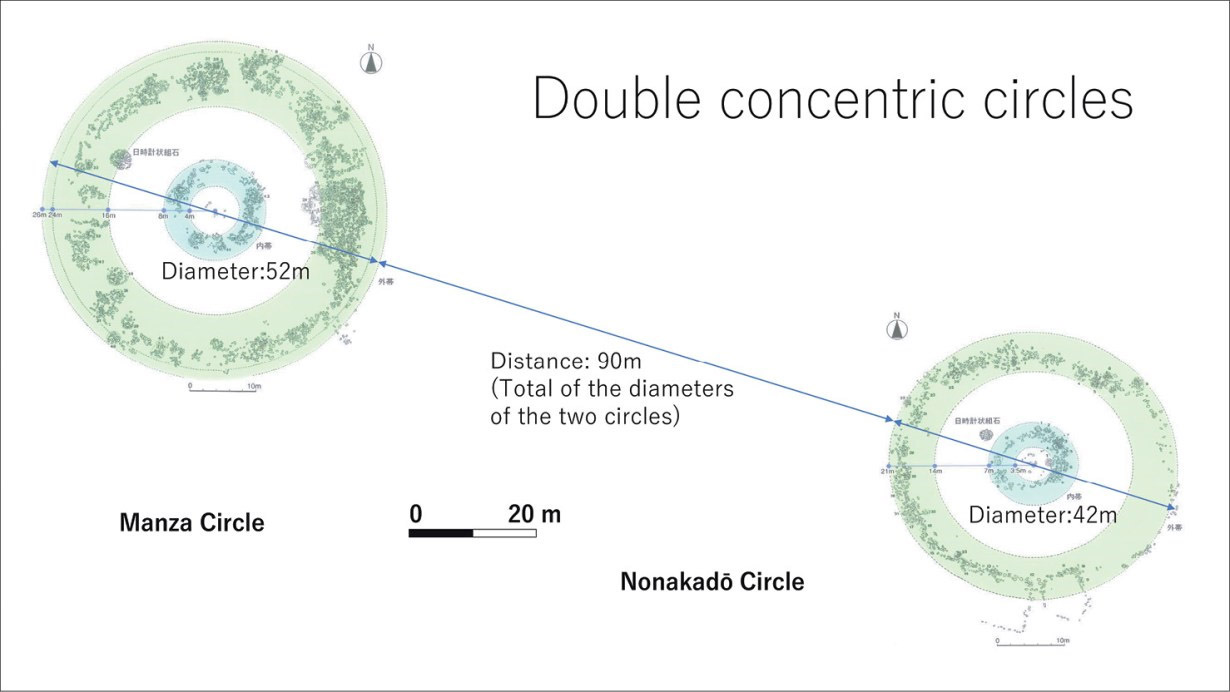
THE MANZA CIRCLE
Careful archaeological measurements of the 5-ring Manza concentric circles provides the following radius divisions from the centre to the extreme exterior ring:
4m, 8m, 16m, 24m & 26m. These divisions, converted to ancient feet generate the following coded lengths:
(4m) = 13.125' ... This provides both navigational and lunar cyclic numbers.
(8m) = 26.25' ... The Greek mile was 5250' or 2625' X 2.
(16m) = 52.5' ... The Greek short Stadium measurement was 525'. Also, 52.5' would be 5 Hebrew Reeds of 10.5' or 50 Greek feet or 25 Assyrian cubits.
(24m) = 78.75' or 1/8th of a Greek long Stadium (630'). It would also be 7.5 Hebrew Reeds or 75 Greek feet.
(26m) = 85.05 to a shortfall tolerance of 3". The outer rim radius was encoding the 6804-day Lunar Nutation cycle, of which 850.5-days was 1/8th of the duration.
Of course, the full diameter of the circle @ 52m = 170.1' to a tolerance of 6". This circle is 1/2 the diameter of the southern circle at Avebury Henge in England and 1/2 the diameter of the standing stone ring at Brodgar in the Orkney Islands of Scotland.
THE NONAKADO CIRCLE
Careful archaeological measurements of the 4-ring Nonakado concentric circles provides the following radius divisions from the centre to the extreme exterior ring
3.5m, 7m, 14m, 21m.
(3.5m) = 11.52' to a tolerance of 0.0370607 of 1' or .44 of an inch. This is navigational coding and 11.52' would be 1/9th of 103.68' ... the side length of the Gaogouli Pyramid.
(7m) = 23.04' ... This relates to navigation with the world configured to be, in a factorable number, 12 X 12 X 12 X 12 X 1.2 -miles in equatorial circumference.
(14m) = 46.08'' ... This, in miles, X 1.5 was 1-degree of arc under this navigational system, found in the base dimensions of the Great Pyramid @ 756' per side, with 2 circumnavigations of the pyramid's perimeter being 1-minute of arc (6048').
(21m) = 69.12 ... Under this navigational system, the Earth was calculated to be 24883.2-miles in equatorial circumference or 69.12-miles per degree of arc.
The distance between the outer rims of both circles (based upon the scale bar reading) appears to be 83m, or coded to represent 272.16' and relating to the equatorial circumference of the Earth. This distance, outer-rim to outer-rim would be 1/480000th of the equatorial circumference of the Earth.
Also, there were anciently two major navigational systems adopted by most nations of the Mediterranean-European theatres, one that read the equatorial circumference as 130636800' (24883.2 Greek-miles of 5250' each) and the other that read the equatorial circumference as 130680000' (24750 English-miles of 5280' each). The epicentre to epicentre of each circle can be read as 435.5' - 435.6' ... thus coding 1/300000th of the equatorial circumference of the Earth ... 435.6' X 3 = 1306.8.
The epicentre to epicentre line running through the two circles orientates onto the horizon's sunrise position of the winter solstice.
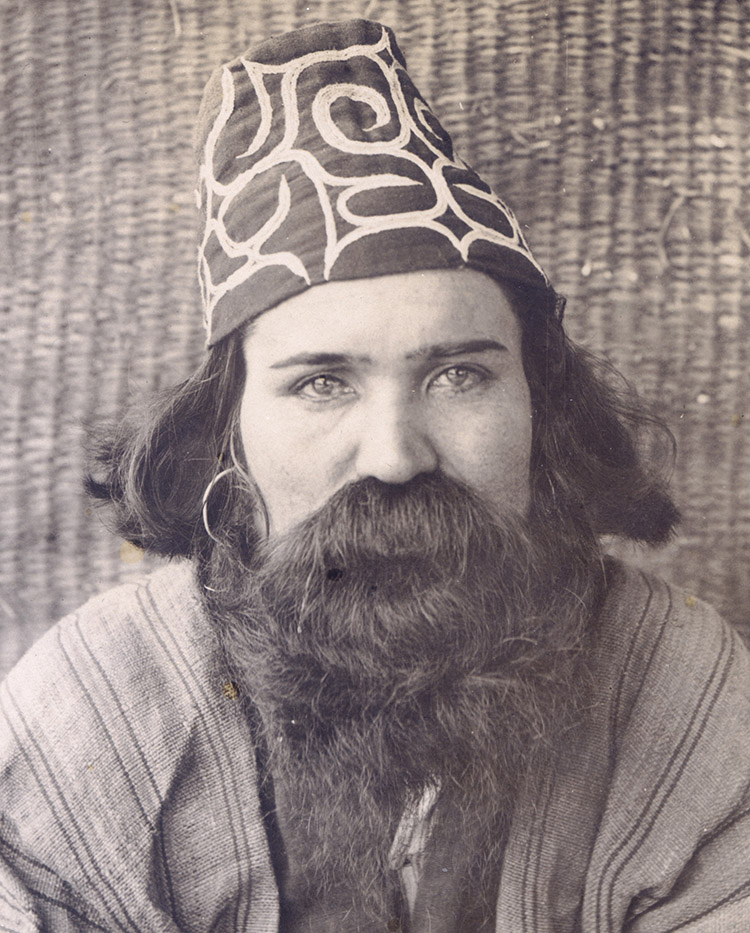
An Ainu leader in 1904.
DECIPHERING THE REST OF THE IN-BUILT CODES.
If the lengths of each block within the 22 courses of the Gaogouli Pyramid could be measured, one could know how long a course was encoded to be with the blocks tightly fitted together ... before root pressure and natural forces pushed or jostled many blocks apart, leaving gaps.
Perhaps the Chinese & Korean archaeologists can collaborate in measuring the lengths of individual blocks in each tier of the Gaogouli Pyramid, then adding the totals to come up with a precise, overall length reading.
There's an added dimension to consider here, inasmuch as it's possible to trace the movements of certain civilisations across the world by the mathematical fingerprints they've left in the landscapes where they settled and thrived for a time.
Martin Doutré, November 6th 2025. ©